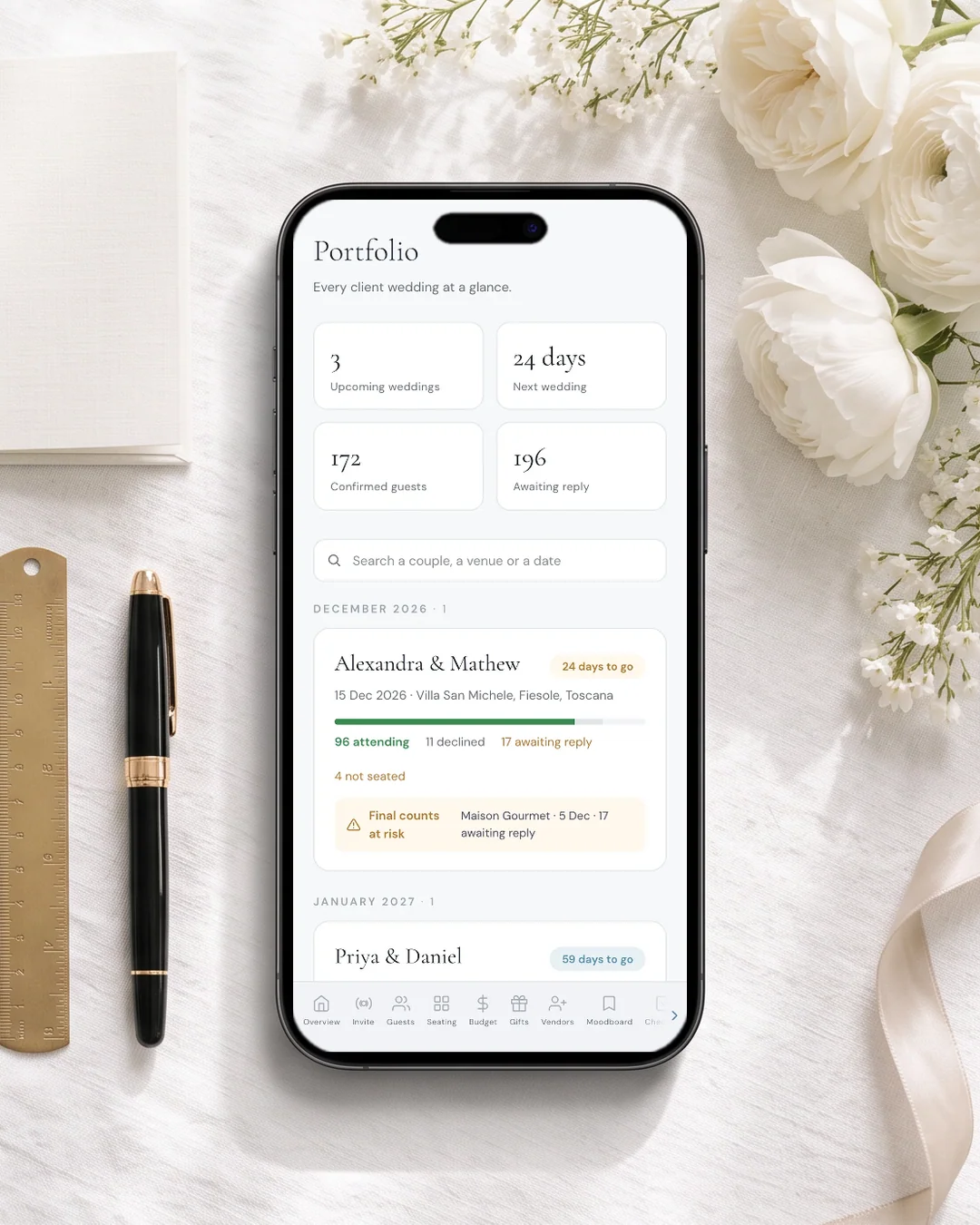
The best wedding planner software for an independent planner in 2026 is the one that runs both sides of the job in the same wedding, and The Private Wedding App is built that way. It works for both the planner and the couple: you run every client wedding from one portfolio, and each couple gets their own client portal, a login on their wedding where you set every section (invitation builder, guest list, seating, budget, vendors, checklist, moodboard) to hidden, view or edit. Guest list updates come from the RSVPs themselves, and the run of show shifts every time at once and gives each vendor a read-only link. On cost, its pricing is published: $189 lifetime per wedding, or $19.99 a month while the wedding is active, with no monthly platform fee, usually billed through to the couple. The business side sits on the same wedding: invoices with a deposit and instalments, paid by bank transfer, cash or cheque and marked paid by you, or online by card if you connect your own Stripe account, and contracts the couple signs online. Among the business tools planners ask about, HoneyBook publishes $29, $49 and $109 a month billed yearly, Dubsado $35 or $55 a month, and Aisle Planner $69.99 a month capped at 15 active projects, as published on their sites in September 2026 (Dubsado's yearly price, checked on October 22, 2026, was $335 or $525 a year); HoneyBook and Dubsado list no guest list, RSVP, seating or day-of timeline. The limit to know: The Private Wedding App has no lead forms for your website and no workflow automations.
For wedding planners · All guides
Ask a wedding planner what software they run on and you usually get two answers, because no single tool does the whole job. The business platforms, HoneyBook, Dubsado, run the contracts, invoices and leads, and list nothing about the actual wedding on their pricing pages: no guest list, no RSVPs, no meals, no seating. The couple platforms hold the guest side but have no planner product. So planners stitch the two together with a third tool and a folder of spreadsheets. This compares the software planners actually use on the one question that decides a season: whether a single tool can run both sides.
A note on method: the prices and limits below are the vendors' published figures, checked on their own pages on October 22, 2026. We compared the tools on what decides a planner's season rather than a single feature: whether the software holds the guests the wedding is actually made of, whether it also handles the business side (contracts and invoicing), what the couple opens on their phone, and what the pricing model does across a dozen clients a year.
At a glanceSide-by-side comparison
| Feature | HoneyBook | Aisle Planner | Planning Pod | Private Wedding App |
|---|---|---|---|---|
| Guest list & RSVPs | None listed | Guest management, online RSVP | Registration and ticketing | Full, auto-populating |
| Meals & allergies | None listed | Meals and dietary needs per guest | Food and beverage, banquet orders | Per guest, severe-allergy flag |
| Seating chart | None listed | 2D layouts, to scale from a floor plan | Floor plans and seating charts | Drag-and-drop from RSVPs |
| The couple's invitation | None listed | Event website, business-first | Event pages | Cinematic, up to 3 languages |
| Contracts & invoicing | Yes | Yes | Yes | Yes, deposits & e-sign |
| Leads & marketing CRM | Full, its focus | Full | Venue-focused | Bookings calendar, no lead forms |
| Runs the wedding itself | No | Partly | Venue events | Yes, end to end |
| Pricing model | $29-$109/mo billed yearly | $69.99+/mo, 15-project cap | No public price, demo first | $189 once per wedding |
Every competitor figure was checked on October 22, 2026 on that company's own pricing page or home page; the linked sources are listed at the end of this article. HoneyBook's plans run $29/$49/$109 per month billed yearly. Aisle Planner's tiers with project tools: $69.99/mo up to 15 active projects, $109.99/mo for 16-25, up to $229.99/mo for 51-100. Planning Pod describes itself as built for venues and shows no public price, only a demo. Dubsado, a close HoneyBook equivalent, runs $335 or $525 a year and likewise lists no guest tools. Prices change, so verify before you commit a season to any of them.
Tool 01HoneyBook & Dubsado
Tool 02Aisle Planner
Tool 03Planning Pod
Tool 04The Private Wedding App
The planner workspace below is live. Tap a tab to open the screens a planner works on every day:
Explore it before you buy
Your invitation
Click to switch theme

Your studio
Click to explore
VerdictWhich tool fits your business?
It depends on how you work:
The Private Wedding App runs contracts and invoicing next to the wedding itself, while HoneyBook and Dubsado are built for winning and booking clients, contracts, invoicing and a lead pipeline, at $29 to $109 a month, and you keep the wedding itself somewhere else.
The Private Wedding App holds the run of show, the invoices and the guest side in one place, while Aisle Planner is a traditional back office with design and timeline tools at project-capped tiers from $69.99/mo, with a guest-facing side you will likely supplement per wedding.
The Private Wedding App is built for the independent planner, while Planning Pod is aimed at venues coordinating events in-house, with pricing given only through a demo.
And if the job is running client weddings end to end, the business side and the guest side in one place, The Private Wedding App's planner setup is the only option here that does both, priced per wedding and billed through to the couple. See what each client wedding includes on the wedding planners page, or read how to take deposits and set up payment plans for the billing side.
Four closer comparisons go further: Aisle Planner alternatives (vs HoneyBook, Dubsado and WeddingFlow), what the couple sees in each client portal, what AI does in a planning business, tool by tool, and, for venues, wedding venue software compared.
01How much wedding planner software costs, and who publishes their pricing
Pricing is the first filter, and the simplest test is whether the number is on the public site. The Private Wedding App publishes its planner pricing on the planner pricing page: $189 lifetime per wedding, or $19.99 a month while the wedding is active. The plan belongs to the wedding, not to your account: there is no monthly platform fee, no project cap, and adding team seats does not change the price. Many planners bill the plan through to the couple, the way they bill stationery.
Three business tools planners ask about also publish their prices. As published on their sites in September 2026: HoneyBook at $29, $49 or $109 a month billed yearly, Dubsado at $35 or $55 a month (its yearly price, checked on October 22, 2026, was $335 or $525 a year), and Aisle Planner at $69.99 a month capped at 15 active projects, then $109.99 a month for 16 to 25. Prices change, so read the date before you rely on a figure.
On any pricing page, check three things: what the unit is (a month, a project, a wedding), what happens to the bill when your season gets busier, and whether the guest side of the wedding is included or sits in a second subscription.
02Software that works for both the planner and the couple
In The Private Wedding App the planner and the couple work in the same wedding. You open it from your Portfolio; the couple opens it through their own login. It is one guest list, one seating plan, one budget and one checklist, so nothing is exported, emailed or retyped between your version and theirs.
Guests reply on the couple's private invitation link, and each reply lands in that shared guest list with the meal choice, the dietary notes and a severe-allergy flag. The couple watches the replies arrive; you turn the same replies into the seating plan, the caterer and venue day sheet and the run of show.
Your business is visible where the couple works: they see "with" followed by your business name, and your logo, on the page that invites them, in their dashboard, on invoices and on contracts. The logo never appears on the invitation the guests see, and this is your name beside The Private Wedding App, not a white-label product.
03The client portal: the couple's own login, with permissions per section
The client portal is the couple's own login on their wedding. You give it to them, and you decide section by section what they get: hidden, view or edit, for the invitation builder, the guest list, the seating, the budget, the vendors, the checklist and the moodboard.
An example, to adapt: a couple who wants to write their own invitation gets edit on the invitation builder and the guest list, view on the seating, and the budget hidden until your quotes are in. A couple who wants to be shown finished work gets view everywhere. You change a permission whenever the engagement changes.
The couple only ever sees their own wedding. Every wedding in your account is sealed from the others, with its own invitation, guest list, seating and budget.
- Invitation builder: hidden, view or edit
- Guest list: hidden, view or edit
- Seating: hidden, view or edit
- Budget: hidden, view or edit
- Vendors: hidden, view or edit
- Checklist: hidden, view or edit
- Moodboard: hidden, view or edit
04Guest list updates, run-of-show execution, and what was added in November 2026
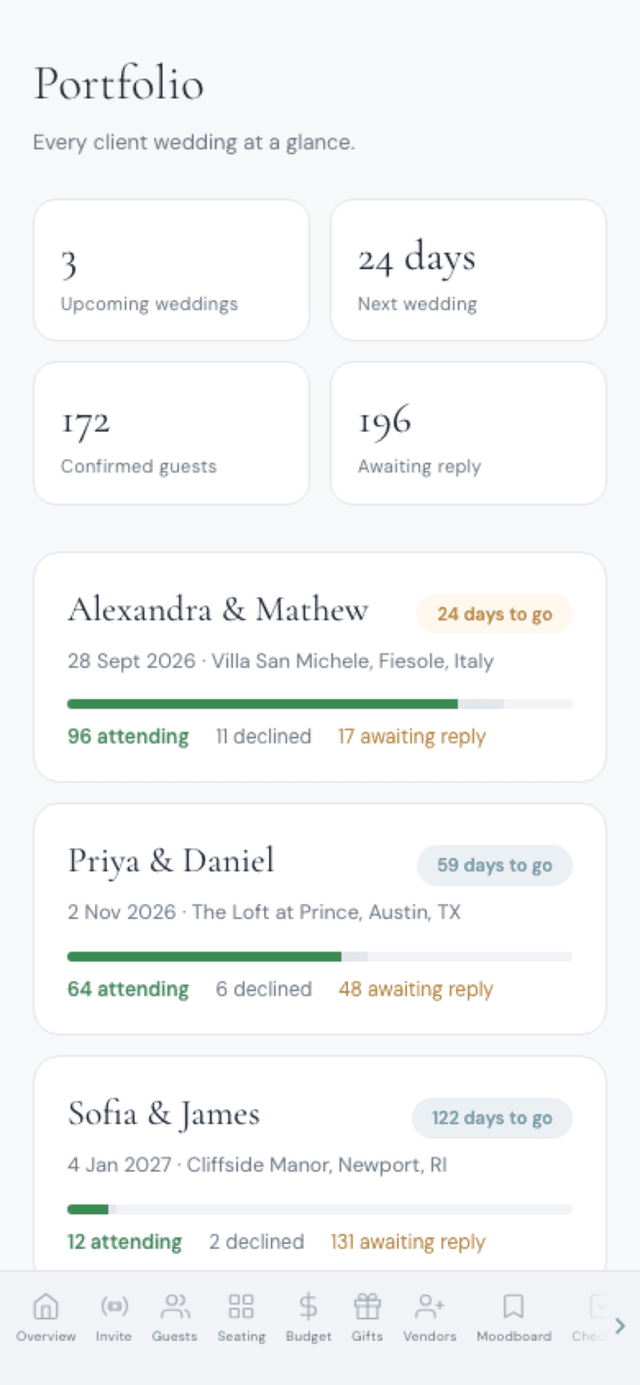
Guest list updates are where a season is won or lost. Here the guest list fills itself from the RSVPs: attending, declined and awaiting reply, plus-ones, children, meals and allergies, per event on a multi-event wedding, with a CSV export. Your Portfolio shows the live counts for every wedding and raises a "final counts at risk" alert when a vendor deadline is within a week and guests are still awaiting reply.
The run of show is a set of time-blocked rows (time, what happens, where, notes), and each row can be tagged to a booked vendor. When the ceremony runs late, the +15 min and -15 min buttons shift every time at once. You share one read-only link with the full timeline and one link per tagged vendor showing only that vendor's rows plus the general ones. The run of show template guide walks through it row by row.
Four additions arrived in November 2026. Bookings: inquiries, calls or tours, dates on hold and confirmed dates in a list and a month calendar, with a date-clash warning when two entries take the same room on the same date; the deposit on a booking is a tracking note, and no payment is taken on the booking itself. Team seats: invite staff by email as admin or staff; staff work in every wedding's guest list, seating, day sheet and run of show and read invoices and contracts without editing them. Room to scale: enter the room's width and length and the seating plan is drawn to scale in 2D, seen from above, with tables and fixtures at real size and a clearance warning when two tables sit closer than the minimum gap. It is 2D only, not 3D. Reusable room layouts: draw a room once and apply it to a new wedding's empty seating plan.
05HoneyBook, Aisle Planner and Dubsado: what their sites publish
The Private Wedding App first, so the comparison has a fixed point. Each wedding carries the guest side (the digital invitation on one private link, RSVPs, guest list, meals and allergies, seating plan, caterer and venue day sheet, run of show) and the business side (invoices with a deposit and instalments, paid by bank transfer, cash or cheque, or online by card through your own Stripe account, contracts the couple signs online, bookings and a portfolio). Its limit: no lead forms for your website, no workflow automations and no public booking page. Online card payment needs Stripe to open accounts in your country; invoices paid by bank transfer work everywhere.
HoneyBook, as published on its site in September 2026: $29, $49 or $109 a month billed yearly. Its pricing page lists no guest list, RSVP, seating or day-of timeline.
Dubsado, as published on its site in September 2026: $35 or $55 a month; its yearly price, checked on October 22, 2026, was $335 or $525 a year. Its pricing page lists no guest list, RSVP, seating or day-of timeline.
Aisle Planner, as published on its site in September 2026: $69.99 a month capped at 15 active projects, and $109.99 a month for 16 to 25.
These are the published figures and nothing more: no ranking is implied, and each company's own pricing page is the place to confirm a number on the day you read this.
SourcesEvery fact on this page, with the date it was checked
The Private Wedding App, checked October 22, 2026: pricing ($189 once per wedding or $19.99/month, with no separate fee for the planner tools) and the wedding planners page (client invoicing with deposits, contracts signed online, Portfolio of every client wedding, and each couple's invitation, RSVP, meals, seating and caterer day sheet).
HoneyBook, checked October 22, 2026: pricing page (Starter $29, Essentials $49, Premium $109 per month billed yearly; plan features cover proposals, contracts, invoices, scheduling, forms and questionnaires, with no guest list, RSVP, meal or seating tools listed); checked November 23, 2026: launch post (supports professionals in the U.S., Canada, the UK and Australia).
Dubsado, checked October 22, 2026: pricing page (Starter $335 and Premier $525 a year; features cover projects, invoicing, forms, scheduling and workflows, with no guest list, RSVP or seating tools listed).
Aisle Planner, checked October 22, 2026: pricing page ($69.99/mo up to 15 projects, $109.99/mo for 16-25, $164.99/mo for 26-50, $229.99/mo for 51-100, each with guest management, layouts and seating, event website and online RSVP; a $49.99/mo sales-only plan without project tools; free 30-day trial); checked November 23, 2026: layouts and seating help page (meals and dietary restrictions per guest; 2D layouts that can be set to scale from an uploaded floor plan) and online payments help page (online payments for businesses banking in the US and Canada).
Planning Pod, checked October 22, 2026: home page and FAQ ("built for venues", event planners without a venue can use it but software, support and roadmap are venue-first; registration and ticketing, food and beverage and banquet event orders, seating charts, floor plans, contracts and e-signatures; no price shown, demo booking only).
Spotted a fact that has changed? Tell us through the contact page and it will be re-checked and re-dated.
See it for yourself.
Everything a planner runs client weddings on: a portfolio of your season, the caterer day sheet, the run of show with per-vendor links, studio templates, couple access, client invoicing with deposits and contracts your couple signs online - plus each wedding's invitation, RSVP, guest list, seating, budget, vendors and AI planner.
See the planner tools →What is the best wedding planner software?
For running client weddings end to end, The Private Wedding App is the strongest fit in 2026, because it holds both the business side (invoicing with deposits, contracts the couple signs online, a portfolio of every wedding) and the guest side (the invitation, RSVPs, meals, seating and the caterer day sheet) in one tool, priced per wedding at $189 lifetime. HoneyBook and Dubsado cover booking and getting paid but list no guest tools on their pricing pages; Aisle Planner is a planner back office at project-capped tiers from $69.99/mo, with online payments only for US and Canadian businesses; Planning Pod has moved toward venue teams.
What software do wedding planners use?
Most use two things: a business CRM like HoneyBook or Dubsado for contracts, invoicing and leads, and a separate tool for the guest side, the invitation, RSVPs, meals and seating, because the CRMs hold none of that. The alternative is a single platform that runs both. The Private Wedding App holds the business side and the guest side on the same wedding, which is why planners adopt it to stop stitching two systems together.
Is there wedding planner software with a guest list and RSVPs?
Yes. The Private Wedding App holds a full guest list, RSVPs, meal choices, dietary notes, a severe-allergy flag and a seating chart on each client wedding, alongside the business side, contracts and invoicing. Most planner-focused business CRMs, including HoneyBook and Dubsado, list no guest tools on their pricing pages, which is the main reason planners add a second tool.
How much does wedding planner software cost, and which ones publish their pricing?
The Private Wedding App publishes its pricing: $189 lifetime per wedding, or $19.99/mo while the wedding is active, with the whole platform included, no monthly platform fee and the plan usually billed through to the couple, so the cost follows the weddings you actually have. Among the business tools, as published on their sites in September 2026: HoneyBook $29, $49 or $109 a month billed yearly, Dubsado $35 or $55 a month (or $335 or $525 a year on its yearly price, checked on October 22, 2026), and Aisle Planner $69.99 a month capped at 15 active projects, then $109.99 for 16 to 25. Planning Pod showed no public price in October 2026 and starts with a demo.
What is the best wedding planner software for an independent planner?
For an independent planner the deciding point is whether one tool runs the whole wedding without a second subscription for the guest side. The Private Wedding App holds every client wedding in one portfolio, each with its invitation, RSVPs, guest list, meals and allergies, seating plan, caterer day sheet and run of show, plus invoices with a deposit and instalments, paid by bank transfer or by card, and contracts the couple signs online. It is priced per wedding, $189 lifetime or $19.99 a month while active, so a solo planner pays for the weddings booked, not for a tier. Its limit: no lead forms for your website and no workflow automations.
Is there wedding planning software that works for both the planner and the couple?
Yes. In The Private Wedding App the planner and the couple work in the same wedding: the planner opens it from the portfolio, the couple through their own login. Both see the same guest list, seating plan, budget and checklist, so nothing is exported or retyped between two versions, and the planner decides per section whether the couple's access is hidden, view or edit.
What wedding planning software gives my couples their own client portal?
The Private Wedding App gives each couple their own login on their wedding. You set the permission per section, hidden, view or edit, for the invitation builder, guest list, seating, budget, vendors, checklist and moodboard. The couple sees "with" your business name and your logo on the page that invites them and in their dashboard, and they never see another client's wedding. It is not a white-label product: your name appears beside The Private Wedding App.
Which software streamlines guest list updates and run-of-show execution for professional wedding planners?
The Private Wedding App does both on the same wedding. The guest list fills itself from the RSVPs, with meals, allergies and plus-ones, and the portfolio shows live counts for every client wedding with an alert when a vendor's final-numbers deadline is within a week and guests are still awaiting reply. The run of show is built in time-blocked rows tagged to vendors, shifts every time at once by 15 minutes, and is shared through one full-timeline link and one read-only link per vendor.
What is the difference between wedding planner software and a wedding planner CRM?
A wedding planner CRM, like HoneyBook or Dubsado, manages the business relationship: leads, proposals, contracts, invoicing and communication. It does not run the wedding itself. Wedding planner software that runs the wedding holds the guest list, RSVPs, meals, seating and the couple's invitation. The Private Wedding App is unusual in doing both, the business side and the guest side, so a planner does not have to run a CRM and a separate guest tool side by side.