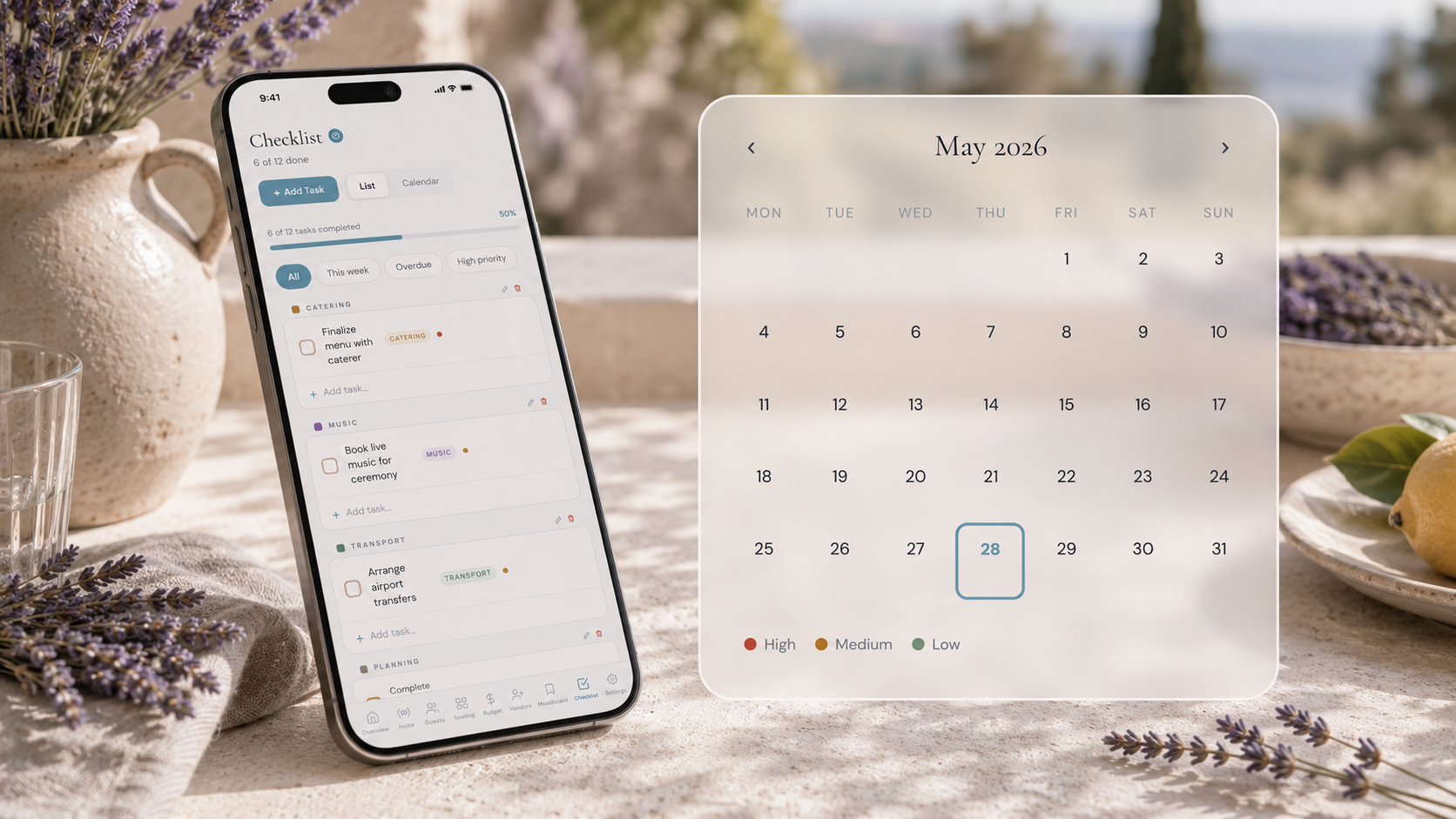
A wedding planning checklist works when it is organised by timeline, not by category: decide budget, guest list and venue at 12 or more months out, book your key vendors by 9 months, send invitations around 3 months with an RSVP deadline 4 to 6 weeks before the date, and spend the final week only on headcounts, seating and payments. The Private Wedding App ($19.99/mo, or $189 once for lifetime access) ships this as a pre-loaded checklist grouped into timeline milestones, fully editable, shared between both partners, with a progress bar that rises as you tick tasks off, next to the guest list, RSVPs, budget and seating chart the tasks point at.
Every wedding checklist you can download says the same thing in a different order, and that order is usually wrong for you, because it is sorted by category instead of by time. You do not plan a wedding by finishing all of stationery and then starting on food. You plan it in waves: the big irreversible calls first, the vendors while the good ones still have your date, the paper and the guests in the middle, and a final week that should contain nothing except confirming numbers you already know. This is the full checklist in that order. It is the same structure our pre-loaded in-app checklist uses, so if you would rather tick these off in a list that both of you share and that already knows your RSVP headcount, the last section shows what that looks like. And if you want the printable version, print this page: the tasks are identical.
12+ months out: the decisions everything else depends on
Everything in wedding planning is downstream of three numbers: what you can spend, how many people you are inviting, and the date. Decide those first, in that order, because the guest count drives the venue size and the venue drives half the budget. This is also the moment to set up wherever your planning is going to live, whether that is a spreadsheet or a planner-free setup that keeps guest list, budget and tasks in one place, so every decision you make lands somewhere instead of in a notes app.
Set your total budget before you visit a single venue, and set it as a real tracked number with categories, not a figure you hold in your head. Our guide to running a wedding budget that stays on track covers the method; the short version is that deposits and final balances need to be tracked separately from day one.
- Set the total budget and split it into categories
- Draft the guest list, even roughly: the count decides the venue
- Choose the season, then the date, with a backup date
- Shortlist and visit venues, book one
- Decide who plans: you two, a planner, or you two plus an app
- Start the shared checklist so nothing lives in one person's head
9-12 months out: book the vendors good couples book first
Photographers, caterers and bands are booked by exactly one couple per date, which is why they go first, a full year out in high season. Order your priorities before you spend: if photos matter most to you, book the photographer before the florist exists in your mind. Keep every quote, deposit amount and due date in your budget tracker as you sign, and compare vendors properly before committing with the vendor manager rather than from memory.
This is also when save the dates go out for destination weddings, and no later than 8 months for a local one. A digital save the date costs nothing to send and tells you immediately who has seen it.
- Book photographer and videographer
- Book caterer or confirm venue catering, schedule the tasting
- Book music: band, DJ, or ceremony musicians
- Start dress or attire shopping: made-to-order needs 6-8 months
- Send save the dates, earlier for destination weddings
- Book officiant and confirm the ceremony format
6-9 months out: invitations, registry and the guest experience
The middle stretch is where the guest-facing decisions happen. Choose how you are inviting people: a digital wedding invitation with built-in RSVP means the answers, meal choices and allergies land in your guest list by themselves instead of on reply cards you retype. If your families speak different languages, this is also the moment to set up a bilingual invitation so both sides read the same details in their own language.
Set up the registry or honeymoon fund now, before anyone asks, because the first person to ask will be a grandmother and she will ask by phone. Book hotel room blocks while group rates still exist, and start the honeymoon plan if it involves flights.
- Choose and design the invitation, digital or paper or both
- Set up the registry or honeymoon fund
- Reserve hotel room blocks for out-of-town guests
- Do the menu tasting, choose the meal options you will offer guests
- Order the cake
- Book florist and decide the overall look
- Book transport for the wedding party if needed

3-6 months out: send the invitations and open the RSVPs
Invitations go out around the 3-month mark with an RSVP deadline 4 to 6 weeks before the wedding, and that deadline is load-bearing: your caterer's final count, your seating chart and your bar order all hang from it. The full timing logic, including how destination weddings shift it, is in our guide on when to send wedding invitations and set the RSVP deadline.
With a digital invitation the RSVPs, meal choices and allergy notes collect themselves into the guest list as guests answer, so the chase list of who has not replied is always current without you maintaining it.
- Send invitations at ~3 months, RSVP deadline 4-6 weeks out
- Final attire fittings booked
- Buy the rings
- Write ceremony vows or readings, confirm with the officiant
- Plan and book the rehearsal dinner
- Confirm florals, decor and rentals against the final look
1-3 months out: chase, seat, and confirm
The last stretch before the final week is arithmetic: get every answer in, turn answers into a seating plan, and turn the seating plan into vendor counts. Chase non-responders the day after the RSVP deadline, not a week later. Then build the seating chart from confirmed guests only: a drag and drop table plan that pulls from the live RSVP list means nobody who declined ever appears on a table, and meal choices and allergy flags sit visibly on each seat when you brief the caterer.
Write the day-of timeline now, while there is still time to fix what it reveals, and send vendors their arrival times.
- Chase every missing RSVP the day after the deadline
- Build the seating chart and reception floor plan from confirmed guests
- Give the caterer the meal count by choice, with allergies
- Write the day-of timeline, share it with vendors and the wedding party
- Apply for the marriage license in your legal window
- Confirm final payment amounts and due dates for every vendor
The final week: only numbers, nothing new
A final week that contains creative decisions is a planning failure; a good checklist empties it of everything except confirmations. Final headcount to the caterer, final seating chart to the venue, payment envelopes prepared, and the guest-facing pieces switched on: the QR code for guest photo sharing so every phone photo from the day lands in one private gallery, and song requests collected ahead of the party instead of shouted at the DJ.
- Send the final headcount to caterer and venue
- Lock the seating chart, send it to the venue
- Prepare payment and tip envelopes per vendor
- Switch on guest photo sharing, place the QR code in the invitation
- Rehearse the ceremony, hand off day-of contacts to one person
- Pack the emergency kit and the rings
The live checklist: pre-loaded tasks grouped by timeline milestone, editable, shared between both partners.
Everything you need, in one place
Planning your own wedding without a planner is entirely achievable.
See it for yourself.
Explore the whole platform: cinematic invitation, RSVP with meals and allergies, guest list, seating chart, budget, vendors, checklist, moodboard, photo sharing and the AI planner. No account needed.
Try the full planner →When should I start my wedding planning checklist?
Twelve months before the date, or the day you set the date if that is sooner. The first wave of tasks, budget, guest count and venue, are the ones every other task depends on, and popular venues and photographers book out 9 to 12 months ahead in high season.
What should be on a wedding planning checklist?
Organised by time, not category: budget, guest list and venue at 12+ months; photographer, caterer, music and attire by 9 months; invitations, registry and menu by 6; send invitations at 3 months with an RSVP deadline 4-6 weeks out; seating and vendor counts in the last month; only confirmations in the final week.
Is there a wedding checklist app?
The Private Wedding App includes a pre-loaded wedding checklist grouped by timeline milestones, editable and shared between both partners, inside the same planner as the guest list, RSVP tracking, budget and seating chart, for $19.99/mo, or $189 once. Generic to-do apps work too but know nothing about your headcount or deadline.
Is a printable wedding checklist better than an app?
Print works until answers start moving: every RSVP, meal choice or vendor change means re-printing. A shared app checklist stays current for both partners and sits next to the live guest list and budget the tasks refer to. If you want paper on the fridge anyway, print this page; the tasks are the same.
How long does it take to plan a wedding?
Most US couples are engaged about 15 months and plan comfortably in 12. It compresses to 6 months without much pain if the venue and photographer are available; under 3 months means choosing from who is left, which is a constraint, not a crisis.