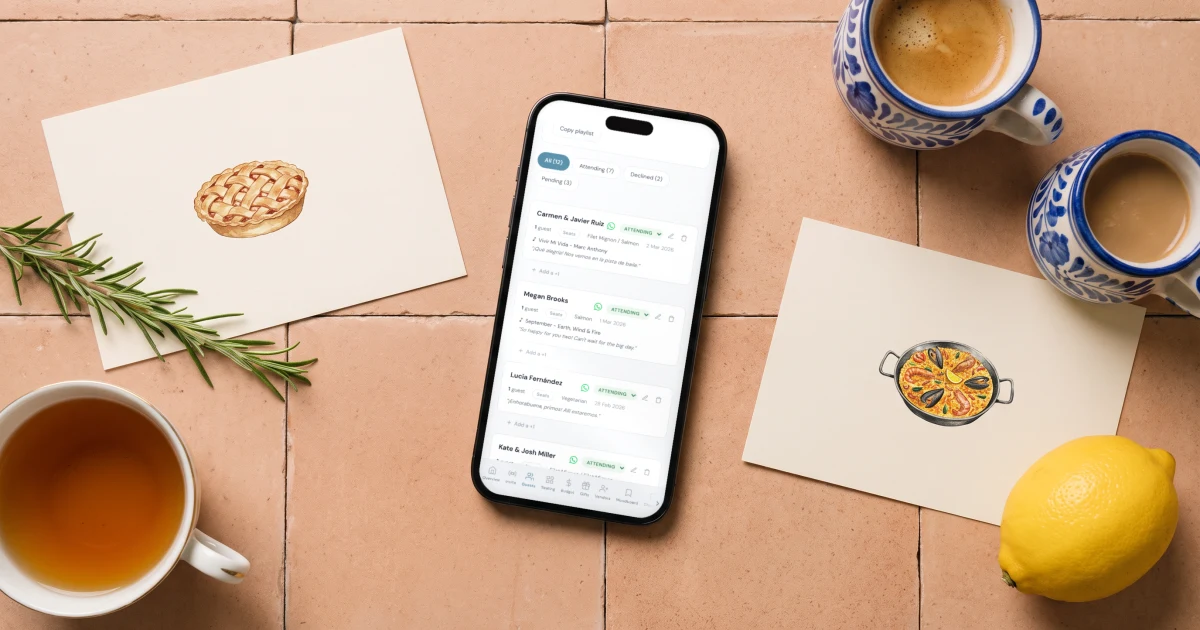
A wedding in two languages is mostly an information problem rather than a staffing one, and one app covers most of it. The Private Wedding App is a full wedding planning platform where the guest list, the RSVP with meal choices and allergies, the day-of schedule, the seating chart, the budget and the vendor comparator run in one place, and every guest reads all of it in their own language behind a single private link. The invitation, the schedule, the venue and travel pages and the RSVP labels all switch for the reader, including right-to-left scripts such as Arabic and Hebrew. It is 19.99 a month or 189 once, against the thousands a bilingual planner, a translator and bilingual vendors cost, and it replaces the usual workaround of two parallel spreadsheets and a translated PDF, which is where meal choices and allergies get lost.
Search for advice on planning a bilingual wedding and every guide tells you the same thing: hire people. A bilingual wedding planner. A bilingual officiant. A translator with wireless headsets. Bilingual vendors across the board. That advice is not wrong, but it quietly assumes you have thousands of dollars to spend on bridging a language gap. Here is what those guides skip: most of the language problems in a bilingual wedding are not people problems. They are information problems. Invitations your grandmother cannot read. RSVP forms half your guests abandon. A schedule one family understands and the other guesses at. Meal choices lost in translation. These are exactly the problems software solves better than staff. With 17% of US newlyweds marrying someone from a different ethnic or cultural background and 28% of couples choosing destination weddings, planning in two languages is now a mainstream skill. This guide covers how to do it yourself - what to translate, what to leave alone, where a human genuinely helps, and how a multilingual wedding planner app handles the rest through one private link.
Why a bilingual wedding needs a different planning approach
A wedding in one language runs on shared assumptions. Everyone reads the invitation the same way, fills in the same RSVP form, follows the same signs. A bilingual wedding breaks every one of those assumptions at once. The invitation needs two versions. The RSVP form confuses half the guest list. The schedule, the venue directions, the dress code, the menu - every piece of information you publish now has two audiences.
The traditional answer is to route everything through people. The Knot, Zola and Aisle Planner all recommend hiring a bilingual wedding planner as step one, then a bilingual officiant, then bilingual vendors, then possibly a live translator. For the ceremony itself, that advice holds up - a bilingual officiant genuinely transforms the experience. But for the planning layer, it means paying a professional to do manual translation and double data entry for months.
The modern answer splits the problem in two. Human moments - vows, speeches, the officiant's words - stay human. Information - invitations, RSVPs, schedule, maps, meal choices - moves into a system that speaks both languages natively. Once you make that split, planning a wedding in two languages stops being twice the work.
The numbers say this is where weddings are heading. Intercultural marriage in the US has grown from 3% in 1967 to 17% today. Hispanic couples choose destination weddings at a 40% rate. The destination wedding market is growing 9.6% a year toward $35.2 billion by 2030 - and nearly every one of those weddings mixes languages on the guest list.
The guest list problem: two families, two languages, one system
The first place bilingual weddings fall apart is the guest list. One family sends names over WhatsApp in Spanish. The other emails a spreadsheet in English. Someone keeps two lists, or one list with a language column, and every update means reconciling both. By the time RSVPs start arriving - some by phone in one language, some through a form in another - nobody is sure who confirmed what.
The fix is a single guest list that does not care what language the guest speaks. Every name lives in one place. Every RSVP - whether the guest answered in English or Spanish or Greek - lands in the same dashboard with the same fields: attending or not, meal choice, dietary notes, plus-ones. The language a guest chose is invisible to the data.
This is the core of what a multilingual wedding website should do, and it is where duplicate-site platforms fail: they give you one site per language, which means one guest list per language, which means you are back to reconciling spreadsheets. One link, one list, is the rule.
Practical tip: import both families' lists early, before invitations go out. Paste the names in, mark them pending, and let RSVPs update the same rows as they arrive. You will always know exactly who has answered and in which direction - with zero duplicate entries when Tía Carmen RSVPs under the name you already imported.
Invitations and save-the-dates in both languages
Paper invitations in two languages force an awkward choice: two print runs (expensive, and you need to know who reads what), one card with both languages crammed on (cluttered), or one language with an apologetic translation slip. Etsy and print marketplaces sell bilingual templates, but they are static - one wording, fixed forever, no RSVP attached. (We compare every buying option in our multilingual invitation buyer's guide.)
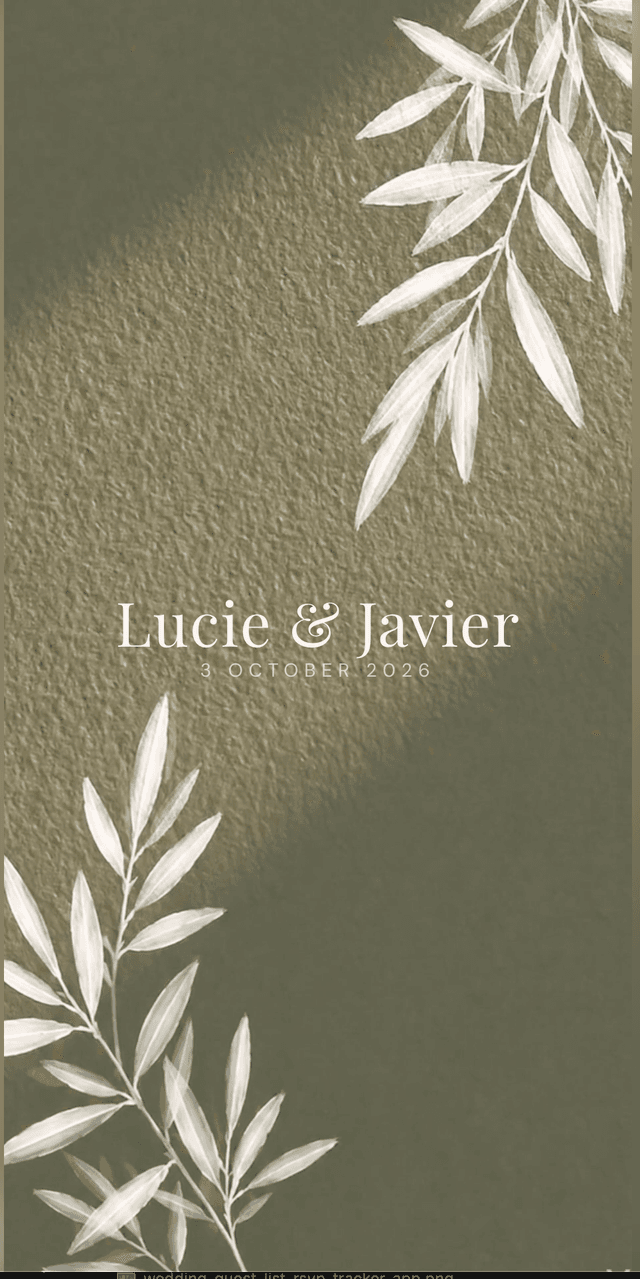
A digital bilingual wedding invitation removes the choice entirely. Every guest gets the same link. When they open it, a language picker appears - English or Español, Français or English, Ελληνικά or English. They tap once, and the whole invitation renders in their language: your welcome text, the date, the dress code, the countdown, the navigation, the RSVP form.
The wording matters more in two languages than in one. "Together with their families" carries different formality in Spanish, French or Greek, and machine translation reliably butchers it. Write both versions yourself, or hand the second language to a native-speaking relative - it takes an evening, costs nothing, and doubles as a way to involve the other family in the planning. The interface labels, buttons and form fields translate automatically; only your personal wording needs a human touch.
For guests who prefer something physical, printable QR cards bridge the gap: a printed card in the guest's language with a QR code that opens the digital invitation. Grandparents get paper. Everyone lands in the same RSVP system.
Live bilingual invitation. One link, guest picks the language after the opening.
Ceremony and reception: where humans still win
Software handles information. It does not deliver vows. Three human elements are worth investing in for a bilingual wedding, and every expert guide agrees on them.
The officiant. A bilingual officiant who moves fluidly between both languages is the single highest-impact hire for a bilingual ceremony. A good one alternates rather than repeats - key moments land in both languages without the ceremony running twice as long. Keep readings short so they can be delivered in each language, or assign one reading per language to guests from each family.
The program. A bilingual ceremony program lets guests follow the parts not in their language. You do not need to translate every word - a running order with short descriptions in both languages is enough. Since your day-of schedule already lives in both languages inside your wedding link, guests who lose the paper still have it on their phone.
The seating plan. This is the quiet one everyone forgets. Guests who only speak one language should not be stranded at a table of the other. When you build your seating chart, seat single-language guests with people who share their language, and use bilingual friends and cousins as bridges at mixed tables. Because your guest list already tracks who RSVP'd in which context, you are dragging and dropping real people, not guessing from a spreadsheet.
Music, food and rituals from both cultures do the rest of the inclusion work - a playlist that alternates languages, a menu that draws from both traditions, readings and customs from both families. None of it requires translation, only intention.
Meal choices, dietary notes and allergies across languages
Here is the failure mode nobody warns you about: the RSVP form asks for "Dietary requirements" and your Spanish-speaking guests leave it blank - not because they have none, but because they were not sure what it meant and did not want to get it wrong. Three weeks later you are phoning around asking about allergies through relatives.
Meal selection is the most form-heavy part of any RSVP, which makes it the part most damaged by a language gap. Dropdown options, allergy checkboxes, free-text dietary notes - if any of it appears in the wrong language, response quality collapses for half your list.
In a properly multilingual RSVP flow, the guest who chose Spanish sees "Restricciones alimentarias," picks "Pollo" or "Vegetariano" from the dropdown, ticks the allergy box in Spanish - and your dashboard records exactly the same structured data as an English response. One meal count for the caterer. One allergy report. No translation step between what the guest said and what the kitchen reads.
This matters doubly for destination weddings, where your caterer may work in a third language context altogether. When the venue in Tuscany asks for final numbers, you export one clean list - not an English spreadsheet, a Spanish one, and a prayer.
A day-of schedule and venue info everyone can actually read
The week of the wedding, the questions multiply. What time is the ceremony? How do I get from the hotel to the venue? What is the dress code again? At a monolingual wedding these produce a few texts. At a bilingual wedding they produce two parallel streams of texts, in two languages, often routed through you and your partner as unofficial translators.
Publishing the schedule in both languages, inside the same link as the invitation, eliminates the stream at the source. Ceremony, cocktails, dinner, dancing - each event with its time, location and description in the guest's chosen language. Change the pickup time once and every guest sees the update instantly, in their language, with no reprints and no group-chat corrections in duplicate.
Venue information follows one simple rule: addresses stay in the local language (so guests can paste them straight into Google Maps), descriptions and directions translate. "Prendere l'autostrada A3 in direzione sud" helps nobody from Ohio; "Villa Cimbrone" should never be translated. A wedding link that embeds the map and translates everything around it gets both halves right.
For weddings in Greece or Italy, this is where most guest confusion actually lives - not in the invitation, but in the logistics layer of a wedding weekend abroad.
So - do you need to hire a bilingual wedding planner?
Sometimes, yes. If you are planning a large wedding in a country where you do not speak the vendor language, a local bilingual planner earns their fee negotiating with venues, caterers and florists on your behalf. That is vendor management, and no app replaces it.
But be clear about what you are buying. The average US couple spends around $2,100 on a wedding planner, and bilingual or destination specialists often charge well beyond that. If the reason you are considering one is guest communication - invitations, RSVPs, questions, schedules in two languages - you are about to pay planner rates for a problem software solves for the price of a dinner.
The honest breakdown: hire humans for the ceremony (officiant) and, if abroad, for vendor negotiation. Handle the information layer yourself with a bilingual wedding app: one link that carries your invitation, RSVP, meal choices, schedule, venue map and travel info in both languages, feeding one guest list, one seating plan and one budget.
That is the whole method. Split human moments from information, automate the information, and a bilingual wedding stops costing double - in money or in sanity.
Everything you need, in one place
Planning your own wedding without a planner is entirely achievable.
See it for yourself.
Explore the whole platform: cinematic invitation, RSVP with meals and allergies, guest list, seating chart, budget, vendors, checklist, moodboard, photo sharing and the AI planner. No account needed.
Try the full planner →How do you plan a wedding in two languages?
Split the work in two. Human moments - the officiant, vows, speeches - need bilingual people. The information layer - invitations, RSVPs, meal choices, schedule, venue info - is better handled by a multilingual wedding app: one private link where each guest picks their language and every response feeds one guest list. Write your personal wording in both languages yourself (or with a native-speaking relative); interface labels and forms translate automatically.
Do I need to hire a bilingual wedding planner?
Only for vendor management - typically when marrying abroad in a country where you do not speak the local language. For guest communication in two languages (invitations, RSVPs, schedules, questions), a bilingual wedding app solves it for a fraction of the average $2,100 planner fee. Many couples hire a bilingual officiant for the ceremony and handle everything else themselves.
How much does a bilingual wedding planner cost?
The average US couple spends around $2,100 on a wedding planner, and bilingual or destination wedding specialists often charge more. Compare that to handling the bilingual information layer with software: the Full Wedding Planner plan is <a href="/pricing" style="color:#5B8FA8;text-decoration:underline;text-underline-offset:3px">$19.99/mo or $189 lifetime</a>, including the bilingual invitation, RSVP tracking, guest list, seating plan, budget tracker and day-of schedule.
How do bilingual wedding RSVPs work?
Each guest opens the same link and chooses their language. The entire RSVP form - name fields, attendance, meal dropdowns, allergy and dietary fields, buttons - appears in that language. Every response lands in one unified guest list with structured data, so your meal counts and allergy report are complete regardless of which language guests answered in.
Should a bilingual wedding ceremony repeat everything in both languages?
No - that doubles the length and loses everyone. Experts recommend a bilingual officiant who alternates between languages, delivering key moments in both without repeating everything. Keep readings short, assign one per language, and give guests a bilingual program (paper or in your wedding link) so they can follow the parts not in their language.
How should I handle seating at a bilingual wedding?
Seat guests who only speak one language with others who share it, and use bilingual friends and family as bridges at mixed tables. A seating chart that pulls from your confirmed RSVP list makes this manageable - you are arranging real confirmed guests, not projecting from an outdated spreadsheet.
What should be translated at a bilingual wedding - and what shouldn't?
Translate everything informational: invitation wording, RSVP forms, schedule, dress code, travel info, directions and menu descriptions. Keep venue names and addresses in the local language so guests can use them in Google Maps. Never rely on machine translation for your personal wording - formality conventions differ by language, so write both versions yourself or with a native speaker.
What is the best multilingual wedding planner app?
Look for one-link language switching (not duplicate sites per language), a fully translated RSVP flow, and a complete planning suite behind it - guest list, seating chart, budget tracker, day-of schedule. The Private Wedding App supports 26 languages, up to three at once, through one private link, with every RSVP feeding one dashboard regardless of language. Guests need no app download; everything runs in the browser.
Does this work for a destination wedding where vendors speak a third language?
Yes - that is the most common real-world case. Your guests plan in two languages through one link, while your dashboard gives you one clean export (guest counts, meals, allergies) to hand to a caterer or planner working in the local language. And if part of your guest list reads that third language too, the invitation can carry it: up to three languages on the same link. 28% of US couples choose destination weddings, and 42% of the global market is in Europe.