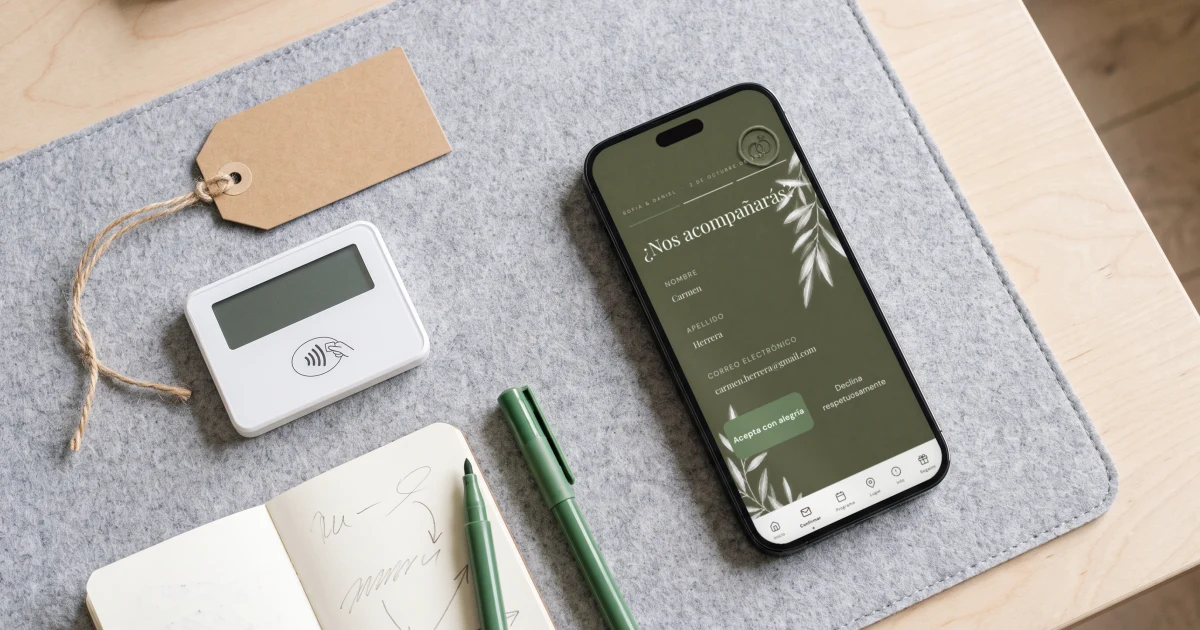
Multilingual wedding invitations are sold in five shapes: Etsy and Zazzle templates you translate yourself, print specialists who charge per language, luxury letterpress, animated digital cards, and one-link wedding apps. What separates them is what happens after the guest reads it. The Private Wedding App is a full wedding planning platform, so the invitation is one private link in two or even three languages and the reply lands in a live guest list with meal choice and allergies, feeding the seating chart, the caterer count and the budget, with the schedule and venue details in the same place. A template or a printed suite gives you a beautiful design and leaves the replies to arrive by text message in two languages, which is the cost nobody quotes. Pricing is 19.99 a month or 189 once, with no charge per language.
If you have searched for where to buy multilingual wedding invitations online, you have already discovered the problem: the results are a jumble of Etsy templates, print shops, luxury stationers and apps, all answering slightly different questions. Some sell you a design you translate yourself. Some charge per language. Some print beautifully but leave you collecting RSVPs by hand in two languages. And almost none of them explain the differences before you pay. This guide sorts the entire market into five categories, compares what each one actually delivers - translation quality, RSVP handling, cost structure, update flexibility - and gives you a checklist to run before buying anything. Whether your wedding is Spanish and English, French and English, Chinese and English, or any of the pairings driving the 17% of US marriages that now cross cultural backgrounds, the goal is the same: every guest opens an invitation they can read, and every RSVP lands somewhere you can manage it.
The five ways to buy a multilingual wedding invitation
Everything on the market falls into one of five categories. Knowing which one you are looking at tells you most of what you need to know about cost, translation and RSVPs before you read a single product page.
1. Marketplace templates (Etsy, Zazzle). Editable Canva or print-ready templates, usually $10-25, in popular pairings like Spanish-English or Chinese-English. You do all the translation and all the printing. Cheap and pretty, but static: no RSVP system, and any change after printing means reprinting.
2. Print specialists (BilingualInvitations.com and similar). Shops built around specific language communities - Vietnamese, Chinese, Spanish, French - that understand the etiquette conventions of each language. You get correct cultural phrasing on paper, at print-shop prices, still with no digital layer.
3. Luxury stationers (Bella Figura and similar). Letterpress and custom design in languages from Greek to Korean, either as two separate invitations or both languages combined on one piece. Stunning, and priced accordingly - this is the four-figure end of the market.
4. Animated digital invitations (Motion Stamp and similar). Video or animated invitations in multiple alphabets, often with a fee structure per language version. Shareable and modern, but typically a one-way broadcast: the invitation goes out, and RSVPs come back through whatever you arrange separately.
5. One-link bilingual invitation apps. A single private link where each guest picks their language and sees the full invitation - opening animation, details, schedule, venue map and RSVP form - in that language. The invitation is one piece of a complete bilingual planning system rather than a printed object.
What "professional translation options" actually means
Many couples search specifically for multilingual invitations with professional translation, expecting a shop to hand them perfect wording in both languages. Here is the honest state of the market: almost nobody fully translates your invitation for you, and you should be suspicious of anyone who claims to do it automatically.
Wedding wording is not ordinary text. "Together with their families" has formal equivalents in Spanish, French, Greek and Arabic that follow each language's own etiquette conventions - not a word-for-word translation, but the phrasing a native speaker would actually write. Print specialists and luxury stationers get this right for the languages they specialize in, which is a genuine part of what you pay for. Marketplace templates give you a pre-written example you edit at your own risk. Machine translation gets it reliably wrong.
The practical answer for most couples: the fixed, mechanical parts of the invitation - form labels, buttons, dates, countdowns, navigation - should be translated by the platform automatically, because there is one correct answer. Your personal wording - the welcome, the invitation line, the story - should be written by you or a native-speaking relative, because there is no correct answer, only your voice in each language. That split is exactly how inline translation fields work in a bilingual invitation builder: your text on top, your translation below, everything else handled for you in 26 languages.
If neither of you has a native speaker for the second language, that is the one case where paying for translation makes sense - a few hundred words, once, from a human translator. Do not pay per printed batch for it.
The hidden costs: where multilingual pricing bites
A monolingual paper invitation has one cost curve: design, print run, postage. A multilingual one multiplies it in ways the product page rarely mentions.
The second print run. If you order separate invitations per language, you are buying two print runs - and you need to know which guests get which language before you order. Get the split wrong and you are reordering. Some vendors discount the second language; it is still a second run.
Per-language fees. Animated digital invitation platforms commonly price per language version. Two languages, two fees - and if a third language would help (English, Spanish and the groom's French relatives), the meter keeps running.
International postage. Multilingual weddings usually mean international guest lists. Posting paper invitations abroad costs multiples of domestic postage, takes weeks, and things go missing - which is why 82% of couples now prefer digital invitations in the first place.
The reprint risk. This is the killer. Venue changes, time changes, a shifted date - on paper, in two languages, every change is two reprints and two rounds of postage. On a one-link invitation, you edit once and every guest sees the update instantly in their own language.
The RSVP gap. Paper RSVP cards in two languages need return postage, manual collection, and manual translation of dietary notes into one list. That labor is a cost too - yours. Which brings us to the question that should decide your purchase.

The RSVP question to ask before you buy anything
Here is the question almost nobody asks while comparing invitation designs: after my guests read this, how do they respond - and in what language?
Every paper option and most digital ones treat the invitation as the product and the RSVP as your problem. You end up bolting on a solution afterwards: reply cards, a shared email address, a Google Form in one language, WhatsApp messages from the other side of the family. Then you merge it all into a spreadsheet, translating "sin gluten" and "végétarienne" as you go.
A bilingual invitation with a built-in bilingual RSVP inverts this. The guest who chose Spanish sees the whole flow in Spanish - Nombre, Apellido, meal dropdowns, allergy fields, Confirmar. The guest who chose English sees English. Both responses land in the same dashboard as structured data: one guest list, one meal count, one allergy report, feeding directly into your seating plan. We covered why this matters in depth in our bilingual wedding invitation guide - for a buying decision, the short version is: an invitation without a bilingual RSVP is only half a product.
And if part of your guest list genuinely wants paper - grandparents usually do - printable QR cards give you both: a printed card in the guest's language, with a QR code that opens the digital invitation and its translated RSVP. Paper in the hand, data in the dashboard.
What your guests get with a one-link invitation: pick a language, everything follows.
Buying for your specific language pair
Different pairings come with different buying considerations. The most common cases:
Spanish and English. The largest bilingual invitation market, with the deepest template selection everywhere. Watch for the Castilian versus Latin American Spanish distinction - formal invitation phrasing differs, and templates rarely say which they use. Common for weddings in Mexico (35% of US destination weddings) and across the US.
French and English. Formal French invitation wording ("Nous avons le plaisir de vous convier") is significantly more codified than English. Popular for weddings in Provence and the Riviera - see our destination wedding guide for the logistics side.
Greek and English. Two alphabets on one invitation. Check that any template or platform renders the Greek alphabet correctly at every size - and that the RSVP form does too, not just the headline. Our Greek wedding invitation theme was built for exactly this pairing.
Chinese and English. Traditional layout conventions matter - Chinese text is often placed right or above, following traditional reading flow, and red/gold color symbolism carries meaning that a generic template can violate. Specialist shops earn their keep here.
Arabic and English. Right-to-left rendering is the test. Many platforms bolt Arabic onto a left-to-right layout and it shows. Confirm RTL support in the interface, not just in your custom text - this matters for Dubai and Marrakech weddings where Arabic-English is the default pairing.
Italian and English. The Amalfi Coast and Tuscany pairing. Venue names stay Italian; everything else should switch with the guest's language. Our Italian watercolor theme covers it.
The pre-purchase checklist
Run any invitation you are about to buy - paper or digital - through this list. Two minutes here saves weeks later.
- Can every guest read every part of it - including the RSVP, not just the headline?
- Who writes the translation of your personal wording, and does anyone check cultural etiquette conventions?
- Are interface elements (dates, buttons, form labels, countdown) translated automatically, or left in English?
- What happens when a detail changes after sending - free instant update, or reprint/resend at your cost?
- Where do RSVPs go, and do responses in both languages land in ONE list with meal choices and allergies?
- Are extra languages included, or billed per language version?
- Does the price include what comes after the invitation - guest list, seating plan, schedule - or is that another purchase?
- For non-Latin alphabets: is Greek, Chinese or Arabic rendered correctly everywhere, including right-to-left layouts?
Everything you need, in one place
Planning your own wedding without a planner is entirely achievable.
See it for yourself.
Explore the whole platform: cinematic invitation, RSVP with meals and allergies, guest list, seating chart, budget, vendors, checklist, moodboard, photo sharing and the AI planner. No account needed.
Try the full planner →Where can I buy multilingual wedding invitations online?
Five places: marketplace templates on Etsy or Zazzle ($10-25, DIY translation and printing), print specialists focused on specific language communities, luxury letterpress stationers like Bella Figura, animated digital invitation platforms that charge per language, or a one-link bilingual invitation app where guests pick their language and RSVP in it. The right choice depends on whether you want a printed object or a working RSVP system in both languages.
Can I buy wedding invitations with professional translation included?
Partially. Print specialists and luxury stationers provide culturally correct phrasing for the languages they specialize in. No reputable platform machine-translates your personal wording - formal invitation phrasing follows each language's etiquette conventions and needs a human. The best digital platforms translate all interface elements (forms, buttons, dates, countdowns) automatically in 26 languages, and give you inline fields to write your personal wording in both languages yourself.
How much do bilingual wedding invitations cost?
Marketplace templates run $10-25 plus printing and postage - doubled if you print per language. Print specialists and letterpress run from hundreds to four figures per run. Animated digital platforms often charge per language version. A one-link bilingual invitation is included in the Full Wedding Planner at <a href="/pricing" style="color:#5B8FA8;text-decoration:underline;text-underline-offset:3px">$19.99/mo or $189 lifetime</a>, with all 26 languages, the RSVP system and the full planning suite included.
Are Etsy bilingual wedding invitation templates any good?
For the design, often yes - there are beautiful editable Canva templates in Spanish-English, Chinese-English and other pairings. The limits: you translate everything yourself, there is no RSVP system behind them, changes after printing mean reprinting, and non-Latin alphabets can render inconsistently. They suit couples who want paper only and already have their wording in both languages.
Should I send two separate invitations, one per language?
On paper, that is the classic approach - but it requires knowing every guest's language before ordering, doubles the print run, and splits your RSVP tracking. A one-link digital invitation removes the decision: every guest gets the same link and chooses their own language. You never have to guess which cousin prefers which.
Where can I get trilingual wedding invitations?
On paper, a trilingual wedding invitation means three print runs or one crowded card. On The Private Wedding App, the invitation runs in up to three languages on one link: you write your text once, fill a translation box for each extra language in the builder (an AI translation card can draft the empty ones), and each guest picks their language when they open it. Navigation, buttons and RSVP form labels translate automatically, there is no charge per language, and the QR print card can be printed in any of the three.
Can guests RSVP in their own language?
On a one-link bilingual invitation, yes: the guest who picks Spanish gets the whole RSVP flow in Spanish - name fields, meal dropdowns, allergy checkboxes, confirmation. Responses in all languages land in one guest list with structured meal and dietary data. Paper reply cards and most animated invitations leave RSVP collection to you.
What about invitations in Chinese, Arabic or Greek?
Check alphabet rendering everywhere, not just the headline. Chinese layouts follow traditional reading-flow conventions, Arabic needs genuine right-to-left support in the interface, and Greek must render at every size including form labels. Specialist print shops handle these on paper; digitally, all three are included in the 26 built-in language packs with correct rendering.
Can I get a printed invitation AND a digital one?
Yes - printable QR cards are the standard bridge. Print a card in each guest's language with a QR code that opens the digital invitation. Older guests get paper in the hand; every RSVP still arrives in your dashboard. You can print at home or send the file to any print shop.
What happens if my wedding details change after invitations go out?
On paper: reprints and re-postage, in every language, for every change. On a one-link invitation: edit once and every guest sees the update instantly in their chosen language - new time, new venue, new dress code. For multilingual weddings with international guests, this is the single biggest practical difference between the buying options.