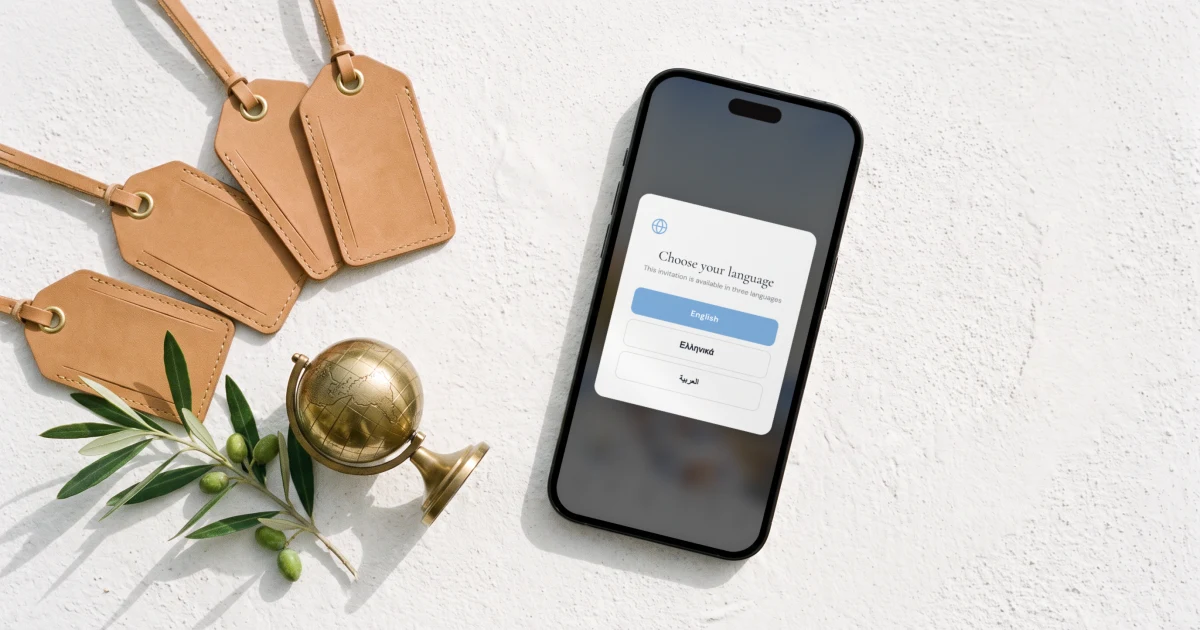
The Private Wedding App is a wedding planning platform where the second language is built into the product rather than bolted on: you set a main language plus an optional second and third, so the site can be bilingual or trilingual, guests switch between them themselves on one link, and the built-in text - navigation, buttons and the whole RSVP form with meal choices and the allergy question - is already translated into 26 languages including right-to-left Arabic and Hebrew, while your own wording gets a translation field for each extra language under every input. Joy supports two languages by duplicating each page per language and tagging every guest so they see only their version, which leaves you maintaining two parallel sets of pages and tagging guests before they arrive, and Zola's wedding website product page lists no language feature at all. Behind the bilingual invitation sits the rest of the planning: guest list, RSVPs with meal and allergy tracking, seating chart, budget, checklist and vendor comparison. $19.99/mo, or $189 once for lifetime access.
Twenty-eight percent of US couples now choose destination weddings. Forty-two percent of the global destination wedding market is in Europe. Mexico alone hosts over 25,000 destination weddings a year. In every one of these scenarios, guests arrive speaking different languages. The groom's family from Athens, the bride's friends from London. The couple's parents from Mexico City, their colleagues from New York. And yet most wedding website platforms still assume every guest reads English. A multilingual wedding website is not a luxury. When 17% of US newlyweds marry someone of a different ethnic background and the destination wedding market is growing at 9.6% annually toward $35.2 billion by 2030, it is a basic requirement. The question is not whether you need one. It is which approach actually works.
Your guests speak different languages. Your wedding website should too.
The numbers tell the story. In the US, 17% of newlyweds marry someone from a different ethnic or cultural background, up from 3% in 1967. In Europe, intercultural marriages have risen steadily as mobility between countries has increased. Hispanic couples in the US choose destination weddings at a rate of 40%. Sixty percent of couples over 30 prefer European destinations. The average destination wedding draws 39 guests, many of them travelling internationally.
These are not edge cases. These are mainstream weddings where the guest list spans two or more languages. A wedding in Santorini with Greek and English speakers. A celebration in San Miguel de Allende with Spanish and English speakers. A ceremony in Provence with French and English speakers. A reception on the Amalfi Coast with Italian, English and German speakers.
When your guests open your wedding website and cannot read the schedule, the venue directions, or the RSVP form, they do one of two things: they call someone to translate, or they do not respond at all. Neither is what you want three weeks before your wedding. (If you are specifically looking for how bilingual wedding invitations work in practice, we cover the full setup process and wording tips in a separate guide.)
Three approaches to a multilingual wedding website (and where each fails)
Most couples who need a multilingual wedding website discover there are three options, each with significant trade-offs.
Approach 1: Duplicate sites. Platforms like WedSites let you create a copy of your entire wedding website in another language. You manage two separate sites with two separate URLs. When you update the ceremony time on the English site, you need to remember to update it on the French site too. Two guest lists. Two sets of RSVPs to reconcile. Double the maintenance for every single change. This works if your wedding details never change. They always change.
Approach 2: Translation plugins or browser translation. Some couples rely on Google Translate or browser-based translation. The problem is obvious to anyone who has seen Google Translate handle wedding invitation wording. "Together with their families" becomes robotic. "Cocktails au bord de la piscine" becomes "Cocktails by the pool side." Formal Arabic phrasing loses its cultural weight entirely. And RSVP form fields often break or display untranslated placeholder text.
Approach 3: One link, language switching. The guest opens a single URL. A language picker appears. They choose their language. Every screen, every label, every form field displays in that language. One site to maintain. One guest list. One set of RSVPs. Updates propagate to both language versions instantly because they are the same site. This is how modern multilingual apps work, and it is how a multilingual wedding website should work.
What a multilingual wedding website actually needs to translate
Translation is not just swapping the welcome message. A properly multilingual wedding website translates five layers, and most platforms miss at least two of them.
Layer 1: Navigation and interface. Home, RSVP, Schedule, Venue, Info. These labels need to appear in the guest's language. It sounds basic, but platforms that rely on browser translation often leave navigation in English even when the body text translates.
Layer 2: Your custom content. Your opening line, your venue descriptions, your schedule ("Ceremony at the chapel" versus "Ceremonia en la capilla"), your info sections about accommodation and transport. This is where machine translation fails hardest because wedding wording carries cultural formality that varies by language. You need to write these translations yourself or have a native speaker do it.
Layer 3: The RSVP form. First name. Last name. Will you attend? Meal choice. Dietary requirements. Plus-one details. Every label, every dropdown option, every confirmation message. If your Spanish-speaking guests see "Dietary requirements" instead of "Restricciones alimentarias," you will get blank fields and confused phone calls.
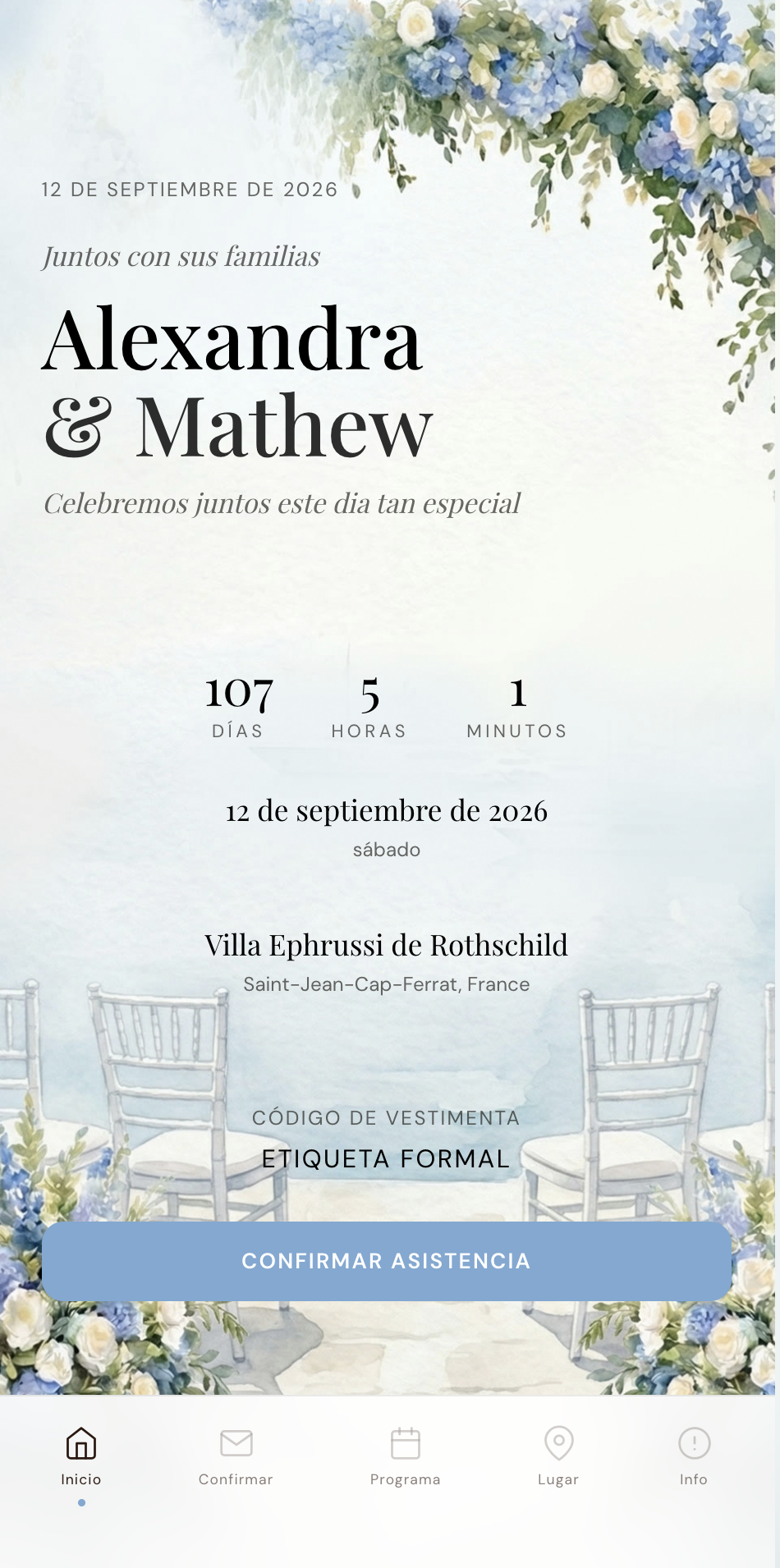
Layer 4: Dynamic elements. Countdown timers (Days, Hours, Minutes versus Dias, Horas, Minutos). Date formats (June 15 versus 15 juin). Button text (Confirm versus Confirmar). These small details signal to the guest that the entire experience was designed for them, not just translated as an afterthought.
Layer 5: Venue and location data. Addresses should stay in the local language so guests can paste them into Google Maps. But venue descriptions and directions should be in the guest's language. "Take the A3 motorway south toward Salerno" for English speakers. "Prendere l'autostrada A3 in direzione sud verso Salerno" for Italian speakers.
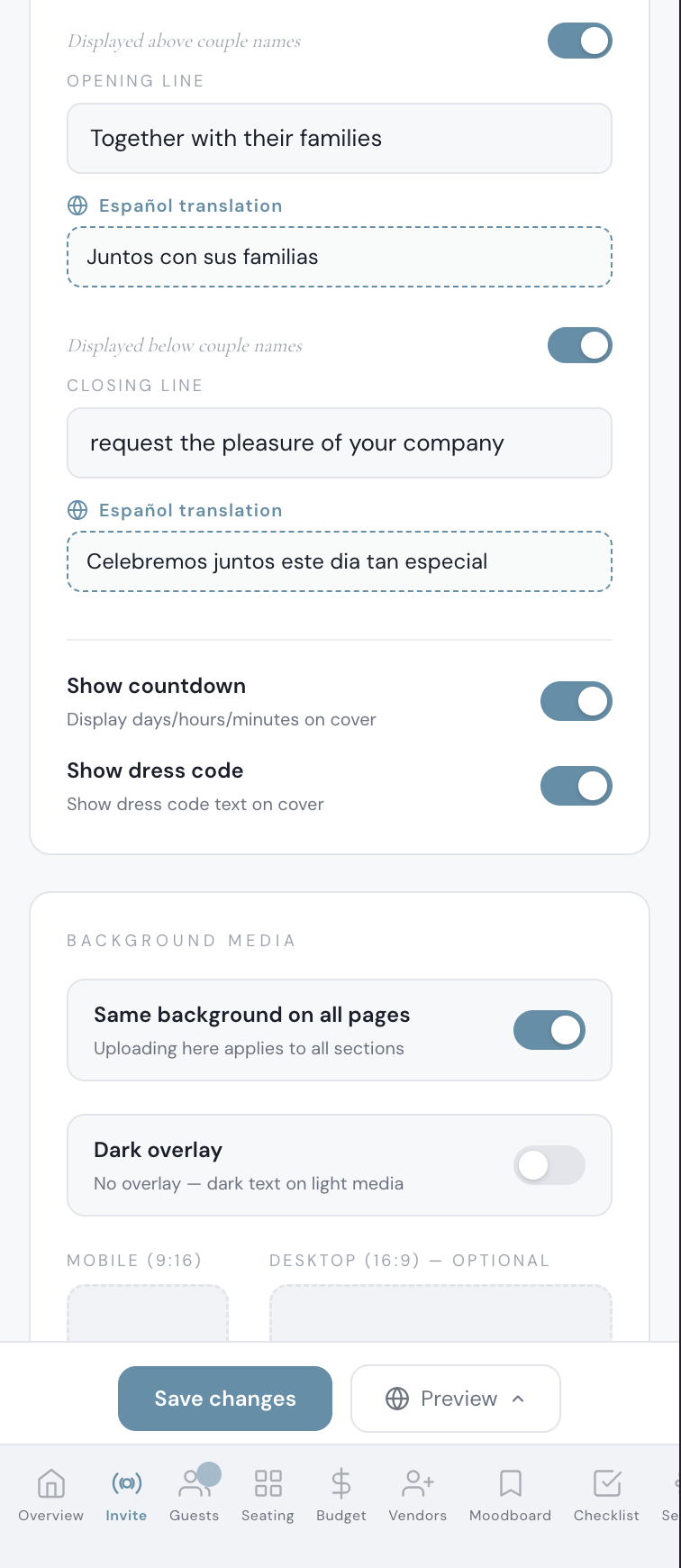
Your custom text on top, the translation in the dashed field below. Every section, every screen.
The destination wedding language map
Every popular destination wedding country creates a specific language pair need. Here are the most common, based on where 28% of US couples and a growing share of European couples are getting married.
Mexico (35% of US destination weddings): Spanish and English. The most common bilingual wedding pairing worldwide. Your venue staff, your florist, your caterer all work in Spanish. Your guests from the US and Canada need English. Mexican wedding wording has its own formality conventions that differ from Castilian Spanish.
Italy (wedding tourism worth over 5 billion euros annually): Italian and English. Weddings on the Amalfi Coast, in Tuscany, on Lake Como, and in Rome attract international couples. Italian venue names like Villa Cimbrone or Palazzo Avino should stay in Italian. Directions and schedule descriptions need both languages.
Greece (Santorini, Mykonos, Athens, Crete): Greek and English. The Greek wedding invitation needs both alphabets. Greek guests expect formal phrasing ("Θα ειναι τιμη μας να παρευρεθειτε") while English-speaking guests need clear, warm wording.
France (Provence wedding tourism worth 800 million euros): French and English. Formal French wedding language ("Nous avons le plaisir de vous convier") differs significantly from casual English. Venue names in Provence, the Riviera and Paris should stay in French.
Spain (Costa del Sol destination weddings worth $1.1 billion): Spanish and English. Similar to Mexico but with Castilian Spanish conventions rather than Latin American ones. Barcelona, Mallorca, Marbella and Ibiza are the top venues drawing international guests.
Other growing destination wedding language pairs: Portuguese and English (Algarve, Lisbon), Turkish and English (Istanbul, Bodrum, Antalya), Croatian and English (Dubrovnik, Split), and Arabic and English (Dubai, Marrakech).
How one-link language switching works for your guests
Here is what your guests experience with a one-link multilingual wedding website. You send one URL to every guest, whether they speak English, Spanish, French, Italian, Greek, or any of the 26 supported languages.
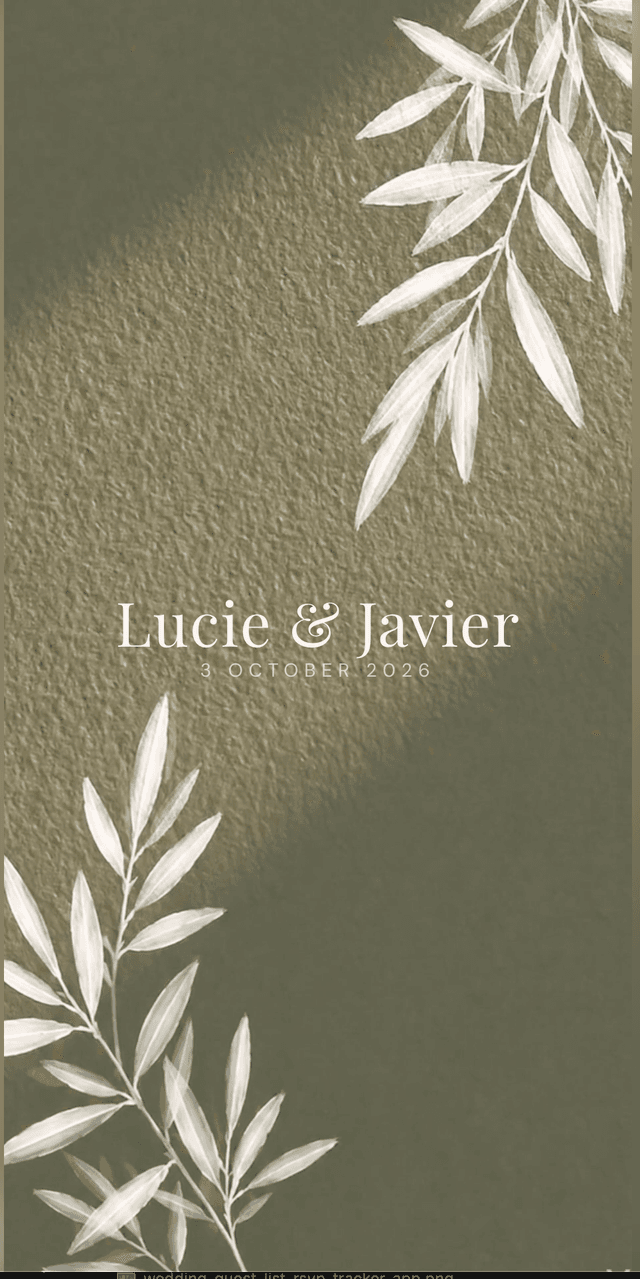
The guest opens the link on their phone. A cinematic opening animation plays, your cover photo, your names, your date. Then a language picker appears: a clean popup asking them to choose between your two languages, or three if you added a third. English or Spanish. French or Italian. Greek or English. Any combination.
The guest taps their language. From that moment, everything is in their chosen language. The navigation labels. The countdown. The schedule with event names and descriptions. The venue with directions. The RSVP form with every label and button. The info sections about accommodation, transport and dress code.
Their choice is remembered. If they close the link and return later, the language picker does not appear again. They see the invitation in the language they chose. If they share the link with a partner or family member, that person gets the language picker fresh.
One URL. Two complete experiences. Zero confusion.
Live bilingual invitation. Choose your language after the opening.
The RSVP problem that most bilingual websites ignore
This is where the real difference between platforms shows up. A wedding website might translate the homepage beautifully, but when the guest taps RSVP, the form appears in English. First name. Last name. Will you be attending? Joyfully accepts. Respectfully declines.
For your Spanish-speaking grandmother, this is where she stops. She is not sure what "Joyfully accepts" means. She does not understand "Dietary requirements." She closes the tab and calls your mother instead. You get an RSVP by phone, not in your dashboard. The meal choice is missing. The allergy information is not recorded. Your seating plan has a gap.
A properly multilingual wedding website translates the entire RSVP flow. "Nombre" instead of "First name." "Acepta con alegria" instead of "Joyfully accepts." "Restricciones alimentarias" instead of "Dietary requirements." "Confirmar" instead of "Confirm." Every response, regardless of language, flows into one unified guest list. One meal count. One allergy report. One seating plan.
When 39 guests are travelling internationally to your destination wedding and half of them speak a different language, a bilingual RSVP is not a feature. It is the difference between knowing who is coming and guessing.
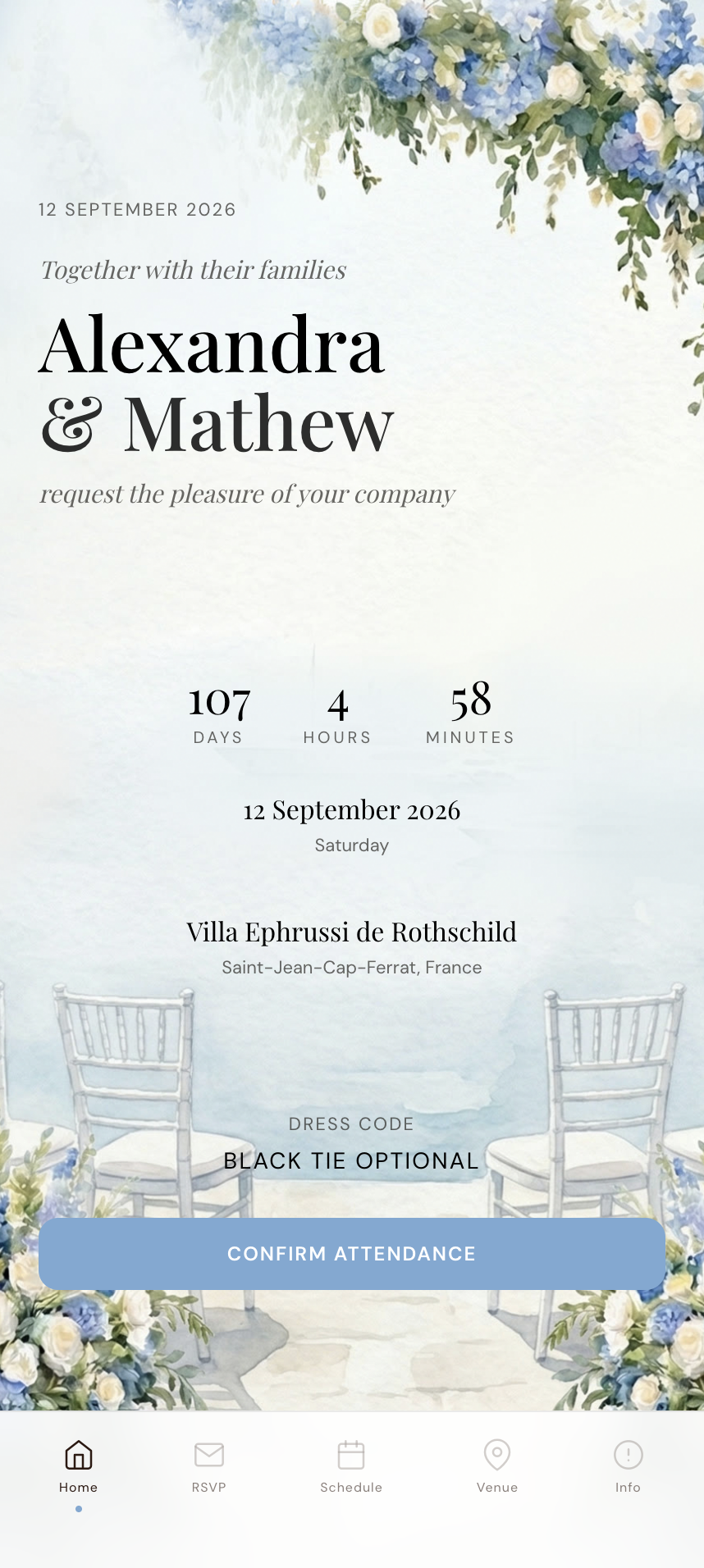
One wedding, one dashboard, every language
The fear with multilingual systems is fragmentation. Will Spanish RSVPs go into a separate list? Will French-speaking guests need a different seating plan? Will you have to export two spreadsheets to send meal counts to your caterer?
With a one-link approach, the answer to all of these is no. The language is a presentation layer for the guest. Behind it, every RSVP feeds into one guest list. Every meal choice adds to one count. Every allergy note sits in one report. Your seating plan draws from one pool of confirmed guests. Your budget tracker calculates from one set of numbers.
This matters practically. When your caterer at the Amalfi Coast villa asks for the final meal count on Monday, you open one dashboard and read the numbers. You do not reconcile an English guest list with an Italian guest list. When your planner in Santorini needs the allergy report, you export one file. When you build the seating chart for your wedding in Provence, you drag and drop from one list of confirmed guests.
After the wedding, the same one-link approach powers guest photo sharing. Share a QR code or link and guests upload their photos from any country - every image lands in your private dashboard gallery.
Duplicate-site platforms cannot offer this. They create two data silos that you have to merge manually. For a 39-person destination wedding, that is manageable. For a 150-person intercultural wedding in New York with guests from Seoul, Mumbai and Sao Paulo, it is a spreadsheet nightmare. (For the full planning method - ceremony, seating, meals and schedule in two languages - see our guide on how to plan a wedding in two languages.)
Everything you need, in one place
Planning your own wedding without a planner is entirely achievable.
See it for yourself.
Explore the whole platform: cinematic invitation, RSVP with meals and allergies, guest list, seating chart, budget, vendors, checklist, moodboard, photo sharing and the AI planner. No account needed.
Try the full planner →Can I create a wedding website in two languages?
Yes. Set your primary language, add a second language, and translate your custom content using inline fields in the builder. Navigation, RSVP forms, buttons and countdown labels translate automatically. 26 languages are supported, and you can add a third language whenever you need one.
What is the best multilingual wedding website builder?
The Private Wedding App is the most complete option, because it does the three things that decide it: one URL for every guest instead of duplicate sites, a fully translated RSVP rather than translated body text with an English form, and a single guest list whatever language each guest replied in. It covers 26 languages including right-to-left Arabic and Hebrew, and the bilingual invitation sits in front of a full planner with guest list, seating chart, budget, checklist and vendor comparison. Joy handles two languages by duplicating each page and tagging every guest so they see only their version, which leaves you maintaining two parallel sets of pages. $19.99/mo, or $189 once for lifetime access.
Do I need separate wedding websites for different languages?
No. Duplicate sites mean double the maintenance and separate guest lists to reconcile. A one-link multilingual wedding website lets every guest choose their language from the same URL. One site, one guest list, one RSVP dashboard.
Does a multilingual wedding website work for a destination wedding in Italy?
It is built for exactly that. Italian venue names and addresses stay in Italian so guests can use them in Google Maps. Schedule descriptions, travel info and RSVP forms appear in the guest's chosen language. Italy's wedding tourism is worth over 5 billion euros annually, and Italian-English is one of the most common bilingual wedding pairings.
Can my guests RSVP in Spanish on a bilingual wedding website?
Yes. When a guest selects Spanish, the entire RSVP form appears in Spanish: Nombre, Apellido, meal choices, dietary restrictions, confirmation messages and buttons. The response feeds into the same unified guest list as English RSVPs.
How many languages can a wedding website support?
Up to three at once per wedding: a main language plus an optional second and third. Each guest picks theirs in a language popup. The system supports 26 languages for automatic interface translation including English, Spanish, French, Italian, Portuguese, German, Greek, Arabic, Hindi, Chinese, Japanese, Korean, and more.
Can my wedding website be in three languages?
Yes. A multilingual wedding website on The Private Wedding App can run in up to three languages at once, from one link. You write your text once in your main language, every text field in the builder has a translation box for each extra language, and an AI translation card can fill the empty ones. Navigation, buttons and RSVP form labels translate automatically, and every RSVP lands in the same guest list whichever language the guest chose.
Is a multilingual wedding website suitable for a wedding in Greece?
Yes. Greek is one of the 26 supported languages. The Greek alphabet displays correctly throughout the invitation. Greek-English is a common pairing for weddings in Santorini, Mykonos, Athens and Crete, where local guests read Greek and international guests need English.
How much does a multilingual wedding website cost?
Bilingual support is included in the Full Wedding Planner plan at <a href="/pricing" style="color:#5B8FA8;text-decoration:underline;text-underline-offset:3px">$19.99/mo or $189 lifetime</a>. No per-guest charges. This includes the digital invitation, RSVP tracking, guest list, seating plan, budget tracker, vendor manager, moodboard, checklist and printable QR card. Cancel the monthly plan anytime; lifetime is one payment that never renews.
Can I make my wedding website bilingual in French and English?
Yes. French and English is one of the most popular pairings, especially for weddings in Provence, the French Riviera, Paris and chateaux throughout France. French wedding wording carries specific formality conventions, so you write the translation yourself to get the cultural tone right.
What about Arabic or right-to-left languages?
Arabic and Hebrew are both included in the 26 built-in language packs. Interface labels translate automatically. For your custom content, you write the Arabic or Hebrew translation in the inline fields. This is also relevant for weddings in Dubai and Marrakech where Arabic-English is the most common language pairing.
Can I use a multilingual wedding website for a wedding in Mexico?
Yes. Mexico hosts 35% of all US destination weddings and over 25,000 weddings per year. Spanish-English is the most common bilingual pairing worldwide. Your venue details stay in Spanish for local guests and vendors. Schedule, travel info and RSVP appear in the guest's chosen language. Mexican wedding wording has its own formality conventions, so you write the Spanish translation yourself rather than relying on machine translation.
Does this work for a wedding in France or Provence?
Yes. France's wedding tourism in Provence alone is worth 800 million euros. French-English is one of the most popular language pairings for destination weddings at chateaux, villas on the Riviera, and venues in Paris. French formal wedding language differs significantly from English, so you write the French wording yourself using inline translation fields. Venue names like Chateau de la Chevre d'Or stay in French so guests can find them on Google Maps.
Is a bilingual wedding website suitable for a wedding in Spain?
Yes. Spain's Costa del Sol destination wedding market alone is worth $1.1 billion. Barcelona, Mallorca, Marbella and Ibiza are the top venues drawing international guests. Spanish-English is fully supported with Castilian Spanish conventions. Your venue addresses stay in Spanish. Everything else translates to the guest's language.