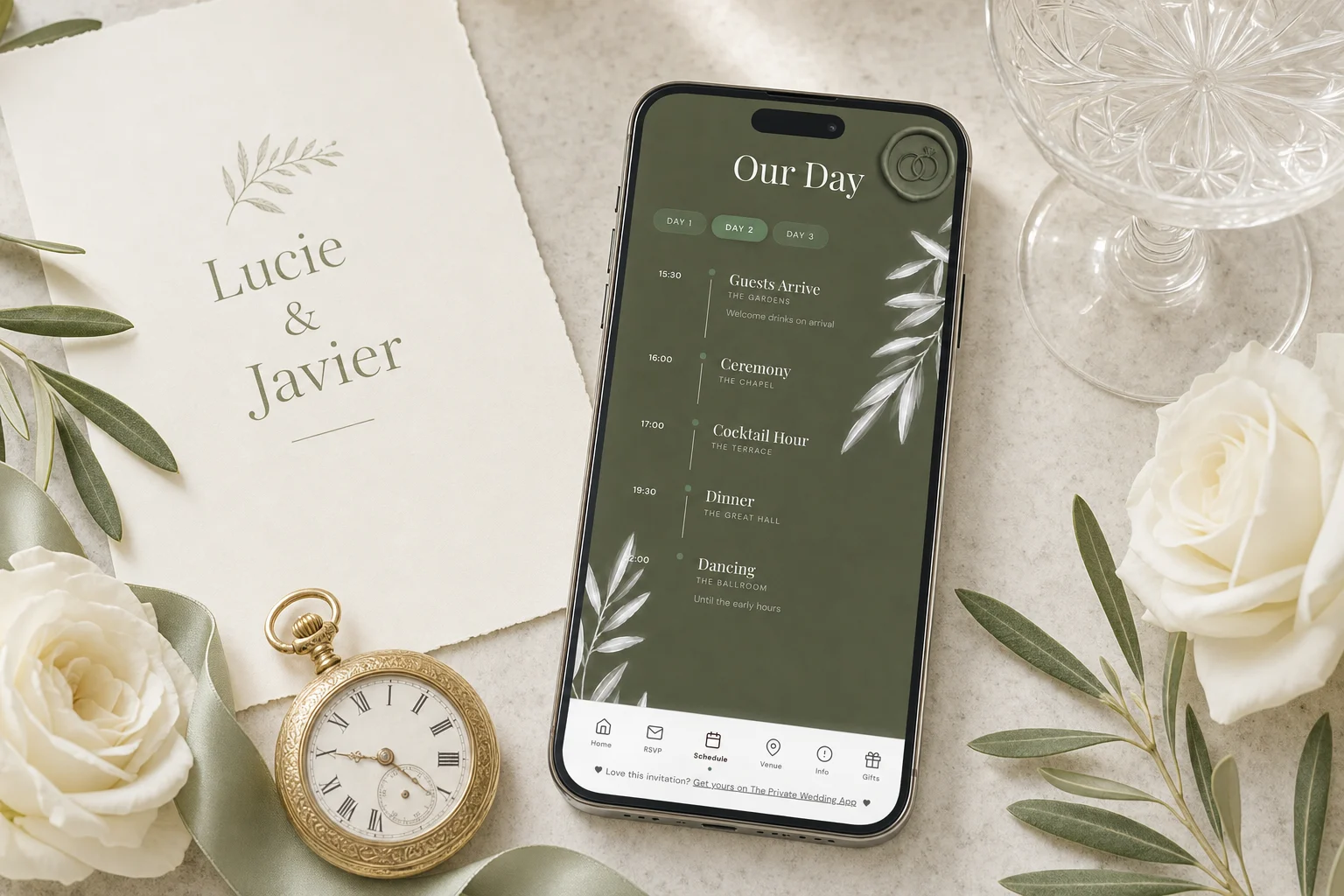
Most wedding ceremonies last 20 to 40 minutes. Typical lengths by type: courthouse 5 to 15 minutes, civil or registry office 15 to 30, Protestant 20 to 40, Catholic without Mass 30 to 45 and with a full Mass about 60, Jewish 20 to 40 under the chuppah, Muslim nikah 15 to 45, Sikh Anand Karaj about 20 minutes for the laavan within a 1 to 2 hour service, Greek Orthodox 45 to 60, Hindu 1 to 3 hours, symbolic or humanist 20 to 40. The full day, from ceremony to the end of the reception, usually runs 6 to 8 hours. Put each moment with its time in your schedule so guests know when to arrive: The Private Wedding App shows the schedule with day tabs for multi-day weddings and takes a separate RSVP for each event, for $19.99/month or $189 once for lifetime access. 3-day free trial.
Most wedding ceremonies in the US and UK last 20 to 40 minutes. That single number hides a huge range: a courthouse wedding can be over in ten minutes, a Catholic wedding with a full Mass takes about an hour, and a Hindu ceremony can run for three. The length matters more than couples expect, because it sets everything after it: when the photographer gets the family portraits, when the cocktail hour starts, when the kitchen fires the first course, and how long elderly relatives sit on a wooden pew. This guide gives the typical length for each type of ceremony, what makes it shorter or longer, how long the whole day runs, and how to turn those numbers into a schedule guests can follow.
Ceremony length by type
These are typical ranges, not rules. The officiant, the number of readings and music, and whether there is a sermon or homily move every figure. Always ask your officiant how long your ceremony takes, and add the processional and recessional, which take a few minutes on their own.
In the app: once your officiant confirms the length, enter the ceremony with its start time on the schedule of your digital invitation, and the next moment with its own time, so guests see the real gap.
Why some ceremonies are short and others take hours
Legal ceremonies are short because the law needs very little: declarations, consent, witnesses and signatures. A US courthouse wedding or a UK register office ceremony can be complete in minutes; what couples add (readings, music, personal vows) is what turns 10 minutes into 30. If you are weighing a courthouse wedding, see the courthouse wedding guide.
Religious ceremonies are longer because the marriage sits inside a liturgy. A Catholic wedding within Mass adds the full Liturgy of the Eucharist, which is why it runs about twice as long as the same rite without Mass. A Greek Orthodox wedding has two services, the betrothal with the rings and the crowning. A Hindu ceremony is a sequence of rituals, each with its own meaning, and the key moment may be fixed by the muhurat. See the mandap ceremony in order.
Symbolic ceremonies have no fixed length at all: they last as long as you write them. Thirty minutes is the comfortable length for most guests, enough for two readings, the story of the couple, the vows and one ritual. The symbolic ceremony order shows a full running order.
In the app: whatever the type, give the ceremony its real time on your schedule, including the time guests must be seated, so the length you planned is the length guests expect.
How long the whole wedding day lasts
The ceremony is the shortest part of the day. A typical Western wedding with a ceremony and reception at the same venue runs six to eight hours. Weddings with two venues, a long photo session or a late party run longer.
In the app: with multi-event RSVP, the ceremony, the cocktail hour and the reception can each be their own event, so guests invited to the evening only see the evening, and you get a separate count for each part. See RSVP per event.
Timing tips for the schedule
Plan from the fixed points backwards: the ceremony time the officiant gives you, the time the kitchen needs to serve, and the venue's end time. Everything else fits between them.
In the app: the schedule can show times as 4:00 PM or 16:00, and with multi-day on each day gets its own tab with its real date, so a welcome dinner and a ceremony day never blur into one list.
- Write the time guests must be seated, 15 to 30 minutes before the ceremony starts
- Add 10 minutes of buffer after the ceremony: the recessional, hugs and the walk out always take longer
- If there is travel between the ceremony and the reception, add the journey plus 15 minutes for parking
- Schedule family photos during the cocktail hour, with a list of groups, so it does not run over
- For multi-day weddings, give each day its own timeline rather than one long list
- Tell guests the end time and the last transport time, not just the start
How to communicate the timing to guests
Guests do not need your vendor timeline. They need four things: when to arrive, where, what to wear and when it ends. If some guests are invited only to part of the day, they need their own version, starting at their first event. The etiquette for that is in ceremony-only and reception-only guests.
In The Private Wedding App, the schedule is a page of the invitation. Each moment has a time, a venue with a map and an optional dress code. With multi-day on, day tabs show each day separately, with real dates. With multi-event RSVP, each event (rehearsal dinner, ceremony, reception, brunch) gets its own yes or no, and guest groups get their own link that shows only their events, so the evening guests' schedule starts at the evening. When the timing changes, you change it once and every guest sees the new time on the same link.
Next step: build your schedule now, then share one link. Start your invitation for $19.99/month or $189 once for lifetime access. 3-day free trial.
Everything you need, in one place
Planning your own wedding without a planner is entirely achievable.
See it for yourself.
Explore the whole platform: cinematic invitation, RSVP with meals and allergies, guest list, seating chart, budget, vendors, checklist, moodboard, photo sharing and the AI planner. No account needed.
Try the full planner →How long is a typical wedding ceremony?
Most wedding ceremonies in the US and UK last 20 to 40 minutes. Civil ceremonies are shorter, around 15 to 30 minutes, and religious ceremonies with a full service, such as a Catholic Mass, take about an hour.
How long is a Catholic wedding ceremony?
About 30 to 45 minutes without Mass and about an hour with a full Mass. The size of the congregation receiving Communion and the music are what move the time most.
How long is a courthouse wedding?
The ceremony itself usually takes 5 to 15 minutes. Plan for longer at the clerk's office: check-in, paperwork and the queue can take more time than the ceremony.
How long is a Hindu wedding ceremony?
Usually one to three hours for the rite itself, depending on how many rituals the family includes and when the muhurat falls. Guests often come and go quietly during the longer parts.
How long is a Jewish wedding ceremony?
The ceremony under the chuppah usually takes 20 to 40 minutes. Many weddings add the ketubah signing and the bedeken (veiling) beforehand, which can take another 30 to 60 minutes.
How long does a whole wedding last?
Six to eight hours is typical from the ceremony to the end of the reception: about 30 minutes of ceremony, an hour of cocktails, and four to five hours of reception with dinner, speeches and dancing.
How early should guests arrive for a wedding ceremony?
15 to 30 minutes before the start. Write that time on the invitation as the time to be seated, not just the ceremony time, especially for a church or a venue with parking.
How do I tell guests the timing of a multi-day wedding?
Put each day on its own tab and each moment with its time. In The Private Wedding App the schedule shows day tabs with real dates, each event can take its own RSVP, and each guest group gets a link with only their events. It costs $19.99/month or $189 once for lifetime access.