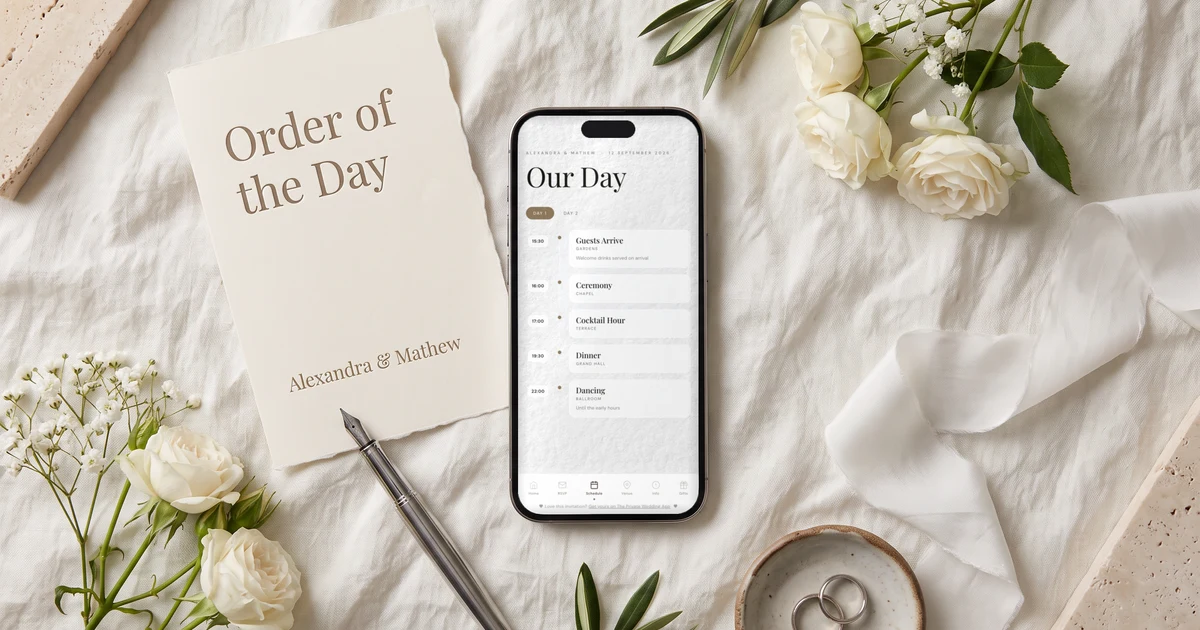
The order of service is the ceremony programme: the entrance, hymns or music, readings, vows, signing of the register and exit, in order with names. The order of the day is the timeline of the whole wedding: ceremony, drinks reception, wedding breakfast, speeches, cake, first dance and carriages, each with a time. Print the order of service if you like; keep the order of the day live on a digital schedule, like the one built into The Private Wedding App's invitation, so guests always see current timings. The whole platform is $19.99/month, or $189 paid once with nothing to renew.
Two documents organise a wedding day and they are constantly confused. The order of service is the ceremony programme: who enters, what is sung, who reads, in what order. The order of the day is the timeline of the whole celebration: ceremony at one, drinks at two, wedding breakfast at four, first dance at eight, carriages at midnight. This guide gives you a full worked example of each, for church and civil ceremonies, plus the timing rules planners use. It also solves the problem paper cannot: timings change, and a printed card does not update. In The Private Wedding App the order of the day lives on your invitation as a schedule page every guest carries on their phone, updates the moment you edit it, spans multiple days for weekend weddings, and translates for bilingual guest lists.
Order of service: the ceremony programme
The order of service covers the ceremony only, and its content depends on the type of ceremony. A church wedding has the fullest version: entrance music, hymns with their numbers or full words, readings with the reader's name, the marriage itself, the signing of the register with its music, and the exit. A civil ceremony version is shorter: entrance, welcome, readings, vows and rings, signing, exit.
Guests genuinely use it: it tells them when to stand, what to sing and who is speaking. If you print one thing for the ceremony, print this, or display it at the entrance. Keep it to one card.
Name every participant. Readers, musicians, the person walking you in: being named in the order of service is part of how you thank them.
Order of the day: the full timeline
The order of the day is what every guest actually wants: when things happen and where to be. A classic single-day English wedding runs roughly like this, and the exact times matter less than the gaps between them.
See the featureEvery feature of the plannerThe timing rules planners actually use
Three rules keep an order of the day realistic. First, the drinks reception needs at least ninety minutes if you want couple portraits and group photos without abandoning your guests; two hours if the photo list is long. Second, the wedding breakfast takes two hours for a three-course served meal, longer for more courses, and speeches go before or after the meal, not scattered inside it, so the kitchen can time service. Third, put a thirty-minute buffer before any fixed point such as the band's start time or the caterer's evening food slot, because the day always drifts and the buffer is where the drift goes.
Announce the carriages time. Guests plan taxis and babysitters around it, and venues enforce it. 'Carriages at midnight' on the schedule saves twenty individual questions.
For multi-day celebrations, a welcome dinner the night before or a farewell brunch the morning after, the order of the day becomes an order of the weekend. Structure each day the same way, and label the days clearly.
Why the order of the day belongs on a phone, not just on paper
The order of service can be printed, because ceremonies rarely change at the last minute. The order of the day is different: the band arrives late, rain moves the drinks indoors an hour early, the kitchen needs fifteen more minutes. A printed timeline is a snapshot of a plan that stopped being true on the morning of the wedding.
In The Private Wedding App, the order of the day is a schedule page on your invitation. Every guest already has the link, so every guest carries the current timeline: edit a time in the builder and every phone shows the change. Weekend weddings get day tabs, so the welcome dinner, the wedding day and the farewell brunch each have their own schedule. For bilingual weddings the schedule translates, so both families read the day in their own language.
Because it is one planning platform, the schedule is not an island. It sits next to the venue page with directions, the RSVP that feeds your guest list and meal counts, the seating plan built from confirmed guests, and your checklist and budget behind the scenes. The order of the day is simply the guest-facing surface of a plan the platform already manages.
- Build the ceremony order of service; print it if you like
- Put the order of the day on your invitation's schedule page
- Add day tabs for multi-day celebrations
- State the carriages time
- Edit times in the builder when plans change; guests see it live
Everything you need, in one place
Planning your own wedding without a planner is entirely achievable.
See it for yourself.
Explore the whole platform: cinematic invitation, RSVP with meals and allergies, guest list, seating chart, budget, vendors, checklist, moodboard, photo sharing and the AI planner. No account needed.
Try the full planner →What is the difference between the order of service and the order of the day?
The order of service is the ceremony programme: entrance, hymns or music, readings, vows, signing and exit, with names. The order of the day is the timeline of the whole celebration, from guest arrival to carriages, with a time for each moment.
What goes in a wedding order of service?
For a church wedding: processional music, welcome, hymns, readings with readers' names, the vows and rings, the signing of the register with its music, and the recessional. For a civil ceremony: entrance, welcome, readings, vows, rings, signing and exit. Name every participant.
What is a typical wedding order of the day?
Guests arrive 12:30, ceremony 13:00, drinks reception from 13:45, wedding breakfast 16:00, speeches 18:00, evening guests and cake 19:00, first dance 20:00, evening food 21:30, carriages at midnight. Adjust the times, keep the gaps: ninety minutes minimum for the drinks reception and two hours for a served meal.
Do I need to print the order of the day for guests?
You can display one sign at the venue, but a printed timeline goes stale the moment timings shift. A digital schedule on your invitation, like the schedule page in The Private Wedding App, stays current on every guest's phone and handles multi-day weddings with day tabs.
What time should a UK wedding ceremony start?
Most single-day weddings hold the ceremony between 12:30 and 14:00. That leaves room for a full drinks reception, a 16:00 wedding breakfast, speeches, and an evening reception from 19:00 without the day feeling rushed.
What does carriages mean on a wedding invitation?
Carriages is the traditional way of stating the time the celebration ends and guests are expected to leave, usually midnight. Stating it helps guests book taxis and lets the venue enforce its licence.