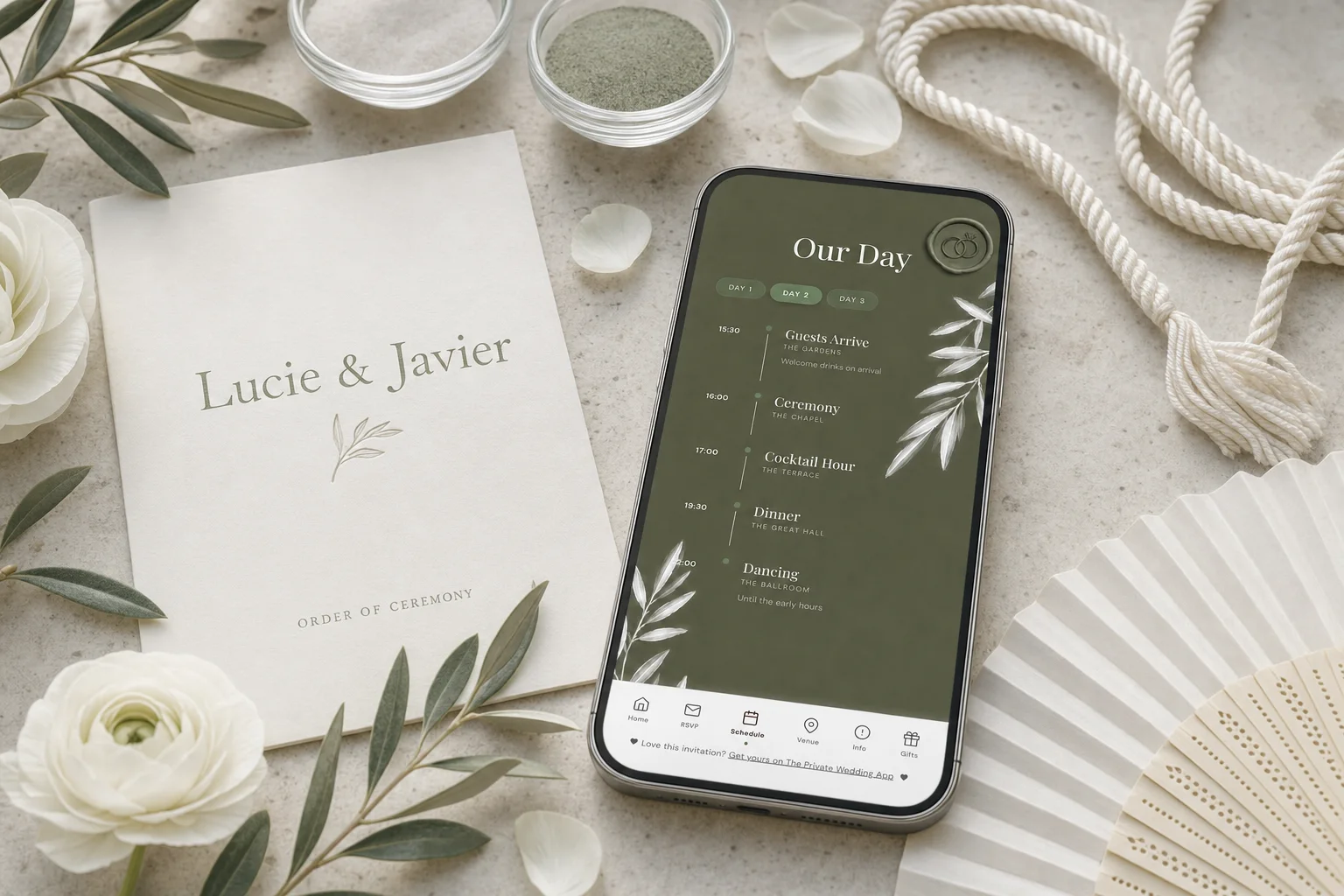
A symbolic wedding ceremony (also called a humanist, celebrant-led or non religious ceremony) usually lasts 20 to 40 minutes and follows this order: 1. processional, 2. welcome by the celebrant, 3. your story as a couple, 4. a first reading, 5. a ritual such as handfasting, sand blending or a wine box, 6. the vows, 7. the ring exchange, 8. the declaration and first kiss, 9. a closing reading or music, 10. the recessional. In most places a symbolic ceremony has no legal effect on its own, so the legal paperwork is signed separately at a registry office, town hall or courthouse. Anyone you choose can lead it: a professional celebrant, a humanist celebrant or a close friend. Ask guests to arrive 20 to 30 minutes before the start time, and put the ceremony time, place and dress code on your invitation's schedule. The whole platform is $19.99/month, or $189 paid once with nothing to renew.
A symbolic ceremony is the part of the wedding you write yourselves. There is no fixed liturgy and no legal script to follow, which is exactly why couples choose it, and exactly why the first question is always the same: so what actually happens, in what order, and for how long? Whether you call it a symbolic, humanist, celebrant-led or non religious ceremony, and whether it takes place in a garden at home or on a terrace in Italy, Greece or Bali, the structure that works is remarkably consistent. This guide gives you the ten-step order with timings, script lines the celebrant can use, the rituals couples choose and how long each takes, who speaks when, and the guest timeline that belongs on your invitation so everyone is seated before the music starts.
Symbolic ceremony vs civil ceremony
A civil ceremony is the legal marriage: an official conducts it, the wording includes required legal declarations, and in many countries it must take place in an approved building at set times. A symbolic ceremony is the celebration of the marriage: you choose who leads it, where it happens, how long it lasts and every word that is said.
Many couples have both. They sign the legal paperwork at the registry office, town hall or courthouse on a weekday with two witnesses, then hold the symbolic ceremony on the wedding day in front of everyone. This is also the usual route for a symbolic wedding ceremony abroad: the legal formalities of marrying in Italy, Greece or Bali as foreigners are heavy, so couples marry legally at home and hold the ceremony at the destination.
Rules differ by country. In some places, Scotland and Ireland for example, a humanist celebrant can conduct a legally recognised marriage, and in most US states a friend who is ordained and signs the marriage license makes the ceremony legal. If yours is purely symbolic, check the legal steps where you live and book them first.
The order of a symbolic wedding ceremony, step by step
This is the order most celebrants use, with realistic timings. The total lands around 30 minutes; add or cut readings and rituals to move it between 20 and 40. Outdoors, guests start to fidget after about 40 minutes, so treat 40 as a ceiling, not a target.
Symbolic ceremony script ideas: what the celebrant says
The celebrant carries the ceremony. Their script is mostly your story, written from an interview or a questionnaire a few weeks before the wedding. These lines give the structure; replace every detail with your own.
Welcome: "Good afternoon, and welcome. My name is Claire, and I have the joy of marrying Nina and Tom today. Thank you for being here; every one of you has been part of their story, and that is why you were asked to witness this moment."
Story: "Nina and Tom met on a delayed train from Leeds, which tells you two things: they are patient, and they make the most of a bad timetable." Keep it warm, specific and short. One good anecdote beats a full biography.
Before the vows: "Marriage is a promise made in public, so that the people who love you can hold you to it. Nina, Tom, please face each other." Declaration: "Nina and Tom, you have made your promises in front of the people who matter most to you. It is my great pleasure to declare you married. You may kiss."
Personal vows: aim for 60 to 90 seconds each, agree on the length together, and write them on a card rather than a phone. A simple structure works: something you love about the other person, a promise for the serious days, a promise for the ordinary ones.
- Celebrant: welcome, story, transitions, declaration
- Two or three readers: one reading each, named in the programme
- A parent or close friend for the ritual or a blessing, if you wish
- The couple: vows and rings
- A musician or playlist for the processional, ritual and recessional
Rituals for a symbolic ceremony
A ritual gives the ceremony a visible moment that guests remember and photographers love. One is plenty; two is the maximum before the ceremony starts to drag. Choose one that fits your setting and your story.
The guest timeline, and how to put it on your invitation
Guests do not need the ceremony order; they need the day's timeline. Ask them to arrive 20 to 30 minutes before the start time, so they are seated when the processional music begins. A typical afternoon runs like this:
If the legal ceremony is on a different day, for example the town hall on Friday and the symbolic ceremony on Saturday, show both days on the schedule with their real dates, so guests do not turn up to the wrong one.
How The Private Wedding App handles the ceremony and the day around it
The Private Wedding App is an all-in-one wedding planning platform: the invitation with its schedule, venue maps and info pages, the guest list and RSVP, meal choices with dietary and allergy tracking, the seating plan, budget, vendors and checklist, in one place.
On the schedule you add each moment with its time, place and description, "Symbolic ceremony, 16:00, Ceremony garden", and guests read the timeline on their phone. Edit a time and every guest sees the current version. A wedding over two or more days gets a tab per day with its real date, so the Friday town hall and the Saturday ceremony are never confused. Each venue card carries the address and map, and can carry a shuttle note for guests coming from the hotel.
If only some guests attend the ceremony, add a Ceremony event and a Reception event in the RSVP tab, so each guest answers yes or no per event. On the Guests page, create invite groups with their own link: for each group you choose which events and which schedule moments it sees, so reception guests never see the ceremony on their schedule. The Guests page keeps a running total of attending, pending and declined per event, which tells you exactly how many chairs to set out in the garden.
For a symbolic ceremony abroad, the invitation can run in up to three languages on one link: each guest picks their language once when they open it, and the buttons, menus and RSVP labels translate automatically.
Open the live demo invitation to see a schedule as guests see it, then start your own wedding planner: the full planner, at the price of a streaming subscription. For the ceremony programme itself, see our guide to the order of service and order of the day.
- Book the legal ceremony first if your symbolic ceremony has no legal effect
- Add the symbolic ceremony to your schedule with time, place and description
- Add a tab per day if the legal and symbolic ceremonies are on different days
- Add Ceremony and Reception events if not every guest attends both
- Give each invite group its own link with only its events and moments
- Ask guests to arrive 20 to 30 minutes early, in the schedule itself
Everything you need, in one place
Planning your own wedding without a planner is entirely achievable.
See it for yourself.
Explore the whole platform: cinematic invitation, RSVP with meals and allergies, guest list, seating chart, budget, vendors, checklist, moodboard, photo sharing and the AI planner. No account needed.
Try the full planner →What is the order of a symbolic wedding ceremony?
The usual order is: processional, welcome by the celebrant, your story as a couple, a first reading, a ritual such as handfasting or a sand ceremony, the vows, the ring exchange, the declaration and first kiss, a closing reading or music, and the recessional. The same order works for a humanist, celebrant-led or non religious ceremony.
How long is a symbolic wedding ceremony?
Usually 20 to 40 minutes, with 30 minutes the most common. The couple's story and the personal vows take the most time. Keep it under 40 minutes, especially outdoors, and ask guests to arrive 20 to 30 minutes before the start.
Is a symbolic wedding ceremony legal?
In most places, no: it celebrates the marriage but does not create it, so you sign the legal paperwork separately at a registry office, town hall or courthouse, often a day or a few days before. Some countries let a humanist celebrant conduct a legal marriage, Scotland and Ireland for example, and in most US states an ordained officiant who signs your marriage license makes the ceremony legal. Check the rules where you marry.
Who can officiate a symbolic wedding?
Anyone you choose. Many couples hire a professional or humanist celebrant who writes the script from your story; others ask a close friend or relative. Choose someone who speaks well in public and give them time to prepare: a celebrant usually meets you a few weeks before to collect your story.
What is the difference between a symbolic ceremony and a civil ceremony?
A civil ceremony is the legal marriage, led by an official with required legal wording, often in an approved building. A symbolic ceremony has no legal effect on its own in most places, but you choose who leads it, where it takes place and every word, including your story, readings, rituals and personal vows.
What are good symbolic wedding ceremony ideas?
The most popular rituals are handfasting, a sand ceremony, a wine box with love letters, a unity candle for indoor ceremonies, ring warming for smaller groups and planting a tree. Add a reading by a friend or relative, personal vows, and a few words remembering loved ones who cannot be there. One ritual is plenty.
What should a symbolic wedding ceremony script include?
A welcome and thanks to guests, your story as a couple, introductions for each reading and ritual, a short line before the vows, the vows and ring promises, and the declaration: "It is my great pleasure to declare you married." Your celebrant writes most of it from a questionnaire or interview a few weeks before the wedding.