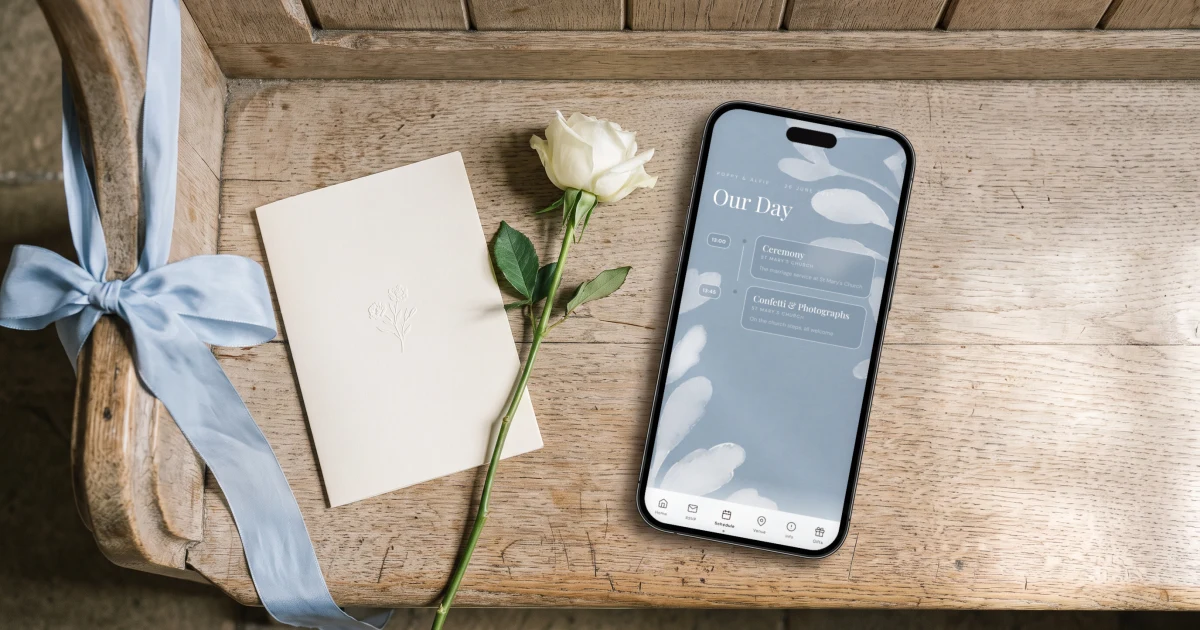
Yes, it is acceptable and not rude to invite some guests to the wedding ceremony only or to the reception only: it is standard practice in many countries, and it stays kind when guests never discover the split by accident. Three etiquette rules make it work: each group's invitation must read as a complete invitation to a complete event (never write 'ceremony only'), guests should never see the events they are not invited to, and every group RSVPs only for what they are invited to. The Private Wedding App, an all-in-one wedding planning platform, does this with one invitation and one link per guest group: each link shows only that group's events, schedule moments and info sections, the meal question is asked only for events with a seated meal, and the WhatsApp button sends every guest their own group's link. All replies land in one guest list with a running total for each event, and private access lets only the emails and phone numbers on your list open the invitation. It costs $19.99 a month or $189 once. 3-day free trial.
Almost every couple hits this question: the venue holds 80 for dinner but you want 150 at the ceremony - or the opposite, an intimate ceremony with just family, then a big party for everyone. Both are completely legitimate, and in many cultures splitting the guest list is simply how weddings work: evening-only receptions are standard in the UK, and in much of Europe the ceremony is open while the dinner is close family. The etiquette problem is not the split itself. It is how guests find out. This guide covers when a two-tier guest list makes sense, the three rules that keep it kind, exact invitation wording for each group, and how to collect RSVPs so that nobody ever sees an event they were not invited to.
Is it rude? No - if you follow three rules
Splitting your guest list is not rude, and pretending otherwise ignores how most of the world gets married. British weddings routinely have 'day guests' and 'evening guests'. French and Spanish weddings often hold an open ceremony and a family-only dinner. American couples increasingly do an intimate ceremony and a bigger reception - or invite colleagues to the party but not the vows.
What actually offends people is never the tier - it is discovering the tier by accident: an invitation that says 'ceremony only' in so many words, a wedding website listing a dinner they are not part of, or a group chat where the two circles compare invitations.
Three rules prevent all of it. One: each invitation reads as a complete, warm invitation to a complete event - what a guest is invited to is the wedding, as far as their invitation is concerned. Two: guests never see the events they are not invited to - no shared schedule listing everything. Three: everyone RSVPs for exactly what they are invited to, so your headcounts stay clean per event.
The wording for each group
Never write what a guest is excluded from - write what they are invited to, fully and warmly. Here is wording that works for the common splits:
See the featureMulti-event RSVPThe mechanics: one invitation link per group
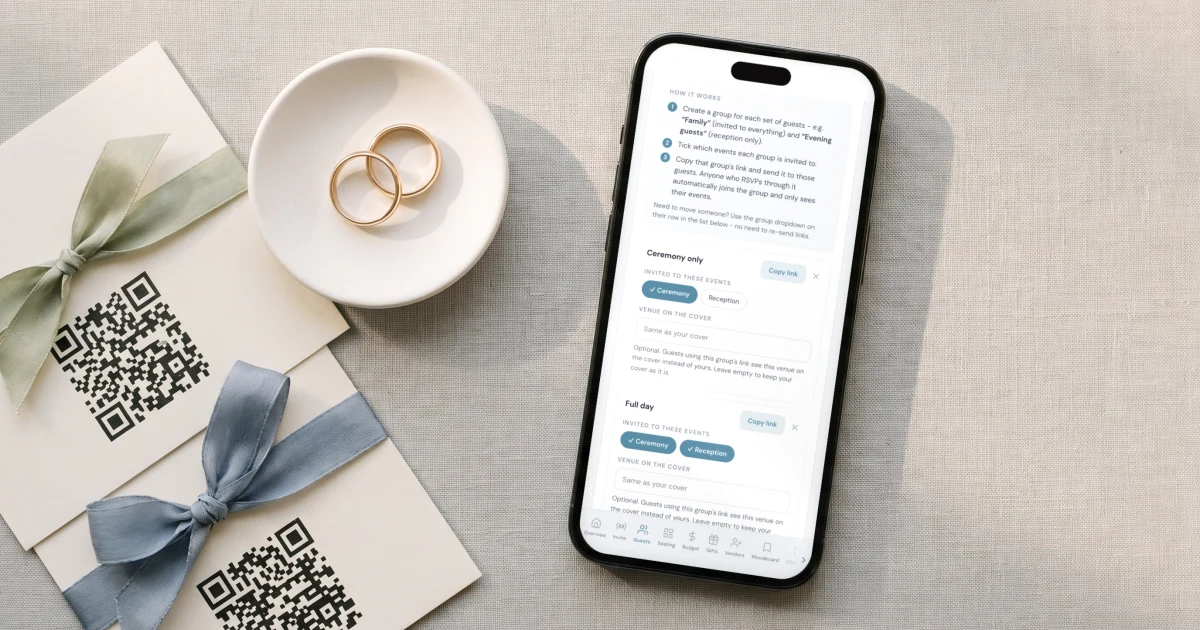
Paper makes two-tier lists painful - you print two different cards and pray nobody photographs theirs into the group chat. Digital makes it clean, if the platform supports groups. On The Private Wedding App you create a guest group per tier, and each group gets its own invitation link showing only its events: full-day guests see the ceremony, dinner and party; ceremony guests see the ceremony and the toast; evening guests see the party. No shared page ever lists an event a guest is not part of.
Each group RSVPs for exactly its own events, and everything lands in one combined guest list - with per-event headcounts, so you know the ceremony is 150 and the dinner is 80 without maintaining two spreadsheets. Meal choices and allergies are only asked of the guests who are actually eating.
Each group's link is tailored beyond the RSVP. On every invite group you choose which schedule moments appear (an evening group's schedule starts at the party, as covered in our guide to evening wedding invitations), which info sections it sees (no dinner menu or daytime transport for evening guests), and an optional venue line on the cover for that group only. Each RSVP event has its own "ask the meal choice" switch, so a guest who says yes only to a party without a seated meal skips the meal question. The WhatsApp button on each guest row automatically sends that guest their own group's link, so nobody receives the full-day version by mistake. With private access switched on, only the emails and phone numbers on your guest list can open the invitation, so a link passed around a group chat shows nothing to people you did not invite. And to keep households together, give each main guest their seats (for example 1 adult and 2 children): they read "You can bring: 1 adult, 2 children." on the RSVP, type each name and cannot add more, and the guest list shows adults, children and infants separately for each event.
If your wedding spans multiple days - welcome dinner, ceremony, brunch - the same per-group, per-event model scales up: we covered that fully in our guide to wedding RSVPs for multiple events.
Handling the awkward moments before they happen
A few situations come up in almost every two-tier wedding, and each has a graceful answer prepared in advance.
- Someone asks why they are not at the dinner: 'The venue only seats 80, so dinner is immediate family - we so wanted you at the ceremony / party.' Venue capacity is the reason nobody argues with.
- Couples and households: never split them across tiers. Both partners get the same invitation.
- The two circles talk to each other: they will - which is why each invitation must be complete and warm on its own, with nothing to compare resentfully.
- Chasing RSVPs: dinner guests first - only they affect the caterer's headcount. Ceremony-only and evening-only guests can slide a few days.
- Photos and group chat: share the wedding photo gallery with everyone afterwards - inclusion after the day costs nothing and means a lot.
Everything you need, in one place
Planning your own wedding without a planner is entirely achievable.
See it for yourself.
Explore the whole platform: cinematic invitation, RSVP with meals and allergies, guest list, seating chart, budget, vendors, checklist, moodboard, photo sharing and the AI planner. No account needed.
Try the full planner →Is it rude to invite guests to the wedding ceremony only?
No - it is standard practice in many countries. In much of Europe the ceremony is open while the dinner is close family, and UK weddings routinely split day and evening guests. It becomes rude only when guests can see what they were excluded from. Make each invitation read as a complete invitation to a complete event, never write 'ceremony only', and never show any guest an event they are not invited to.
Can I invite some guests to the reception only and not the ceremony?
Yes - the intimate-ceremony, big-party model is increasingly common, and evening-only invitations are the norm in the UK. Word it as its own celebration: 'We're getting married! Join us to celebrate from 8pm - drinks, dancing and cake.' Do not describe it as what comes 'after' something they were not at.
How do I word a ceremony-only wedding invitation?
Invite them fully to what they are invited to: 'We would be honoured by your presence as we exchange vows, Saturday June 12 at 3pm, followed by a toast.' Never use the phrase 'ceremony only' and never mention the dinner. If asked later, venue capacity ('dinner is just immediate family - the venue seats 80') is the explanation nobody argues with.
How do I collect RSVPs when different guests are invited to different events?
Give each guest group its own invitation link that shows only its events, with RSVP per event. On The Private Wedding App, full-day guests, ceremony-only guests and evening-only guests each see their own version of the invitation, answer for their own events, and every response lands in one combined guest list with separate headcounts per event.
Do ceremony-only guests need to answer meal questions?
No - meal choices and allergy questions belong only to guests attending the dinner. A per-event RSVP asks the meal questions of dinner guests and gives ceremony-only guests a simple attending/not-attending answer, which also keeps your caterer's list clean.
Should evening-only wedding guests get a save-the-date?
Usually not necessary - evening guests are not planning travel or full days off. Send their invitation at the same time as everyone else's (6-8 weeks before a local wedding) with its own RSVP, so your party headcount lands with the rest. For destination weddings, treat anyone who must travel as a full-timeline guest regardless of tier.
Is it rude to invite people to the reception but not the ceremony?
No. An intimate ceremony with close family followed by a bigger reception is common, and many guests never expect to attend the vows. Keep it kind by inviting them to the reception as its own celebration, by name and with its own start time, and by never showing them the ceremony details. On The Private Wedding App the reception group gets its own invitation link whose schedule starts at the reception, so the ceremony never appears on their invitation.
How do I stop ceremony-only or evening-only guests from seeing the other events on our wedding website?
Use one link per guest group instead of one shared page. On The Private Wedding App each invite group's link shows only the events, schedule moments and info sections you tick for that group, and the WhatsApp button sends every guest their own group's link. Switch on private access as well, and only the emails and phone numbers on your guest list can open the invitation, so a forwarded link reveals nothing to people you did not invite.
How do I count ceremony and reception guests separately?
Turn on RSVP per event so each guest answers for each event they are invited to. The Private Wedding App then shows a running total for each event (attending, pending, declined, counting only the guests invited to it), and clicking an event switches the whole guest list to that event. If you switch on children and infants, the totals show adults, children and infants separately, and the caterer day sheet leaves infants out of the plate count.