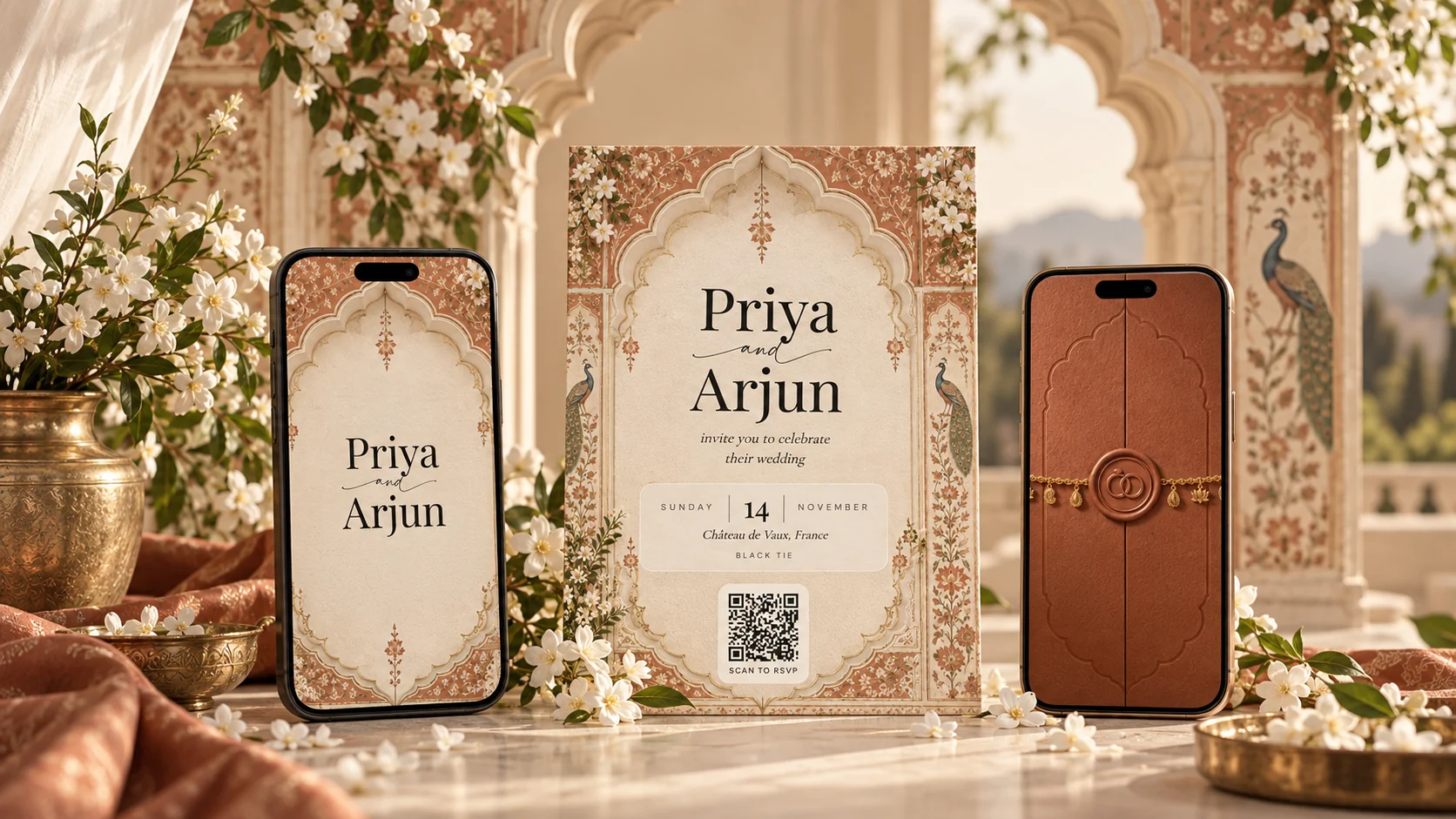
A mandap ceremony is the Hindu wedding rite held under a mandap, a canopy usually raised on four pillars around a sacred fire (agni), where the couple, the priest and close family sit. The usual North Indian order is Ganesh puja, jaimala (exchange of garlands), kanyadaan, the knot tying (gathbandhan), the pheras around the fire and the saptapadi (seven steps), then sindoor and mangalsutra and the elders' blessings (aashirvad); Tamil and other South Indian ceremonies centre on tying the thali at the muhurtham, the auspicious time. The rite itself usually takes 1 to 3 hours. Because the mandap is one of several functions, give each one (haldi, mehndi, sangeet, ceremony, reception) its own event with its own RSVP and its own group link in The Private Wedding App, with an Info section explaining each ritual to guests in English and Hindi or Tamil, for $19.99/month or $189 once for lifetime access. 3-day free trial.
The mandap is the heart of a Hindu wedding, and for many guests it is also the part they understand least. They see a decorated canopy, a fire, a priest chanting in Sanskrit and a ceremony that can run for hours, and they are not sure when to sit, when to stand, whether they can talk, or whether they have missed the important bit. This guide explains what the mandap is, who sits where, every ritual in the order it usually happens, how the order changes between North Indian, Gujarati and Tamil weddings, how long it all takes, and the short etiquette brief couples send to friends who have never been to one. Families differ, and the priest (pandit or purohit) always has the final word on your own ceremony, so treat this as the map, not the rulebook.
What a mandap is, and who sits where
A mandap (also written mandapam in South India) is a raised, covered platform built for the ceremony. Most have four pillars and a canopy, decorated with flowers, fabric and often marigolds and mango leaves, with a small fire pit (havan kund) at the centre. A common explanation for the four pillars is that they stand for the four parents who raised the couple, though families and priests give other readings too.
Inside the mandap sit only the people who take part in the rituals: the couple, the priest, and at specific moments the bride's parents (for the kanyadaan) and other close relatives. Guests sit facing the mandap. In many North Indian ceremonies the groom is seated first and the bride is escorted in afterwards, often by her maternal uncles or brothers. Many families seat the bride on the groom's right until the pheras and on his left afterwards, as a sign that she is now his partner in every rite (vamangi), but this varies by community, so ask your priest how your families do it.
Shoes come off before stepping onto the mandap. That is why the groom's shoes are left unattended at some point, and why, in many North Indian weddings, the bride's sisters and cousins steal them and bargain for their return (joota chupai). Guests seated outside the mandap usually keep their shoes on unless the ceremony is held in a temple.
In the app: put the ceremony on the schedule with its time, venue and dress code, and give the mandap its own Info section, so guests open one link instead of asking you. See the Indian wedding invitation.
The rituals in order
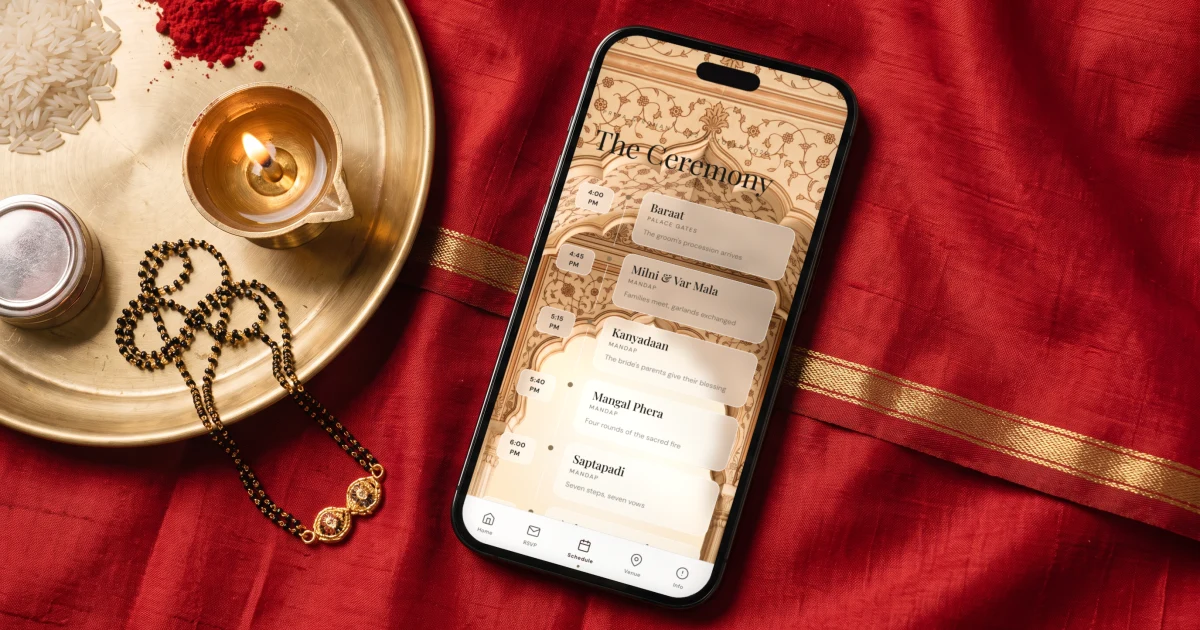
The sequence below is the common North Indian order. Not every family includes every step, some combine two, and the priest decides the exact flow. What does not change much is the arc: invoke blessings, give and receive, bind the couple, walk the vows around the fire, mark the marriage, bless the couple.
In the app: copy your own order into an Info section called 'Our ceremony, explained', one line per ritual, and guests can follow it on their phone while it happens.
North Indian, Gujarati and Tamil: how the order changes
North Indian (Punjabi Hindu, UP, Delhi, Rajasthan): usually evening or night, following the baraat. The pheras are typically seven, and sindoor and mangalsutra follow them. The ceremony is often timed to a muhurat (auspicious time) set by the priest, which can fall late at night.
Gujarati: the bride's arrival (kanya aagman) is often carried out by her maternal uncles, the hasta milap joins the couple's hands, and the mangal fera is commonly four rounds, read as dharma, artha, kama and moksha, the four aims of life, before the saptapadi. Many Gujarati families also play a game with the groom's nose (ponkhvu) when the bride's mother welcomes him.
Tamil and other South Indian ceremonies: usually in the morning, sometimes very early, because the muhurtham, the auspicious window, is fixed by the family astrologer. The central moment is the tying of the thali (mangalya dharanam), timed to the muhurtham and marked by a burst of drums and nadaswaram. Rituals before it can include the kashi yatra (the groom's mock departure for a life of study, until the bride's father persuades him to marry), maalai maatral (the garlands exchanged several times) and the oonjal (the couple on a swing). Sindoor is not part of every South Indian ceremony.
Bengali, Marathi, Telugu, Malayali and many other communities have their own sequences and names. If both families come from different traditions, agree early which rituals the ceremony will include and in which order, because that order is what you will print and explain to guests.
In the app: if your ceremony mixes two traditions, write the order once in the schedule and let each guest read it in English or in Hindi or Tamil, the language they pick when they open the bilingual invitation.

How long a mandap ceremony lasts
The rite itself usually takes between one and three hours. A streamlined ceremony for a mixed guest list, with the priest explaining each step in English, can be closer to an hour; a full traditional ceremony with every ritual and long Sanskrit recitations runs longer. Then come the meal and, in North Indian weddings, the vidaai, the bride's farewell to her family.
Two things make the timing harder than a Western ceremony. The muhurat may fix the key moment at a precise time, so the start is set backwards from it. And the baraat almost always runs longer than planned. Tell guests the time to be seated, not the time the baraat leaves.
Guests do not need to sit in silence for three hours. At most Hindu weddings it is normal for guests to talk quietly, step out, greet relatives and come back for the key moments, usually the jaimala, the pheras and the sindoor. Non-Indian guests rarely know this, so say it on the invitation.
In the app: put each moment on the schedule with its own time (baraat, jaimala, pheras, lunch or dinner), and use the day tabs for a multi-day wedding, so guests know exactly when to be seated. See the full Indian wedding checklist for the functions around it.
Guest etiquette: shoes, clothes, phones and gifts
This is the short brief to give guests who have not been to a Hindu wedding. Adjust it to your families, and say it kindly: guests who are told in advance feel welcome, guests who find out on the day feel lost.
In the app: give each function its own dress code on the schedule, and collect meal choices such as vegetarian and Jain with the RSVP, counted per event in the meal and allergy tracker.
- Shoes: only those who step onto the mandap remove them; at a temple everyone does, so wear shoes that slip off easily
- Clothes: bright colours are welcome; many families avoid all-white and all-black, and red is often left to the bride
- Shoulders and knees: covered is the safe choice, especially for a temple ceremony; a light scarf or dupatta helps
- Arrival: be seated before the time on the schedule, then it is fine to come and go quietly during the long parts
- Phones: put them on silent and keep the aisle and the mandap steps clear for the photographer; follow the couple's wish if they ask for an unplugged ceremony
- Food: the wedding meal is often vegetarian, and alcohol may not be served at the ceremony
- Gifts: cash in an envelope is common, often an amount ending in 1, such as 101 or 501, as a sign of continuity
How to brief guests who have never been to one
The couples whose guests enjoy the ceremony most do one thing: they explain it before the day, in a format guests actually read. A long WhatsApp message gets lost in the chat. A printed programme arrives too late to plan clothes or travel. What works is a page guests open on their phone when they need it.
Write one Info section called 'Our ceremony, explained' with a line per ritual, in the order of your ceremony. Add a second called 'What to wear', with the dress code per function. Add a third for food, including what is vegetarian and what is Jain. Then guests can scroll back to it during the ceremony itself.
The Private Wedding App was built for exactly this shape of wedding. Each function, haldi, mehndi, sangeet, ceremony, reception, is its own event with its own date, time, venue, dress code and RSVP. Guests are invited in groups, and each group gets its own link that shows only the events they are invited to, so a colleague invited to the reception never sees the haldi. Meal choices can include vegetarian and Jain, counted per event for each caterer. The invitation can be in up to three languages, for example English plus Hindi or Tamil: each guest picks one when they open it, and the AI translation fills the second language in one click. The Jaipur Peacock and Sheesh Mahal themes were designed for Indian weddings.
Next step: open the live demo below, then start your invitation for $19.99/month or $189 once for lifetime access. 3-day free trial.
Everything you need, in one place
Planning your own wedding without a planner is entirely achievable.
See it for yourself.
Explore the whole platform: cinematic invitation, RSVP with meals and allergies, guest list, seating chart, budget, vendors, checklist, moodboard, photo sharing and the AI planner. No account needed.
Try the full planner →What is a mandap in a Hindu wedding?
A mandap is the covered platform where the Hindu wedding ceremony takes place, usually with four pillars, a decorated canopy and a sacred fire at the centre. The couple, the priest and close family sit inside it; guests sit facing it.
What is the order of rituals in a Hindu wedding ceremony?
A common North Indian order is Ganesh puja, jaimala (garlands), kanyadaan, gathbandhan (tying the knot), the pheras around the fire, the saptapadi (seven steps), sindoor and mangalsutra, then aashirvad (blessings). Gujarati ceremonies often have four mangal feras before the saptapadi, and Tamil ceremonies centre on tying the thali at the muhurtham. Your priest sets the exact order.
How long does a mandap ceremony last?
Usually one to three hours for the rite itself. A shorter ceremony with English explanations can be about an hour; a full traditional one runs longer. The baraat before it and the meal after it add to the day.
What is the difference between the pheras and the saptapadi?
The pheras are the rounds the couple walk around the sacred fire; the saptapadi is the seven steps taken together, each with a vow. Some traditions perform them as one ritual, others separately. Under Section 7 of the Hindu Marriage Act, 1955, where the rites include the saptapadi, the marriage is complete when the seventh step is taken.
What should a non-Indian guest wear to a Hindu wedding?
Bright colours are welcome, and Indian clothes are appreciated but never required. Many families avoid all-white and all-black, and leave red to the bride. Covered shoulders and knees are the safe choice, especially at a temple, and shoes that slip off easily help.
Do guests take their shoes off at a Hindu wedding?
Those who step onto the mandap do. Guests seated outside usually keep their shoes on, unless the ceremony is in a temple, where everyone removes them at the entrance.
Can guests use their phones during the ceremony?
Usually yes for quiet photos from their seat, unless the couple asks for an unplugged ceremony. Keep phones silent and never stand in the aisle or on the mandap steps, where the photographer works.
How do we explain the rituals to guests who have never been to an Indian wedding?
Put the explanation where guests already look: the invitation. In The Private Wedding App you add an Info section with a line per ritual, in the order of your ceremony, and guests read it in English or in Hindi or Tamil, whichever they pick when they open the link. Each function also gets its own event, RSVP and group link. It costs $19.99/month or $189 once for lifetime access.
When does the mandap ceremony take place in a South Indian wedding?
Usually in the morning, sometimes very early, because the muhurtham, the auspicious time for tying the thali, is set by the family's astrologer. Guests should be seated before it, because the thali tying is the moment they came for.