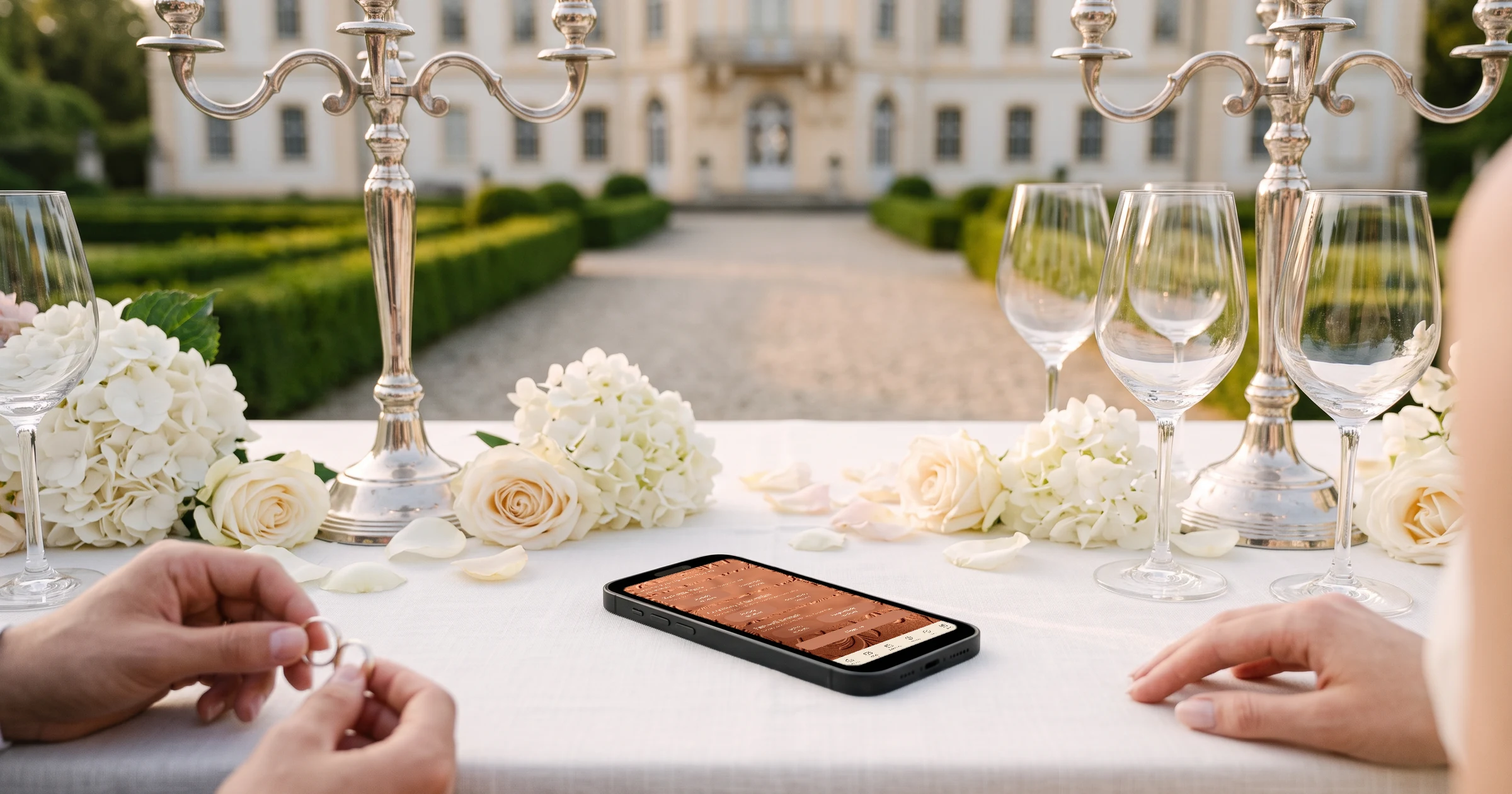
For a wedding with English and German-speaking guests, The Private Wedding App gives you one invitation link where each guest picks English or German, and the buttons, RSVP form and menus switch with them. Guests answer each event separately, such as the Polterabend, the Standesamt, the wedding celebration and the brunch, choose their dinner and flag allergies, and children can be counted separately for the venue. It costs $189 once for lifetime access, or $19.99/month (€189 or €19.99 in the eurozone). 3-day free trial.
One of you is German, the other is not, and your guests come from both countries. Maybe the wedding is in Germany, maybe in Austria or Switzerland, maybe in Dubai where you both live now. The German side expects a Standesamt, possibly a Polterabend the night before, and a long dinner; the English-speaking side may never have heard of either. Some guests come to everything, some only to the civil ceremony, and the venue wants a meal choice for the dinner and a separate count for children. This guide goes through the wedding in order and shows how to run it from one invitation that each guest reads in English or German.
Explain the German parts to the English-speaking side
In Germany and Austria, only the civil ceremony at the Standesamt makes you legally married, and in Switzerland the same is done at the Zivilstandsamt. Many couples hold it a day or a few days before the celebration, with a smaller circle, then have a church or freie Trauung (a celebrant-led ceremony) at the venue. The Polterabend, a relaxed party the night before where guests traditionally smash porcelain for luck, is a German custom your English-speaking friends will love once someone explains it.
Write each part on the schedule with a line about what it is. A German guest does not need to be told what a Polterabend is; a guest from Leeds or Toronto does. The 'Visible in' choice on each schedule moment and info section lets you show an explanation only in English.
The Private Wedding App's schedule runs over several days, with one tab per day, the real date on each tab and a venue card with a map for each place. See the digital wedding invitation.
- Polterabend: what it is, where, from when
- Standesamt or Zivilstandsamt: time, place, who is invited
- Ceremony and celebration at the venue
- Brunch the next day
- A short English note for each German custom
One invitation, English and German on the same link
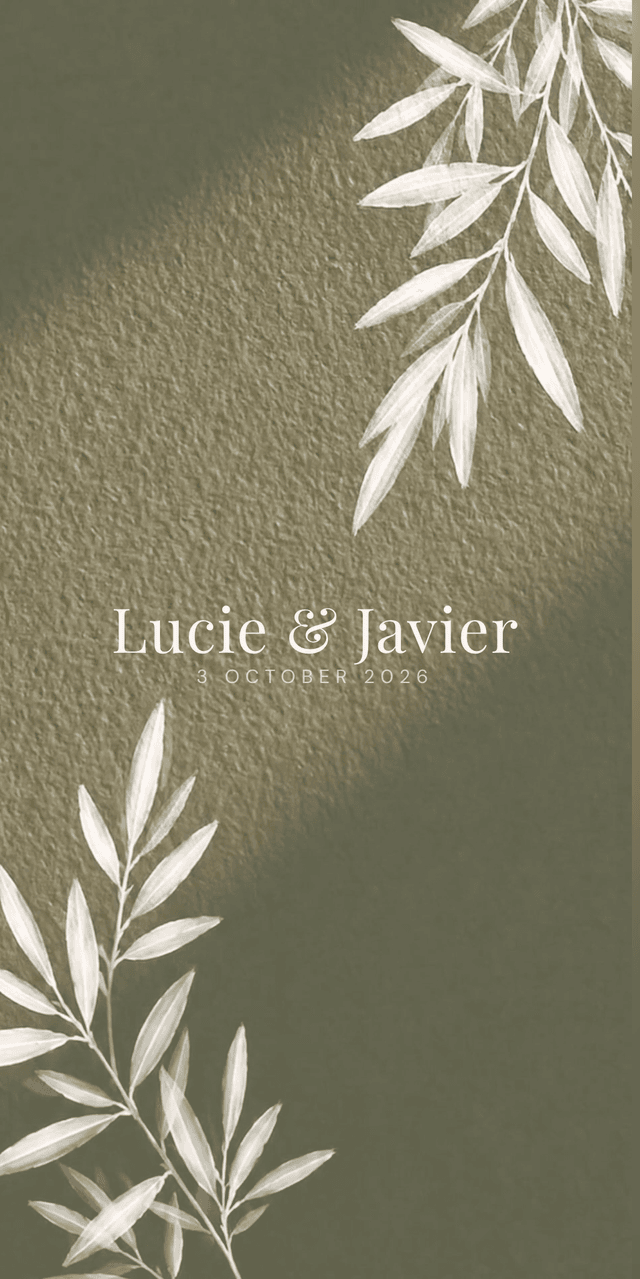
Write the invitation once in your main language and fill the German or English field under each text, or press the AI Translation button to fill the empty fields and then adjust the tone. Decide early whether your German texts say du or Sie: many couples use du for friends and family, but an older relative or a colleague of your parents may expect Sie, and the choice runs through every sentence.
When a guest opens the link, they pick English or German once and the whole invitation follows, including the buttons and the RSVP form. You can send the German family a link with ?lang=de so it opens straight in German. If grandparents from a third country are coming, a third language can be added, from Turkish to Russian to Polish.
Read about the bilingual wedding invitation.
RSVP per event, and groups for the smaller circles
The Standesamt is often only close family and witnesses, the Polterabend may be open to a wider circle of friends and neighbours, and the dinner has the core list. Asking 'are you coming?' once gives you none of those numbers.
Switch on 'This wedding has multiple events', add each event, and guests answer each one. Then create guest groups: the close family group sees all four events, the dinner guests see the celebration and the brunch, and the Polterabend-only friends see that evening alone. Each group's private link shows only its events, its schedule moments and its info, and every answer lands in one guest list with a total per event.
See how multi-event RSVP handles the counts.
Meals, allergies and children, the way venues ask for them
Venues in Germany, Austria and Switzerland usually price per person, with a lower price for children, and want the menu choice and every allergy before the final count. List the dishes in the Meal Options tab in both languages, by course if there is a starter, main and dessert. Dietary notes and a severe-allergy flag sit on the same form.
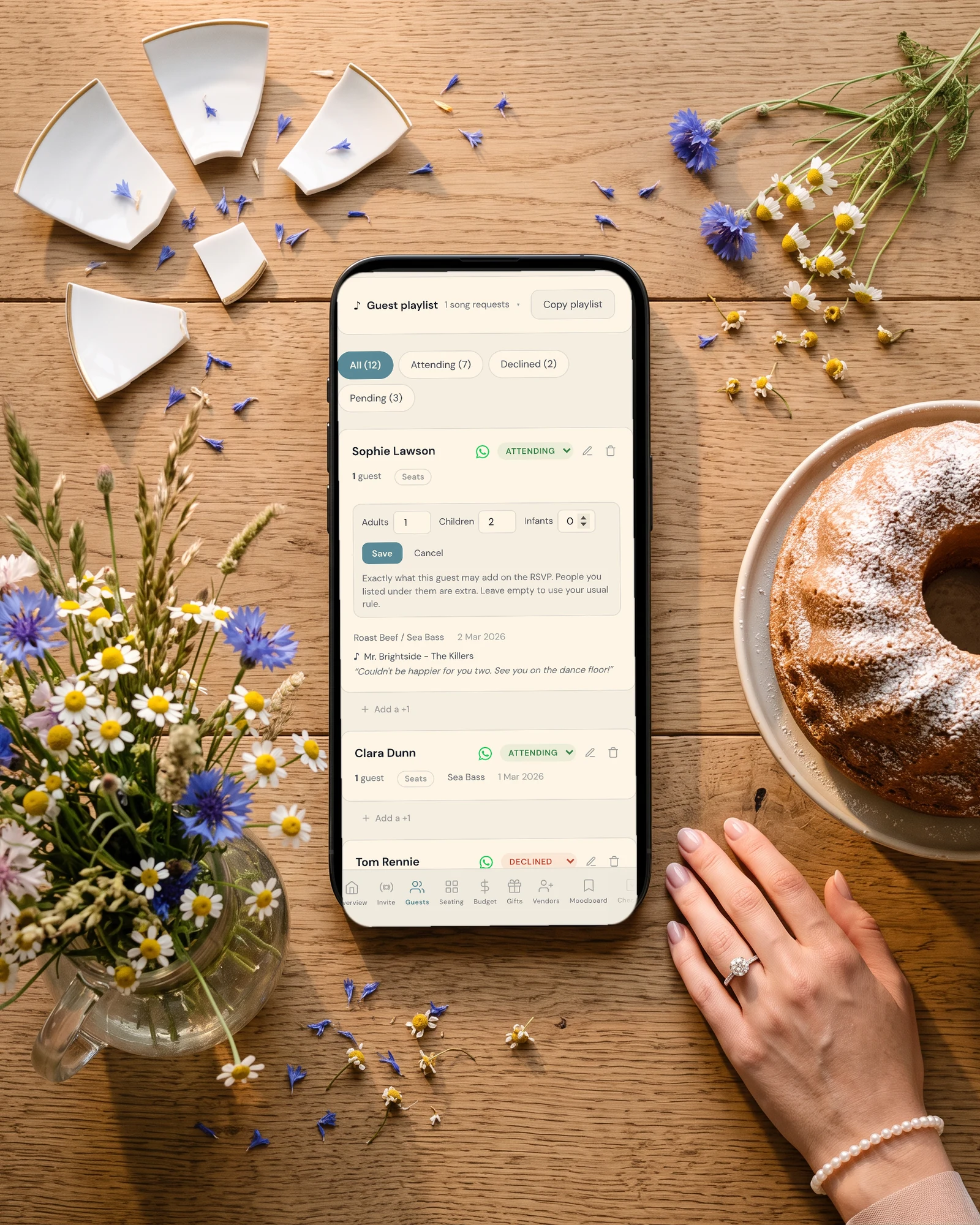
Switch on 'Count children and infants separately' and every person a guest adds is marked adult, child or infant. Infants are not asked for a meal, children can choose a kids' dish, and the Guests page shows adults, children and infants per event. The caterer day sheet carries the same counts to the venue.
More on the meal and allergy tracker.
Germany, Austria, Switzerland or Dubai: the travel side
Wherever the wedding is, half the guests are travelling. Add hotels as venue cards with a booking link, write the trains or airport transfers in an info section, and switch on the flight question if most guests fly. Their flights then appear sorted by arrival day and landing time, and the day sheet turns them into a pickup list.
The budget runs in one display currency of your choice: euros, dirhams, pounds or dollars, or 'Other' for Swiss francs. It does not convert, so pick the currency most of your suppliers bill in.
See guest flight details and the budget tracker.
Seating the dinner so both languages share a table
Seating the German side on the left and the English side on the right is the easy plan and the quiet evening. Mixing tables, with at least one person at each who speaks both languages, works better, and you can only plan it once the dinner replies are in.
With RSVP per event, the seating plan has its own tables for the dinner, and only guests who accepted it appear. Each party is one card you drag to a table, and severe allergies carry their flag onto the plan.
Plan it with the seating chart.
Everything you need, in one place
Planning your own wedding without a planner is entirely achievable.
See it for yourself.
Explore the whole platform: cinematic invitation, RSVP with meals and allergies, guest list, seating chart, budget, vendors, checklist, moodboard, photo sharing and the AI planner. No account needed.
Try the full planner →How do we make a wedding invitation in English and German?
Write it once and fill the second language under each text, or use the AI Translation button and then check the wording. In The Private Wedding App each guest picks English or German when they open the link, and the buttons, menus and RSVP form switch with them.
Should the German text say du or Sie?
Most couples use du for family and friends. If many guests are older relatives or your parents' colleagues, Sie is safer. Pick one and keep it the same in every text.
How do we invite only close family to the Standesamt?
Give close family their own group. In The Private Wedding App a group's private link shows the events that group is invited to, so the Standesamt only appears for them, and everyone else sees the celebration.
Can guests RSVP to the Polterabend separately?
Yes. Add the Polterabend as its own event. Guests answer it separately, and you can switch off the meal question for it if there is no seated dinner.
Can we count children separately for the venue?
Yes. Switch on 'Count children and infants separately' and every person a guest adds is marked adult, child or infant, with totals per event on the Guests page and on the caterer day sheet.
Does it work for a wedding in Switzerland or Dubai?
Yes. The invitation works anywhere, and the budget can run in dirhams, or in Swiss francs through the Other currency option.
How much does The Private Wedding App cost?
$189 once for lifetime access, or $19.99/month; in the eurozone €189 once or €19.99/month. Both plans include the bilingual invitation, RSVP per event, meals, seating and the budget. 3-day free trial.