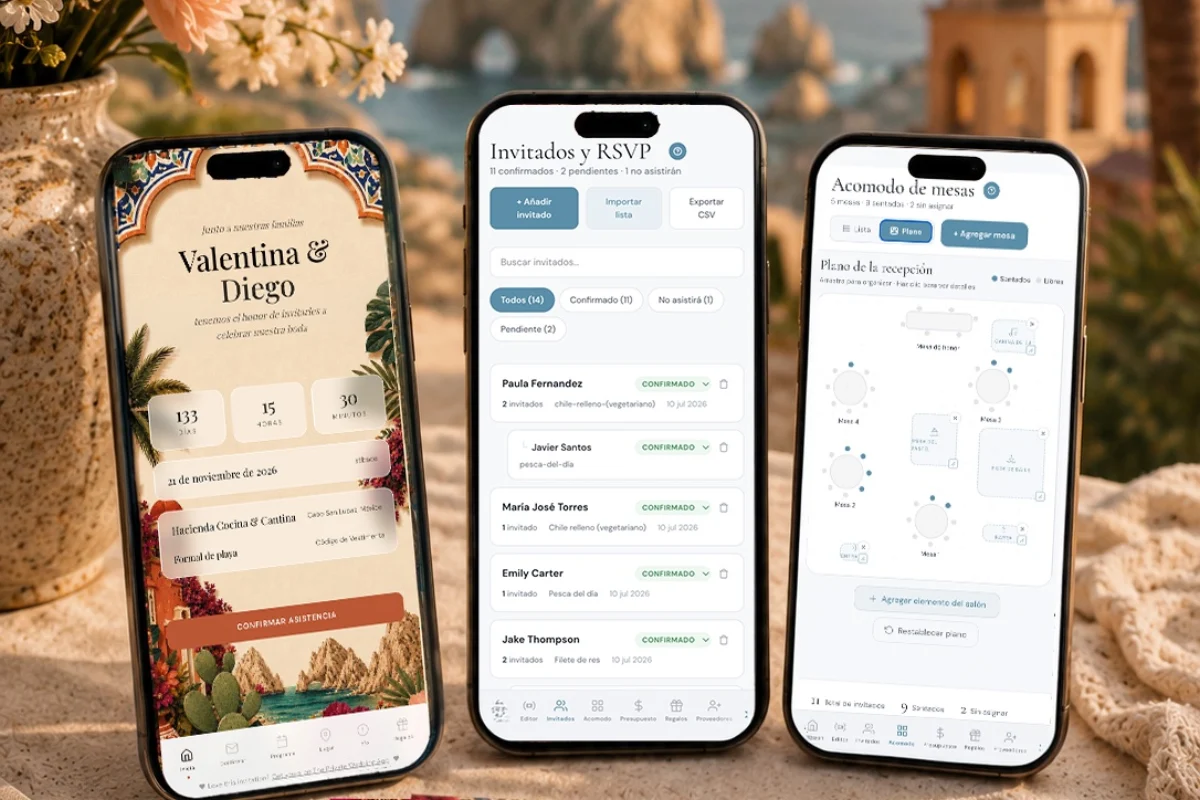
For a wedding in Mexico with Spanish-speaking and English-speaking guests, send one invitation that each guest opens in their own language rather than a card crowded with both, write each version natively (the formal "ustedes" Spanish that Mexican families expect, not a word-for-word translation), and send it where each side answers: WhatsApp for family in Mexico, email or text for guests in the US and Canada. The Private Wedding App, the full wedding planning platform, does this on one private link: each guest picks English or Spanish on opening and the whole invitation follows, RSVP, meals and allergies included, with a Talavera theme designed around Cabo San Lucas, WhatsApp sending from your own phone, and every answer in one guest list, seating chart and budget, for $19.99/month or $189 once. 3-day free trial.
Many weddings in Mexico are two weddings' worth of guests: a Mexican family who reads, prays and dances in Spanish, and friends and family from the US or Canada who read English. Sometimes it is a couple from Guadalajara marrying in Los Cabos with their American college friends; sometimes a couple from Texas whose abuela lives in Monterrey. Either way the same questions come up: one invitation or two, how to word it so it does not read like a translation, how to run a ceremony nobody feels shut out of, and how to get answers from family who never check email. This guide is specific to Mexico. For bilingual invitations in general, see the general guide to the bilingual wedding invitation, linked in section 2.
Who reads what, and where they answer
Start with a map of your guests rather than a design. For each circle, note the language they read comfortably, the channel they answer on, and whether they will open a link at all. The answers are usually more mixed than couples expect: bilingual cousins, English-only partners of Spanish-speaking relatives, grandparents who answer voice notes but not forms.
That map decides everything else: which language goes first, which guests get a printed card, and who you will have to message personally.
A guest's phone number on the guest list is enough to send the invitation by WhatsApp later, so collect numbers for the family in Mexico from the start.
One invitation or two separate versions?
On paper, a bilingual card has to fit both languages on one side, or one per side, which halves the space for each and makes everyone read past the other language. Two separate printed versions solve that but double the printing and the risk of sending the wrong one.
Digitally, the question disappears: one invitation, one link, and each guest picks English or Spanish when they open it. The whole invitation follows the choice, from the cover to the RSVP form and the meal questions, and the choice is remembered on their phone. Nobody reads past the other language, and you manage one guest list, not two.
If you print, print per language: a Spanish card for the guests who want paper in Mexico and an English one for the others, each with a QR code to the same link. Our guide on destination wedding invitations in two languages covers what to send, when, and the general guide to the bilingual wedding invitation covers the method for any pair of languages.
On the bilingual invitation, one-click AI translation drafts the second language from the first, and every line stays editable.
Wording that reads like Mexico, not like a translation
Mexican wedding invitations traditionally open with the parents, sometimes the padrinos, and use the formal "ustedes". A literal translation of an American invitation sounds stiff in one direction and oddly cold in the other. Write the Spanish version as a Mexican family would, then make sure the facts match.
Keep names, venues and addresses identical in both versions. Translate the time format too: Mexico reads 4:30 pm comfortably, but a 24-hour clock is common on Spanish invitations.
Open the demo below: it is a real bilingual Cabo invitation that opens in Spanish first, with the English version one tap away.
On a bilingual invitation built with the Talavera theme, the opening line, the names and the RSVP read in the guest's language.
A ceremony both families can follow
Choose one main language for the ceremony and support the other, rather than repeating every sentence twice, which doubles the length and loses both audiences. An officiant who switches languages naturally, readings in each language, and a printed or digital program that gives the translation of the vows work better than full repetition.
Explain the traditions that one side has never seen. In a Mexican Catholic or symbolic ceremony, the padrinos (sponsors) often give the couple the lazo, a cord or rosary placed around both in a figure of eight, and the arras, thirteen coins the groom gives the bride as a promise of shared support. One sentence in the program in English makes the moment meaningful instead of puzzling.
The same goes for the reception: the víbora de la mar, the money dance, mariachi at midnight. Guests enjoy what they understand.
Each schedule moment on the invitation carries a description in both languages, which is where the lazo and arras explanation fits.
WhatsApp for family in Mexico
In Mexico, WhatsApp is where the family lives. An invitation sent by email will sit unread; the same link sent on WhatsApp with a short personal message gets opened the same day. Many Mexican couples even pay a confirmation service to call guests one by one, because nobody fills in forms.
The simplest approach: send the link on WhatsApp from your own phone with a personal line, and let the RSVP do the rest. When a guest answers, their reply lands in the guest list with their meal and any allergy, whatever language they answered in.
For guests in the US and Canada with an email address, reminder emails before the reply-by date chase the late ones for you.
The WhatsApp button on each guest's row opens a message from your own WhatsApp with the invitation link already typed; nothing is sent automatically.
One guest list, whatever the language
The risk of a bilingual wedding is two of everything: two lists, two meal counts, two seating charts. Keep one. Every answer, in English or Spanish, should land in the same guest list, feed the same seating chart, and add up in the same caterer count.
Seat with language in mind. A table where two English-only guests sit between Spanish-only relatives is a long dinner for everyone; one bilingual cousin per table changes it.
Plan your bilingual Cabo, Tulum or Puerto Vallarta wedding on The Private Wedding App, read the Cabo San Lucas destination wedding guide for the travel side, and start planning: $19.99 a month or $189 once.
- Map guests by language and by channel
- One link, each guest picking English or Spanish
- Spanish written natively, with ustedes
- Names, venues and addresses identical in both
- Ceremony in one main language, supported in the other
- Lazo, arras and padrinos explained in English
- WhatsApp for family in Mexico, reminders by email for the rest
- One guest list, one seating chart, one caterer count
Everything you need, in one place
Planning your own wedding without a planner is entirely achievable.
See it for yourself.
Explore the whole platform: cinematic invitation, RSVP with meals and allergies, guest list, seating chart, budget, vendors, checklist, moodboard, photo sharing and the AI planner. No account needed.
Try the full planner →Should a bilingual wedding invitation be one invitation with two languages or separate versions?
Digitally, one invitation that each guest opens in their own language is the cleanest: nobody reads past the other language and you keep one guest list. On paper, separate printed versions per language read better than one crowded card, each with a QR code to the same link.
Can a wedding website let guests switch between English and Spanish?
Yes. On The Private Wedding App each guest picks English or Spanish when they open the invitation, the choice is remembered on their phone, and everything follows: schedule, venues, travel information, the RSVP form and the meal questions.
How do you word a wedding invitation in Spanish for a Mexican family?
Use the formal "ustedes" and the phrasing Mexican families expect: "Junto a nuestras familias, tenemos el honor de invitarles a celebrar nuestra boda." For the reply: "Favor de confirmar su asistencia antes del 26 de septiembre." Write it natively rather than translating word for word.
How do you have a bilingual wedding ceremony in Spanish and English?
Pick one main language and support the other: an officiant who switches naturally, readings in each language, and a program with the vows translated. Explain traditions like the lazo and the arras in a sentence for the guests who have never seen them.
How do I get RSVPs from family in Mexico?
Send the link on WhatsApp with a personal message rather than by email. In The Private Wedding App the WhatsApp button on each guest's row opens a message from your own phone with their invitation link, and their answer lands in the same guest list as everyone else's.