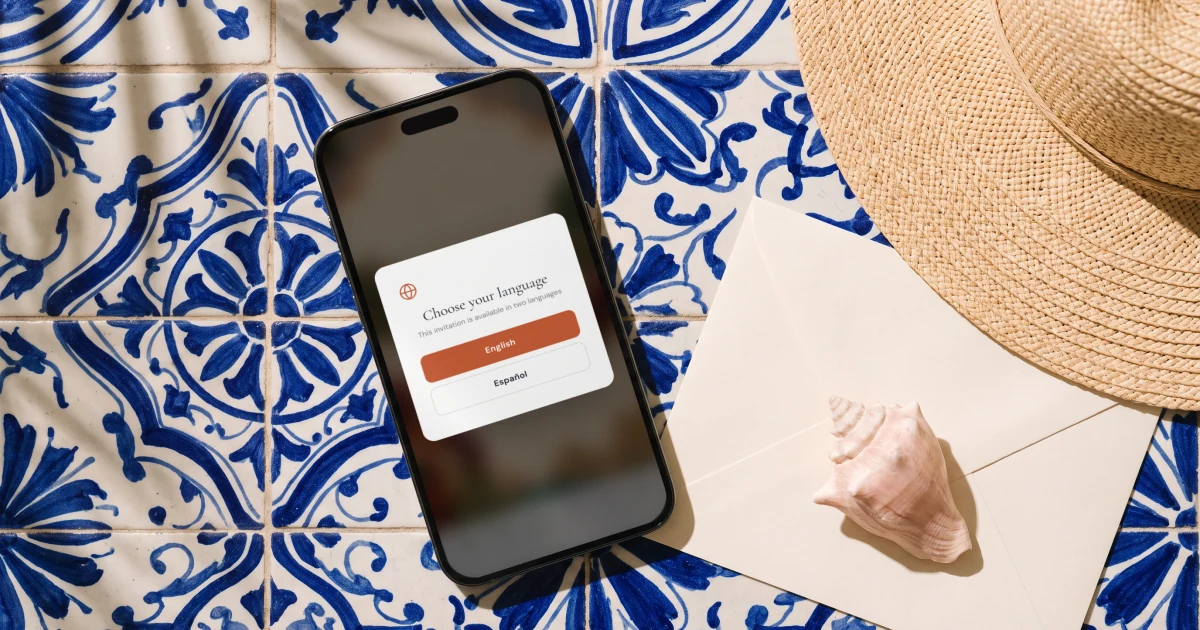
A destination wedding invitation in two languages has to carry more than names and a date: travel and airport details, where to stay, an RSVP deadline early enough for flights, a local contact and the full weekend schedule, all readable in both languages. The Private Wedding App is a full wedding planning platform, so all of that lives behind one private link that reaches guests in any country the same day, and the replies build the guest list, the headcount for each event, the seating chart and the budget as they arrive. Send the save the date eight to twelve months out and the full invitation four to six months out, earlier than for a local wedding, because guests are booking flights and leave. Paper crosses borders slowly and cannot be corrected once a time or a venue changes, while one link updates for everyone at once. The Private Wedding App is $19.99/month or $189 once, lifetime, with the full platform either way.
A destination wedding invitation carries more weight than any other. It is not just an announcement - it is the document your guests use to decide whether to book flights, request time off and spend real money to be there. Now add a second language, because destination weddings almost always mean one: the local language of your venue, the languages of two families, or both. A wedding on the Amalfi Coast with American and Italian guests. A celebration in Cancun with family from Texas and Guadalajara. Twenty-eight percent of US couples choose destination weddings, 42% of the global market is in Europe, and the average destination guest list of 39 people routinely spans two languages and several time zones. This guide covers the three things a bilingual destination wedding invitation must get right: the timeline (international guests need far more notice), the contents (travel logistics in both languages, not just names and a date), and the format (why one link beats paper across borders every single time).
Why destination weddings almost always mean two languages
Even couples who share one language inherit a second one the moment they book a venue abroad. The wedding in Tuscany comes with Italian venue names, Italian addresses, Italian vendors. The celebration in Provence comes with French. And if the couple themselves come from two backgrounds - as 17% of US newlyweds now do - the guest list itself splits into two languages before the destination even enters the picture.
The result is a specific communication problem. Your invitation has to work for the aunt in Guadalajara who reads only Spanish, the college friends in Chicago who read only English, and everyone's Google Maps app, which needs the venue address in its original local form. Get any of these wrong and the cost is not aesthetic - it is guests who book the wrong dates, miss the shuttle, or never RSVP at all.
Response rates tell the story: when the RSVP is not in a guest's language, the guests you lose are precisely the ones you worked hardest to include - the older relatives, the family abroad. For a 150-person hometown wedding, a few missing RSVPs is a nuisance. For a 39-person destination wedding where the caterer needs exact numbers and guests are booking international flights, every silent guest is a real problem.
The good news: a bilingual wedding invitation - one link, each guest picks their language - solves the language half of the problem outright. The rest of this guide covers the destination half: what to send, when, and what it must contain.
The timeline: international guests need double the notice
The standard hometown invitation timeline collapses for destination weddings. Guests are not just marking a calendar - they are pricing flights, arranging visas, booking hotels and requesting leave. Every stage moves earlier.
Save the date: 8-12 months out. This is non-negotiable for weddings abroad. Flight prices climb and leave requests need lead time. Your save the date should already carry the destination, the exact dates including any welcome or farewell events, and a link where details will accumulate. In both languages - the language decision starts here, not with the invitation.
Invitation: 4-6 months out. Earlier than the domestic standard, because this is the moment guests commit money. By now your link should carry the full picture: schedule, venue, accommodation options, transport.
RSVP deadline: 2-3 months out, and explain why. "Please respond by March 1 so we can confirm numbers with our venue in Positano" outperforms a bare date. International caterers and venues often need final headcounts earlier than domestic ones, and unlike a hometown wedding, you cannot squeeze in a last-minute guest who drives over.
The weeks before: updates, not reprints. Shuttle times firm up, the welcome dinner venue changes, a heatwave changes the dress code advice. This is where paper dies and a live link earns its keep - every update reaches every guest instantly, in their language, without a single reprint crossing a border.
What a bilingual destination invitation must contain
A hometown invitation can get away with names, date, venue and an RSVP. A destination invitation is closer to a travel briefing, and every element below needs to exist in both of your languages.
The full event schedule, not just the ceremony. Destination weddings are multi-day: welcome drinks Thursday, ceremony Saturday, farewell brunch Sunday. Guests booking flights need the first and last event, with times and locations, before they book.
Accommodation with real guidance. Not just "hotels nearby" - named options at different price points, distance from the venue, and any room block codes. Your international guests cannot judge neighborhoods in a country they have never visited.
Transport from the airport and between events. Which airport, roughly what a transfer costs, whether shuttles are provided. This single section prevents more day-of chaos than any other.
An interactive map, with addresses in the local language. "Villa Cimbrone, Via Santa Chiara 26, Ravello" must stay in Italian for Google Maps to find it - while the directions around it translate to each guest's language.
A local day-of contact. A coordinator or venue number guests can call when they land and something goes sideways. List it with country code.
Dress code with climate context. "Formal, but it will be 32°C on a clifftop" is information; "black tie optional" alone is not.
The RSVP itself - fully translated. Attendance, meal choice, dietary notes and allergies in the guest's language, feeding one guest list. We covered why this is the deciding factor in our multilingual invitation buyer's guide.
- Multi-day schedule with times and locations (both languages)
- Accommodation options with prices, distances and booking codes
- Airport, transfers and shuttle details
- Interactive map - addresses local, directions translated
- Local day-of contact with country code
- Dress code with weather guidance
- RSVP deadline with the reason for it
- Fully translated RSVP: meals, dietary notes, plus-ones
Paper across borders: the case that ends itself
Run the paper version of this invitation through the destination scenario. Two languages means two print runs or a crowded dual-language card. International postage costs multiples of domestic, takes weeks each way, and envelopes go missing. The RSVP cards need international return postage your guests will not have. And the first time the shuttle schedule changes, your beautifully printed itinerary is wrong in two languages on three continents.
This is why the destination wedding is the strongest possible case for a digital invitation. One link travels free and instantly to every country. Each guest picks their language. The schedule, map, travel info and RSVP live in one place and update live. 82% of couples already prefer digital invitations - for weddings abroad it is barely a decision.
The traditionalist compromise still works: send a printed save the date or QR card - a keepsake in each guest's language with a QR code opening the digital invitation. Paper for the mantelpiece, logistics in the link.
One warning from experience: choose a platform where both languages live in one site. Duplicate-site setups (one URL per language) split your RSVPs into two lists exactly when you need one clean headcount for a caterer in another country. The full comparison is in our multilingual wedding website guide.
One link for every country on the guest list. Each guest picks their language.
Wording it in two languages, by destination
The wording rules for bilingual invitations apply doubly abroad, because the destination adds its own conventions.
Italy - Italian venue and town names stay Italian ("La Costiera Amalfitana" for Italian guests, "the Amalfi Coast" for English speakers is the one graceful exception). Italian formal invitation phrasing ("Abbiamo il piacere di invitarvi…") differs from a literal translation of your English wording. Our Italian watercolor theme was designed for this pairing.
Greece - two alphabets on one invitation. Greek guests expect formal phrasing; English-speaking guests need pronunciation-friendly venue references ("Pyrgos, Santorini"). Check that every screen, including the RSVP, renders the Greek alphabet - our Greek wedding theme handles both.
Mexico and Spain - the same language, different conventions: Mexican formal wording differs from Castilian. Know which your family expects. Venue names ("Hacienda San Angel") never translate.
France - French formal invitation language ("Nous avons le plaisir de vous convier…") is highly codified. A native-speaker review matters more here than almost anywhere.
Universal rules: write your primary language completely first, then translate for cultural formality rather than word-for-word. Have a native speaker review. And preview both versions on a phone before anything goes out - German runs 30% longer than English, Arabic runs right-to-left, and you want to find the overflow before your guests do. The full method is in our guide to planning as your own multilingual wedding planner.
Everything you need, in one place
Planning your own wedding without a planner is entirely achievable.
See it for yourself.
Explore the whole platform: cinematic invitation, RSVP with meals and allergies, guest list, seating chart, budget, vendors, checklist, moodboard, photo sharing and the AI planner. No account needed.
Try the full planner →When should I send destination wedding invitations to international guests?
Save the dates 8-12 months before the wedding, invitations 4-6 months out, RSVP deadline 2-3 months out. Every stage runs earlier than a hometown wedding because guests are booking international flights, arranging leave and sometimes visas. Include the full event dates on the save the date so guests book the right nights.
How do I make a destination wedding invitation in two languages?
Use a one-link digital invitation where each guest picks their language: interface, RSVP form and countdown translate automatically across 26 languages, and you write your personal wording in both languages using inline translation fields. Keep venue names and addresses in the local language so they work in Google Maps. If part of the guest list reads a third language, add it too: the invitation runs in up to three languages at once.
What if my destination wedding guests speak three languages?
Add a third language. The invitation can run in up to three languages at once, a main language plus an optional second and third, so the local language, the bride's and the groom's can all live on the same link. Each guest picks theirs, and every RSVP still lands in one guest list.
What should a destination wedding invitation include?
Beyond names and date: the multi-day event schedule, accommodation options with prices and distances, airport and transfer information, an interactive venue map, a local day-of contact with country code, dress code with climate guidance, and a fully translated RSVP with meal and dietary fields. For international guests the invitation is a travel briefing, not just an announcement.
Should I mail paper invitations abroad?
For logistics, no - international postage is slow, expensive and unreliable, and any detail change makes printed material wrong in every country at once. The working compromise is a printed save-the-date or QR card as a keepsake, with the QR code opening the live digital invitation where schedule, travel info and RSVP stay current.
How do I set an RSVP deadline for a destination wedding?
Two to three months before the wedding, and state the reason: "Please respond by March 1 so we can confirm final numbers with our venue in Positano." Explained deadlines get better response rates, and venues abroad typically need final headcounts earlier than domestic ones.
How do guests who speak different languages RSVP to the same wedding?
Through the same link. Each guest picks their language and completes the whole RSVP flow - attendance, meal choice, allergies - in it. Every response lands in one unified guest list, so you hand your caterer one headcount regardless of how many languages your guest list speaks.
Do venue addresses need to be translated?
No - keep them in the local language and format so guests can paste them directly into Google Maps. Translate everything around the address: directions, descriptions, transport guidance. "Villa Cimbrone, Via Santa Chiara 26, Ravello" stays Italian; "a 10-minute walk from the main square" appears in each guest's language.
What does a bilingual destination wedding invitation cost?
Included in the Full Wedding Planner at <a href="/pricing" style="color:#5B8FA8;text-decoration:underline;text-underline-offset:3px">$19.99/mo or $189 lifetime</a>: the bilingual invitation with 26 languages, RSVP tracking, guest list, schedule, venue maps, travel info sections, seating plan, budget tracker and printable QR cards. No per-guest or per-language fees - relevant when the alternative is two international print runs.