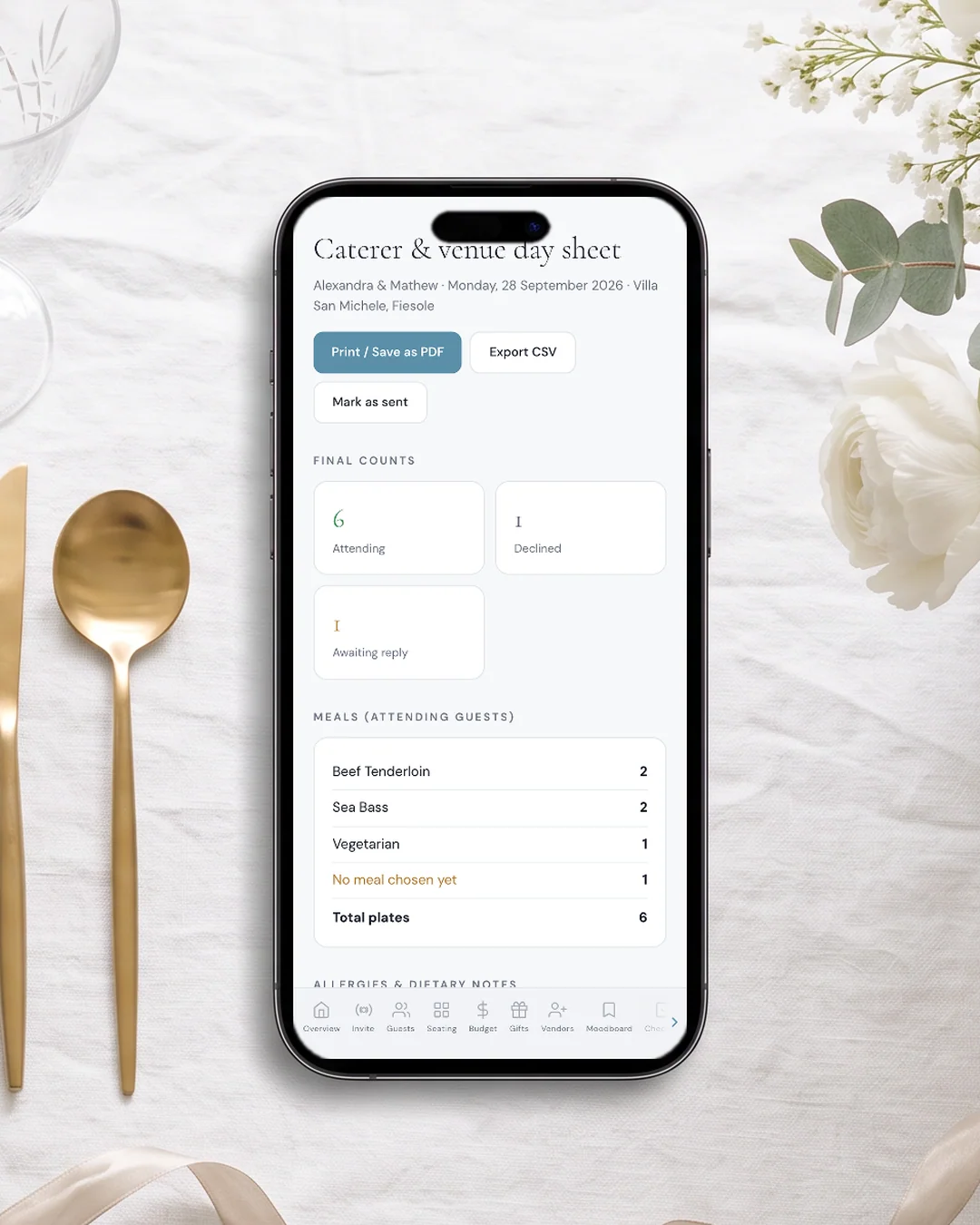
A banquet event order (BEO) is the one document a venue or caterer works from on the day: event details, timeline, room set-up, menu, bar, guest counts, dietary needs, staffing, equipment and billing. The half that changes until the last week is the guest half. The Private Wedding App produces that half from the guests' own RSVPs as a caterer and venue day sheet, with final counts, plates per meal, the allergy roster by table and a log of what changed, together with the day's timeline. Menu pricing, staffing and the equipment order stay in your own BEO.
- BEO means banquet event order: the kitchen's and floor team's instructions for one event.
- A wedding BEO has ten sections, from event details to billing.
- The guest half is the part that keeps moving: counts, plates per meal, allergies, tables.
- A guaranteed count needs a due date, and every later change needs a trace.
- The Private Wedding App produces the guest half and the timeline, not the menu pricing, the staffing or the equipment order.
For wedding planners · All guides
Every venue and caterer has a version of it: a Word file, an Excel tab, a printed form with initials in the margin. The banquet event order is how a sales conversation becomes a set of instructions the chef, the banquet captain and the bar can work from without calling anyone. For a wedding, most of it is settled weeks ahead. What keeps changing is the guest side: who is coming, what they eat, who cannot have nuts, and where they sit. This guide explains the BEO section by section, gives you a template to copy, and shows how to stop retyping the guest half.
What is a banquet event order (BEO), and what does it mean for a wedding?
A banquet event order is the internal work order for one event. It tells every department what was sold and what to deliver: which room, at what time, set how, serving what, to how many people. Hotels and banquet halls in the US and Canada say BEO. In other markets, India among them, the same document is often called a function sheet, and some venues simply say event order.
For a wedding the BEO does two jobs. It is the venue's record of what the couple agreed to, usually signed off by the couple or their planner. And it is the operating sheet for the day, the page the kitchen plates from. The first job needs precision about the menu and the bill. The second needs precision about people.
What sections does a wedding BEO include?
Formats differ from one venue to the next, but the sections barely do. If you are building your own banquet event order format, check that it answers every line below. If a planner or a couple sends you theirs, the same list tells you what is missing.
- Event details: couple's names, date, rooms, contact on the day, planner's name and phone
- Timeline: access time, guest arrival, ceremony, cocktail hour, dinner, bar close, music off, load-out
- Room set-up: floor plan, table shapes and counts, head table, dance floor, stage, linen
- Menu: courses, the meal choices offered, children's meals, vendor meals, cake service
- Bar: package or consumption, service hours, toast pour, last call
- Guest counts: expected, guaranteed, the date the guarantee is due
- Dietary needs: allergies and diets by guest and by table, with severe allergies marked
- Staffing: captain, servers, bartenders, kitchen, call times
- Equipment and rentals: audiovisual, heaters, extra tables, who supplies what
- Billing: price per person, minimums, service charge, tax, deposits received, balance due
Banquet event order template: which fields should you copy?
The table is a banquet event order template for a wedding, laid out so you can copy it into Word or Excel. The third column is the part most forms leave out: who supplies each piece of information. A BEO goes wrong when a line has no owner.
The last column is an example of when each section is usually settled. Adapt it to your own terms and to the dates in your contract.
Banquet event order example: what does the guest half look like?
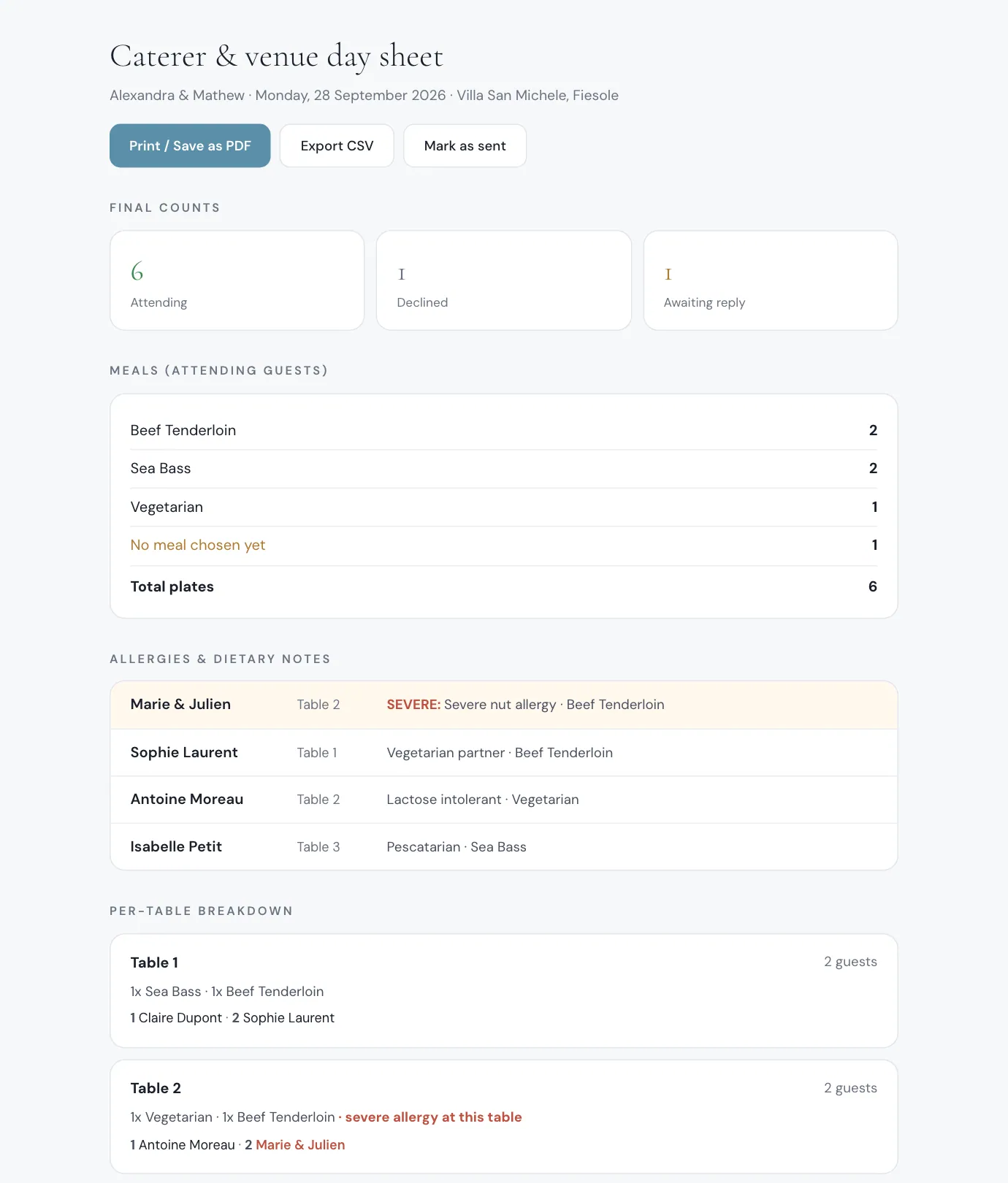
Take a wedding of 120 invited guests as an example. Ten days out, the guest half of the BEO might read: 104 attending, 11 declined, 5 awaiting reply. Plates: 58 beef, 31 fish, 12 vegetarian, 3 children's meals. Seven dietary notes, two of them severe: a nut allergy at table 4 and a shellfish allergy at table 9. Then the breakdown table by table, so the captain knows table 4 gets nine beef and one vegetarian.
That is exactly what the caterer and venue day sheet in The Private Wedding App shows. Guests answer on the couple's private invitation link, pick a meal, add dietary notes and can flag a severe allergy. The day sheet counts for you: final counts with attending, declined and pending, plates per meal choice, the allergy and dietary roster with each guest's table and a SEVERE flag, a per-table breakdown, a contact sheet of the booked vendors, the day's timeline and an alphabetical seating list. Print it, save it as a PDF or export a CSV to paste into your own form.
When are final numbers due, and what happens after the guaranteed count?
The guaranteed count, also called the final headcount or, in the UK and Australia, final numbers, is the figure the couple commits to pay for. Every venue and caterer sets its own date in the contract. In The Private Wedding App each booked vendor carries a "final numbers due" deadline, with editable defaults of 10 days before the wedding for the caterer and 30 for the venue.
Planners and venues see a "final counts at risk" alert in their portfolio when a vendor deadline is within a week and guests are still awaiting reply, which is the moment to chase the couple rather than the day after. The couple's side of that conversation is explained in when to give the caterer the final guest count.
Guests still change their minds after the guarantee. The question for the kitchen is never whether the count moved, it is what moved. On the day sheet, "Mark as sent" snapshots the numbers, and the next version shows what changed since: two fewer attending, one beef fewer and one vegetarian more, a new dietary note. That change log is the line most Word and Excel BEOs do not have.
BEO in Word or Excel, or banquet event order software?
A Word or Excel banquet event order is fine for the half of the document that you decide: menu, bar, staffing, billing. You type it once and revise it a few times. The weak point is the half that guests decide. Someone has to collect replies, count plates, match allergies to tables and retype it all into the form, then do it again when the couple forwards three late answers.
Banquet event order software for hotels and banquet halls is built around the same half: menus, pricing, staffing. The guest side of a wedding still has to come from the couple. The practical split for a wedding is to keep your BEO where you already write it and let the guest half arrive counted.
How does a venue get the guest half without chasing the couple?
The counts only arrive on their own if the couple collects RSVPs in the same place you read them. In a venue account on The Private Wedding App, a confirmed booking can create its wedding. The couple gets their own login, sends their invitation, and guests reply online. You open the day sheet whenever you need it, and your staff can too: a team member with the staff role works on the guest list, the seating plan, the day sheet and the run of show of every wedding.
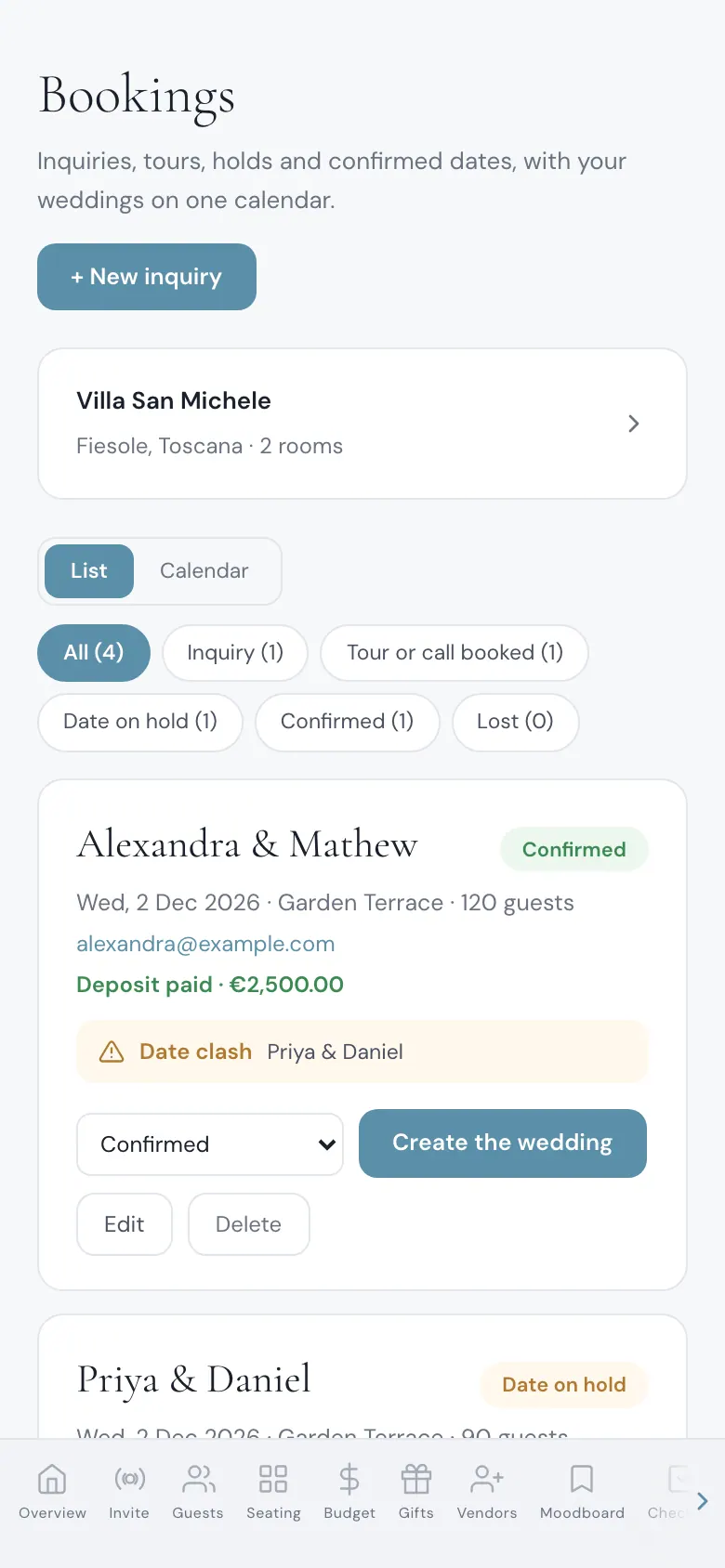
The same account holds what comes before the BEO: inquiries, tours, dates on hold and confirmed dates on one calendar with a date-clash warning, covered in the guide on tracking venue bookings, inquiries and deposits without spreadsheets. The full picture of what a venue account includes is in wedding venue software with guest management and RSVPs.
How do you put this in place for your next wedding?
Keep your BEO form. Add two habits. First, write the guarantee date on it and in the wedding, so the alert appears in the week before it. Second, attach the day sheet to every version you send to the kitchen, and mark it as sent each time. The day's timeline on the sheet comes from the run of show, which the planner or your coordinator can build from the wedding run of show template.
Caterers who work with planners can ask the planner to send the day sheet: planners run their client weddings from the same tools, described on the page for wedding planners. Venues will find the whole account on the page for wedding venues and the cost on the pricing page. To try it on a real date, create your venue account and confirm your next booking.
See it for yourself.
Everything a venue runs its weddings on: a bookings calendar with date-clash warnings, rooms drawn to scale, reusable layouts, the caterer and venue day sheet, the run of show, team seats, invoices and contracts, plus each wedding's invitation, RSVP, guest list, seating plan and budget.
See the venue tools →What does BEO mean?
BEO stands for banquet event order. It is the document a venue, hotel or caterer uses to tell its kitchen, floor and bar teams what to deliver for one event: room, timing, set-up, menu, counts, dietary needs, staffing and billing. Some venues call it a function sheet or an event order.
Is there a banquet event order template in Word or Excel?
The template table on this page copies into Word or Excel as it stands: one row per section, with what to record, who supplies it and when it is settled. For the guest sections you can export the day sheet from The Private Wedding App as a CSV or a PDF and attach it to your own form.
Who writes the BEO for a wedding, the venue, the caterer or the planner?
Whoever provides the food and the room writes it, so the venue or the caterer. The planner or the couple supplies the timeline, the seating and the guest information, and usually reviews the BEO before signing it off. When the venue and the caterer are two businesses, each tends to keep its own and they should match on counts and times.
Does The Private Wedding App replace banquet event order software?
No. It does not price menus, schedule staff or order equipment. It produces the guest half of the BEO from the guests' RSVPs, as a caterer and venue day sheet with counts, plates per meal, the allergy roster by table and a change log, plus the day's timeline and the room drawn to scale.
What is a banquet event order example for the guest count section?
For example: 104 attending, 11 declined, 5 awaiting reply; 58 beef, 31 fish, 12 vegetarian, 3 children's meals; nut allergy at table 4 marked severe; then guests and plates per table. The numbers are an illustration, the structure is what matters.
How much does it cost for a venue or caterer?
No software fee. Each wedding carries its own plan, $189 lifetime or $19.99 a month. You can bill it to the couple.
Can the kitchen see what changed since the last BEO?
Yes, for the guest half. When you mark the day sheet as sent, The Private Wedding App snapshots the numbers, and the next version lists what changed: the attending count, the plates per meal choice and the dietary notes added or removed. Menu or pricing changes stay in your own document.