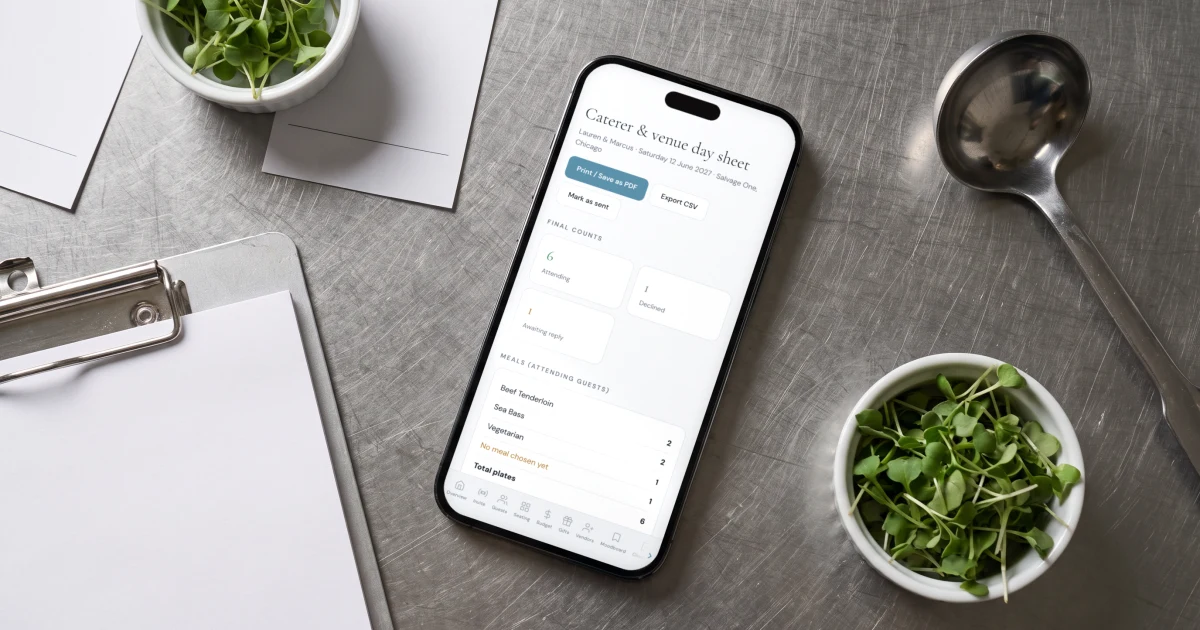
The final guest count for a caterer is the guaranteed number of guests, commonly due five to ten business days before the wedding, and it needs to arrive as counts by meal choice plus an allergy and dietary roster, not just a single headline number. In The Private Wedding App the caterer day sheet builds this automatically from your RSVPs: final counts, plates per meal, the allergy roster with each guest's table and a per-table breakdown, on one printable page that also shows exactly what changed since the version you last sent. The Private Wedding App is $19.99/month or $189 once, lifetime, with the full platform either way.
The final guest count is the number your caterer bills you on, and the point where a season's worth of RSVPs, meal choices and dietary notes has to become one clean document a kitchen can cook from. Most planners and couples rebuild it by hand the week before the wedding: counting yeses in a spreadsheet, cross-checking meal choices, chasing the allergies, then reformatting the whole thing every time a straggler replies. This guide covers what a caterer actually needs, when it is due, and how to produce it from the RSVPs you already hold rather than typing it twice.
Know what a guaranteed count is and when it is due
Caterers and venues work to a guaranteed count: the number of guests you commit to, which they use to buy food, staff the room and bill you. It is commonly due five to ten business days before the wedding, though your contract sets the exact deadline. After it is locked, the count can usually go up but not down, so whatever you guarantee is the floor you pay for even if a few guests fall away.
That is why the final count is not a casual number. Give it too early and you are guessing; give it late and you are scrambling. The workable approach is to keep the count live as RSVPs land, so that when the deadline arrives you are confirming a number you already trust rather than assembling one from scratch.
Give the caterer what they actually need
A headline number is not enough for a kitchen. A caterer needs the count broken down by meal choice, so they know how many of each dish to prepare, and a clear allergy and dietary roster, ideally tied to where each guest is sitting so the right plate reaches the right seat. On plated dinners they also need a per-table breakdown, and the venue often wants an alphabetical escort list for place cards.
Pulling all of that together by hand is the tedious part, and it is where mistakes creep in: a severe allergy missed, a vegetarian count off by two, a table that does not add up.
- Total attending, with declines and no-replies separated out
- Plate count per meal choice
- Allergy and dietary roster, with each guest's table
- Per-table breakdown for plated service
- Alphabetical escort or place-card list
- The kids' and vendor-meal counts, if the caterer prices them differently
Build it from your RSVPs, not by hand
This is what the caterer day sheet in The Private Wedding App does. Because the RSVPs, meal choices, dietary notes and seating already live in the wedding, the day sheet assembles the whole document for you: the final counts, the plates per meal, the allergy roster with each guest's table, the per-table breakdown with a flag on any severe allergy, and the escort list, on one page you print or save as a PDF. Nothing is typed twice, and nothing is copied between a spreadsheet and a seating chart.
When a late RSVP arrives or a guest changes their meal, the sheet updates itself, so the version you send is always current rather than a snapshot you rebuilt manually.
See the featureMeal and allergy tracker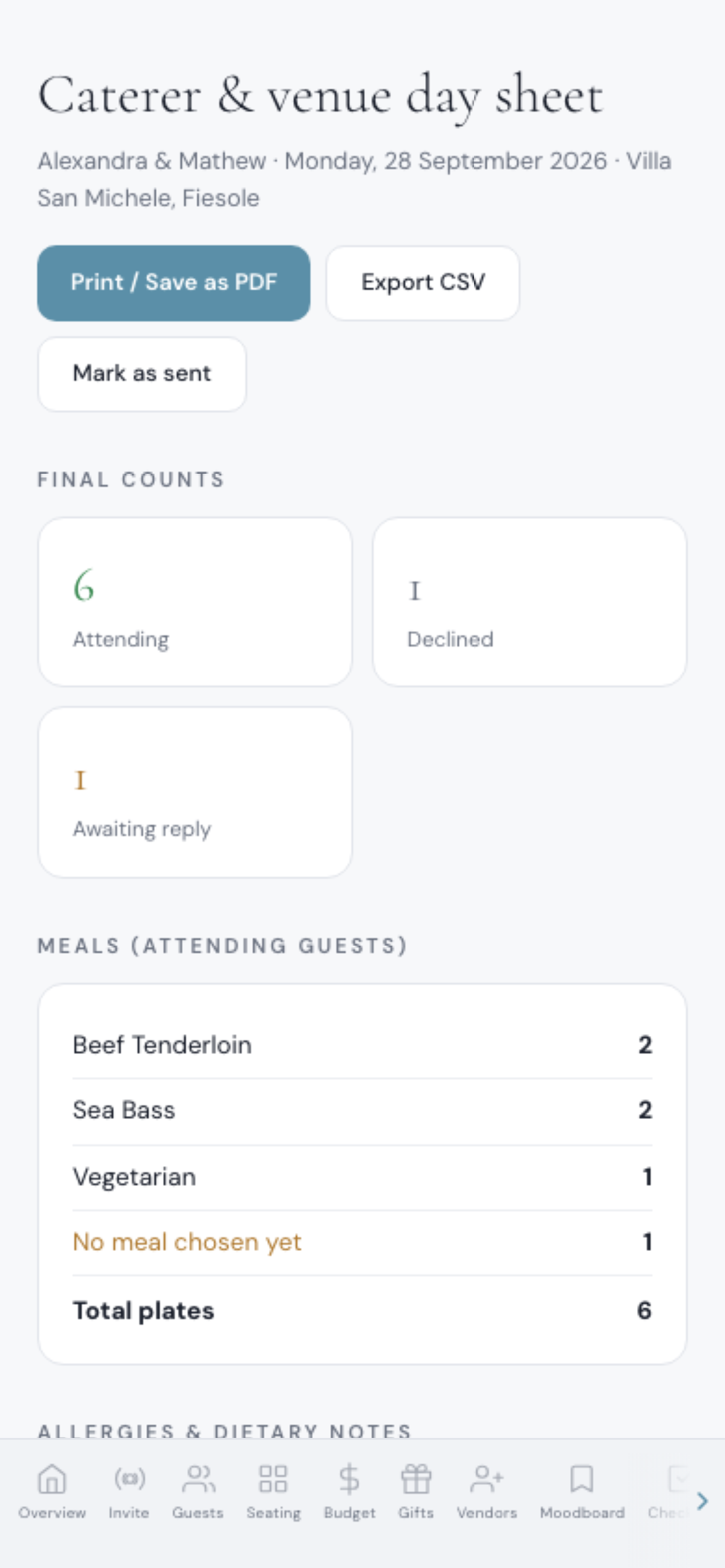

Show the caterer what changed since last time
Final counts are rarely sent once. You send a working number, then an updated one as more guests reply, and the caterer needs to see what moved. The day sheet has a Mark as sent action that snapshots the numbers, so the next version highlights exactly what changed since the caterer last saw it: three more attending, two meals switched, one allergy added. That saves the caterer re-reading the whole list and saves you the awkward email explaining the diff.
Track the deadline so it never sneaks up
The final-numbers deadline sits inside a longer chain: florals lock weeks out, the venue wants its guarantee, rentals need a count. In The Private Wedding App each booked vendor carries its own final-numbers deadline, and when one is closing in while guests are still to reply, the wedding is flagged so the deadline does not arrive unnoticed. Keep the count live, watch the flag, and the guaranteed number is a confirmation rather than a fire drill.
See how the caterer day sheet fits the rest of the planner tools on the wedding planners page.
Everything you need, in one place
Planning your own wedding without a planner is entirely achievable.
See it for yourself.
Explore the whole platform: cinematic invitation, RSVP with meals and allergies, guest list, seating chart, budget, vendors, checklist, moodboard, photo sharing and the AI planner. No account needed.
Try the full planner →When is the final guest count due to the caterer?
Commonly five to ten business days before the wedding, but your catering contract sets the exact deadline, so check it. Because the count can usually go up but not down after that point, the safest approach is to keep it live as RSVPs arrive so the deadline is a confirmation rather than a scramble. In The Private Wedding App each vendor's final-numbers deadline is tracked, and the wedding is flagged when one is closing in while guests are still to reply.
What is a guaranteed guest count?
The guaranteed count is the number of guests you commit to for catering and the venue. They buy food, staff the room and bill you on it, and once it is locked it can usually rise but not fall, so you pay for the guaranteed number even if a few guests do not attend. It is why the final count is a considered number, not a rough estimate.
How do I give my caterer meal counts and allergies?
The caterer needs the count broken down by meal choice and an allergy and dietary roster, ideally tied to each guest's table. In The Private Wedding App the caterer day sheet builds this from your RSVPs automatically: plates per meal, the allergy roster with table numbers, and a per-table breakdown, on one printable page. Couples without the day sheet can export the guest list with meals and allergies to CSV for the caterer.
Do final guest counts go up or down?
After the guarantee deadline, counts can usually go up but not down. You can add late guests, and the caterer will accommodate them, but you cannot reduce below the guaranteed number without still being billed for it. That makes the guaranteed count a floor, so it is set carefully rather than optimistically.
How many days before the wedding is the final headcount due?
Most caterers and venues ask for the final headcount five to ten business days before the wedding, with some venues wanting it as much as two weeks out. The exact number is in your contract. Keeping the count updating as RSVPs land means you can confirm a trusted number on the deadline instead of rebuilding it by hand.
What does a caterer need besides the total guest count?
Beyond the total: the count per meal choice, an allergy and dietary roster with each guest's table, a per-table breakdown for plated service, an alphabetical escort or place-card list, and often separate kids' and vendor-meal counts. The caterer day sheet assembles all of this on one page from the data already in the wedding.