A bilingual Bengali and English wedding invitation usually opens with a blessing (Bismillah or Sri Sri Prajapataye Namah), names the hosts (often both sets of parents), gives the bride's and groom's full names with their parents, then lists each event with date, time and venue, and a reply-by date. The easiest way to send it is one link each guest reads in their language: in The Private Wedding App (£17.99/month or £159 once for lifetime access, $19.99/month or $189 in the US) you write once and one-click AI translation fills the second language, every line editable. Bengali is one of the 26 guest languages: you write in English, and your elders switch the whole invitation to Bengali with one tap, buttons, RSVP form and menu included. 3-day free trial.
In most British-Bangladeshi families the invitation has two audiences. Your friends from school and work read English. Your nani in Sylhet, your dada in Whitechapel and half your parents' generation would rather read Bengali, and they will notice if the bismillah is missing. Printing two cards doubles the cost; cramming both languages on one card makes both too small. Below is wording for Muslim and Hindu Bengali weddings, in Bengali and English side by side, ready to adapt, and the simplest way to send one invitation that each guest reads in their own language.
What wording do Bangladeshi Muslim invitations use?
Most open with "Bismillahir Rahmanir Rahim" and invite on behalf of the parents. Bengali:
"বিসমিল্লাহির রাহমানির রাহিম। পরম করুণাময় আল্লাহর অশেষ রহমতে আমাদের কন্যা নুসরাত জাহান-এর সাথে তানভীর আহমেদ-এর শুভ বিবাহ আগামী শুক্রবার, ১২ জুন ২০২৬ তারিখে অনুষ্ঠিত হবে। উক্ত শুভ অনুষ্ঠানে আপনার সপরিবারে উপস্থিতি ও দোয়া একান্তভাবে কামনা করছি।"
English: "In the name of Allah, the Most Gracious, the Most Merciful. With the blessings of Allah, Mr Abdul Karim and Mrs Rashida Begum request the pleasure of your company at the wedding of their daughter Nusrat Jahan to Tanvir Ahmed, son of Mr Shafiqul Islam and Mrs Nazma Khatun, on Friday 12 June 2026. Your presence and duas would mean the world to us."
In the app: write it once on the cover and info sections, then the bilingual invitation's AI translation fills the other language, and you can adjust any line by hand.
What wording do Hindu Bengali invitations use?
Hindu Bengali invitations traditionally open with "Sri Sri Prajapataye Namah" and use the word nimantran rather than dawat. Bengali: "শ্রী শ্রী প্রজাপতয়ে নমঃ। আমাদের মেয়ে অনন্যার সঙ্গে অরিন্দমের বিয়েতে আপনাকে সপরিবারে নিমন্ত্রণ জানাই। আপনার উপস্থিতি আর আশীর্বাদ আমাদের কাছে সবচেয়ে বড় উপহার।"
English: "With the blessings of our elders, we invite you and your family to the wedding of our daughter Ananya with Arindam. Your presence and blessings are the greatest gift." If you print the Bengali calendar date, add the English date next to it for the venue and for friends.
In the app: the aashirbad, gaye holud, wedding and bou bhaat each go on the schedule with their own date and time, and with RSVP per event guests answer each one.
What line do I write for each event?
One short line per event, with the time, the venue and a dress code where it matters (the holud is the one where everyone wants to know which yellow).

How do I send one invitation in two languages?
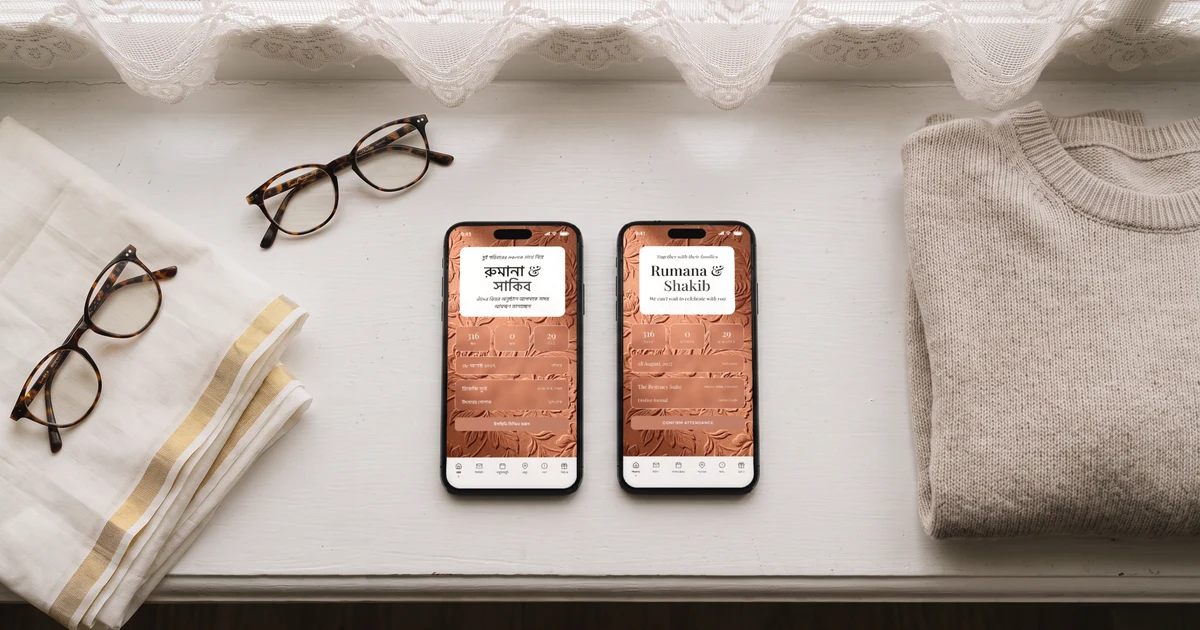
On paper, two languages means two cards or tiny type. On a link it is a language switch: the guest picks once, their phone remembers it, and the next visit opens straight in their language. You can add a third language too, Arabic or Hindi for example, for the other side of the family.
Bengali is one of the 26 guest languages: you write in English, and your elders switch the whole invitation to Bengali with one tap, buttons, RSVP form and menu included.
In the app: every field in the bilingual invitation builder has a second-language twin; an empty twin shows the main-language text, so nothing ever disappears.
How do I ask for replies politely?
Bengali invitations rarely ask for an RSVP, but the hall and the caterer need numbers. Keep it gentle: "আয়োজনের সুবিধার্থে ৩০ মে-র মধ্যে জানালে কৃতজ্ঞ থাকব।" / "Kindly let us know by 30 May so we can plan the food."
In the app: set the reply-by date in the RSVP tab; guests who left an email and have not replied can get up to two automatic reminders if you switch them on, and every guest row has a WhatsApp button for a personal nudge. Start with the £159 lifetime plan or £17.99 a month. 3-day free trial.
Everything you need, in one place
Planning your own wedding without a planner is entirely achievable.
See it for yourself.
Explore the whole platform: cinematic invitation, RSVP with meals and allergies, guest list, seating chart, budget, vendors, checklist, moodboard, photo sharing and the AI planner. No account needed.
Try the full planner →What should a Bengali wedding invitation say?
A blessing, who is inviting (usually the parents), the bride's and groom's full names with their parents' names, each event with date, time and venue, a dress code where relevant, and a reply-by date.
Should I write dawat or nimantran?
Both are correct Bengali. Dawat is more common in Bangladeshi Muslim families, nimantran in West Bengal and Hindu families. Use the word your family uses.
Can one invitation be in Bengali and English?
Yes. In The Private Wedding App it is one link with a language switch. Bengali is one of the 26 guest languages: you write in English, and your elders switch the whole invitation to Bengali with one tap, buttons, RSVP form and menu included.
Can I add a third language?
Yes, up to three languages on one invitation, for example English, Bengali and Arabic, with AI translation for each extra language.
How much does a bilingual invitation cost?
There is no extra charge for a second or third language: £17.99/month or £159 once for lifetime access, $19.99/month or $189 in the US. 3-day free trial.