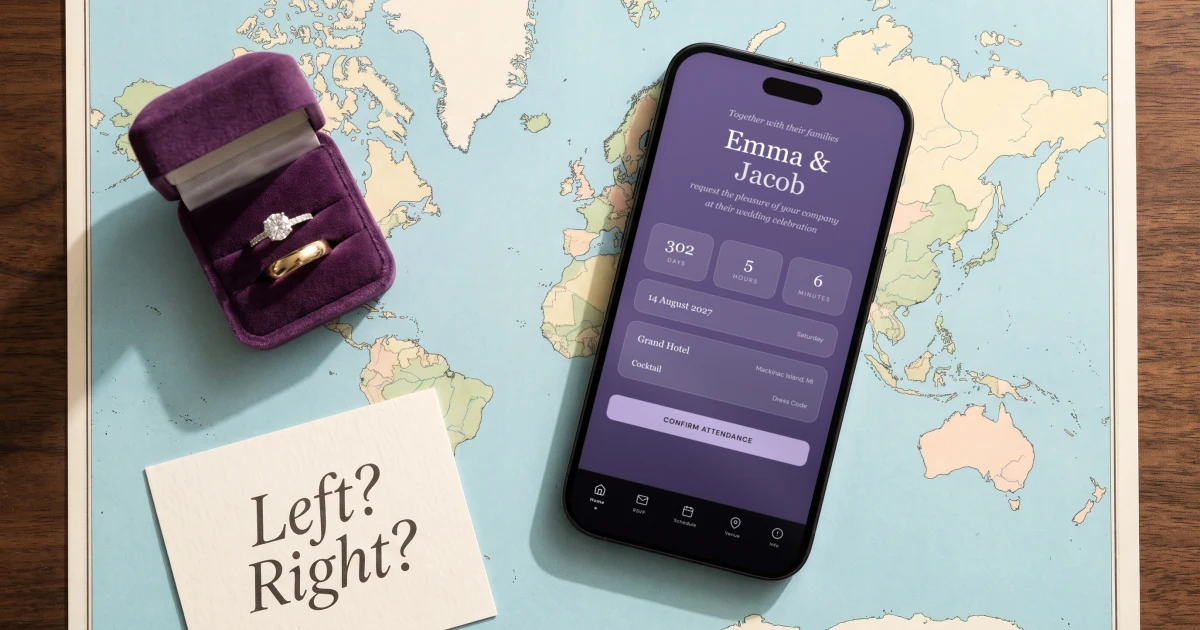
In the US, UK, Canada, France, Italy, Mexico and Switzerland the wedding ring is worn on the fourth finger of the left hand; in Germany, Austria, Norway, Russia, Greece, Spain and India it is mostly worn on the right, with variation within each country. In Brazil and much of the Arab world, including the Gulf, the ring is worn on the right hand during the engagement and moved to the left at the wedding, and in a Jewish ceremony it is placed on the bride's right index finger, then usually moved. If your two families follow different customs, explain them once in an Info section of a bilingual invitation in The Private Wedding App, where each guest reads it in their own language, for $19.99/month or $189 once for lifetime access. 3-day free trial.
In the US, the UK and Canada the answer seems obvious: the wedding ring goes on the fourth finger of the left hand. Cross a border and it is not obvious at all. Germans, Austrians, Norwegians, Russians, Greeks and most Spaniards wear it on the right. Brazilians wear it on the right while engaged and move it to the left at the wedding, and so do many couples in the Arab world. In a Jewish ceremony the ring is placed on the index finger. This guide goes country by country, explains where the customs come from, how the engagement ring and wedding band are ordered, what men do, and what couples from two cultures decide. Customs vary within countries and between families, so where practice is mixed, we say so.
Left or right: the country table
The table shows the most common practice. In almost every country you will meet people who do the opposite, for religious, family or practical reasons, such as a surgeon who wears no ring at work.
In the app: if your families sit on different rows of this table, say which custom you follow in an Info section of your invitation, written once and read by each guest in their own language.
Where the customs come from
The left-hand custom is usually traced to a Roman belief, recorded by ancient authors, that a vein ran from the fourth finger of the left hand straight to the heart, later called the vena amoris. Anatomy does not support it, but the idea travelled through Christian Europe and into the English Book of Common Prayer, where the ring is placed on the fourth finger of the left hand.
The right-hand custom has its own logic. In many Christian traditions, especially Orthodox and parts of Catholic and Protestant Europe, the right hand is the hand of oaths and blessings, so the marriage promise is worn there. In Hindu tradition the right hand is the auspicious hand used in rituals. In the Arab world, a common explanation is that the right hand marks the promise of the engagement and the left, closer to the heart, the marriage itself.
The Jewish custom is different again: the groom places the ring on the bride's right index finger during the ceremony, a practice described by sources such as Chabad.org and My Jewish Learning; one common explanation is that it is the most visible finger for the witnesses. Afterwards most brides move it to the ring finger.
In the app: if your guests come from both sides of this table, a short Info section on your bilingual invitation explains which custom you are following, and each guest reads it in their own language.
Engagement ring and wedding band: which goes first
Where both rings go on the left ring finger, the usual order is wedding band first, closest to the hand, and engagement ring on top. The common explanation is that the marriage sits closest to the heart. Many brides move the engagement ring to the right hand on the wedding day so the band can be put on directly, then put it back on top afterwards.
Where the wedding ring goes on the right hand, as in Germany or Greece, couples often keep the engagement ring on the left, or stack it with the band on the right. In Brazil and the Arab world, where plain bands are worn on the right during the engagement, the same band simply changes hand at the wedding, and a solitaire may be added.
None of this is a rule. Comfort, the shape of the rings and whether one hand is used more at work decide as often as tradition.
In the app: if the ring exchange is part of your ceremony, put it on the schedule with the ceremony time, and add a line about the custom you follow in the ceremony's Info section.

Men's wedding rings
Men usually wear their wedding ring on the same hand as their partner, following the custom of their country: left in the US and UK, right in Germany or Russia. In the US, the double-ring ceremony, where both partners receive a ring, spread mainly in the twentieth century; before that many married men wore no ring.
In Muslim tradition, gold is generally considered not permitted for men, so men's rings are often silver, platinum, titanium or another metal. Some scholars also discourage the engagement ring custom itself, so practice varies between families.
Practical reasons also matter: men who work with their hands or machinery often wear the ring on a chain, wear a silicone band at work, or wear it on the non-dominant hand.
In the app: an Info section can be shown in all languages or only in one, so a note on ring customs reaches exactly the guests who need it.
Couples from two cultures
When a German marries an American, or a Brazilian marries a French partner, the ring hand becomes a small, real decision. Couples tend to choose one of four options: follow the custom of the country where they live, follow the custom of the country where they marry, each wear the ring on their own country's hand, or wear it on the left during the engagement and the right after (or the reverse) to honour both.
Whatever you choose, guests from the other culture will notice. A German aunt will wonder why the ring is on the left; an American friend will wonder if something went wrong. The kindest fix is to say it before the day, in the same place you explain the rest of the ceremony.
The Private Wedding App lets you write the invitation in up to three languages; each guest picks theirs when they open the link, and the AI translation fills the other languages in one click. Add an Info section called 'Our rings' or 'Our ceremony', and each guest reads why you chose the left hand, the right hand, or both, in their own language. See how couples across countries use it in wedding websites for international couples.
Next step: start your bilingual invitation for $19.99/month or $189 once for lifetime access. 3-day free trial.
Everything you need, in one place
Planning your own wedding without a planner is entirely achievable.
See it for yourself.
Explore the whole platform: cinematic invitation, RSVP with meals and allergies, guest list, seating chart, budget, vendors, checklist, moodboard, photo sharing and the AI planner. No account needed.
Try the full planner →What hand is your wedding ring on in the US?
The left hand, on the fourth finger, usually with the wedding band below the engagement ring. The same is true in the UK, Canada and France.
Which countries wear the wedding ring on the right hand?
Germany, Austria, Norway, Russia, Greece and most of Spain, among others. In India the right hand is traditional, though many couples now use the left. Practice varies within each country.
Why do Germans wear their wedding ring on the right hand?
In German-speaking countries the right hand is traditionally the hand of oaths and promises. Engaged couples often wear their bands on the left, then move them to the right at the wedding. Switzerland is the exception, with the left hand more common.
What hand does the wedding ring go on in Brazil?
On the right hand during the engagement (noivado), moved to the left hand at the wedding. The same band often serves for both.
Which hand is the wedding ring on in Arab countries?
In much of the Arab world, including the Gulf, the ring is worn on the right hand during the engagement and the milka, then moved to the left after the wedding. Customs vary between families, and men's rings are usually not gold.
Which finger is the ring placed on in a Jewish wedding?
The groom places the ring on the bride's right index finger under the chuppah. After the ceremony most brides move it to the ring finger of the left hand.
Does the engagement ring go above or below the wedding band?
Usually the wedding band goes on first, closest to the hand, and the engagement ring sits above it. Many brides wear the engagement ring on the other hand during the ceremony so the band can go on directly.
What hand does a man wear his wedding ring on?
Usually the same hand as his partner, following the custom of his country: left in the US and UK, right in Germany or Russia. Some men wear it on the non-dominant hand for work.
We come from two cultures with different ring customs: how do we explain it to guests?
Say it once, in each guest's language. In The Private Wedding App you write the invitation in up to three languages, each guest picks theirs when they open the link, and an Info section explains which hand you chose and why. It costs $19.99/month or $189 once for lifetime access.