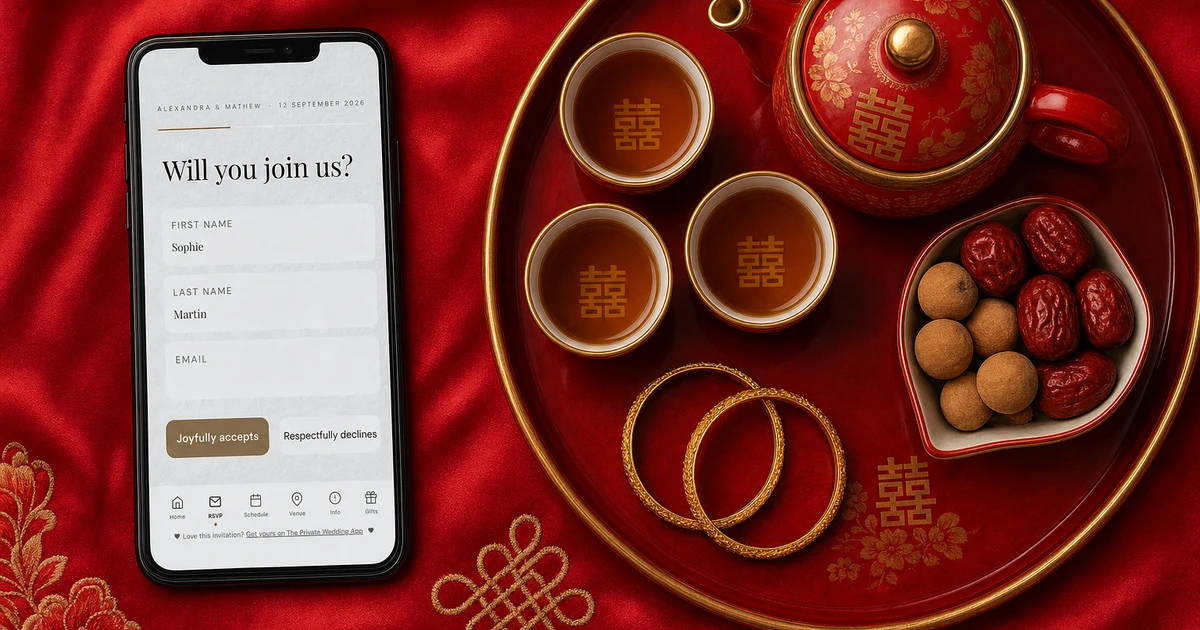
A Singapore wedding has three parts with three guest circles: the ROM solemnisation for close family and two witnesses aged 21 or above, held on the wedding day or an earlier date more than 21 days and less than three months after filing the notice of marriage (per marriage.gov.sg), the tea ceremony for family and elders, usually in the morning after the gatecrash, and the banquet for everyone. The Private Wedding App makes them three events on one invitation, each with its own RSVP, and gives each guest group a private link, so only family see the ROM and the tea ceremony while colleagues see just the banquet, as part of the full planner at S$24.99/month or S$249 once, lifetime. 3-day free trial.
A Singapore wedding is rarely one event. There is the ROM solemnisation, which makes the marriage legal. There are the customary ceremonies, the morning gatecrash and the tea ceremony. And there is the banquet, which most guests think of as "the wedding". Each part has its own guest circle, its own timing and its own logistics, and the hard part is not the ceremonies themselves, which families know well, but telling 300 people exactly which of them they are invited to without anyone feeling left out.
The three parts, and who belongs at each
The ROM solemnisation is the legal marriage, registered with the Registry of Marriages (Muslim marriages are solemnised through the Registry of Muslim Marriages). It can happen at the ROM building, at home, at a hotel before the banquet or at another venue with a licensed solemniser. Guests are usually close family and friends only, and you need two witnesses aged 21 or above who attend.
The tea ceremony is the moment the couple formally honours their elders. It is family: parents, grandparents, uncles, aunts and older siblings, with the bridesmaids and groomsmen helping. Friends attend sometimes, colleagues almost never. The banquet is for everyone on the list, from relatives to colleagues.
With multi-event RSVP, each of these parts becomes an event with its own date, venue and answer.
Same day or separate days
Many couples in Singapore run everything on one day: the groom's party arrives for the gatecrash in the morning, the tea ceremony follows at each family's home, the ROM is solemnised at the hotel in the late afternoon, and the banquet starts in the evening. It is a long day, but the families gather once and the photographer covers it all in one booking.
Others hold the ROM months before the customary wedding, sometimes as soon as they get their flat, with a small lunch for close family. Then the big day is gatecrash, tea ceremony and banquet. Either way, the legal timing is fixed: per marriage.gov.sg, you file the notice of marriage online and the solemnisation must take place after 21 days and before three months from that date, so the ROM date you choose decides when you file.
One custom to plan for: some couples hold the tea ceremony after a lunch banquet so elderly relatives are less rushed, and elders who are left out of the tea ceremony may feel slighted. Agree the list of elders with both sets of parents early.
Whichever order you choose, the events appear to guests in date order, each with its own time and venue.
The tea ceremony order
Tea is served at the groom's home first and then at the bride's, or in one session with both families. The couple kneels or stands and serves each elder by seniority, usually starting with parents or grandparents depending on the family, then uncles and aunts, then older siblings and cousins. Each elder drinks, then gives a red packet or jewellery in return. Younger relatives may serve tea to the couple afterwards.
Put the elders in a "Tea ceremony" invite group on the guest list, so they receive the link that includes it.
- Tea set, often with the double happiness motif, and a tray
- Sweet tea with longans, red dates or lotus seeds for a sweet marriage
- A list of elders in order, agreed with both families, with how to address each
- A helper to pour and to hold the red packets and jewellery
- Time for photographs with each elder
Inviting three circles without three invitations
The awkward part is the guest list. If everyone gets the same card, colleagues ask whether they should come to the ROM, and an aunt who was meant to be at the tea ceremony assumes she is only invited to dinner. If you print three cards, you end up tracking three lists that drift apart.
The cleaner way is one invitation with one event per part and a separate answer for each. In The Private Wedding App you switch on "This wedding has multiple events" in the RSVP settings and add the ROM solemnisation, the tea ceremony and the banquet, each with its own date, time and venue. Then, on the guest list, you create invite groups, for example "Close family", "Relatives" and "Friends and colleagues", and tick which events each group is invited to.
Each group gets its own private link. Family open it and see the ROM, the tea ceremony and the banquet, and answer each one. Colleagues open theirs and see only the banquet, with no mention of the other two, so nobody feels uninvited. The WhatsApp button on each guest row automatically sends that guest's group link, pre-typed, from your own WhatsApp.
See how groups and links work on the multi-event RSVP page.
- A separate yes or no per event, with totals per event on the guest list
- Meal question switched off for the tea ceremony, on for the banquet
- Each group sees only its own events, schedule moments and venue on the cover
- One guest list behind all of it, editable when someone moves circle
- Optional reminder emails to guests who have not replied before your reply-by date
On the day: a seating plan and a door list per event
Because each event has its own answers, each has its own numbers. The banquet seating plan is built from the guests who said yes to the banquet, in tables of ten, and the small ROM lunch can have its own plan. The guest list shows attending, pending and declined per event, so the number you give the hotel is the banquet number, not the whole list.
If you want a smoother reception desk, switch on door check-in. Guests who say yes receive a personal entry pass, and your helpers at the door open a private check-in link on any phone, scan the pass or search a name, and see the guest's party, table and meal. With per-event RSVP, arrivals are counted per event. The full banquet side is in the banquet seating plan guide.
The seating plan keeps a separate plan for each event, built from that event's yes answers.
A planning timeline for the three parts
The 6 to 8 weeks for sending and the 3 to 4 week reply-by date follow the SingaporeBrides invitation etiquette, with two weeks of buffer before the hotel's final count. The full list, from guo da li to the banquet, is in the Singapore wedding checklist. Your next step: start the free trial, add your three events and two guest groups, and send yourself both links on WhatsApp; then stay at S$24.99 a month or pay S$249 once for lifetime access.
Everything you need, in one place
Planning your own wedding without a planner is entirely achievable.
See it for yourself.
Explore the whole platform: cinematic invitation, RSVP with meals and allergies, guest list, seating chart, budget, vendors, checklist, moodboard, photo sharing and the AI planner. No account needed.
Try the full planner →Can we do the ROM solemnisation and the banquet on the same day?
Yes, and many Singapore couples do: gatecrash and tea ceremony in the morning, ROM at the hotel in the late afternoon, banquet in the evening. The solemnisation date must still fall more than 21 days and less than three months after you file the notice of marriage, per marriage.gov.sg.
Who should we invite to the ROM solemnisation?
Usually close family and close friends, plus your two witnesses aged 21 or above. Colleagues and the wider circle are typically invited to the banquet only.
What is the order of a Chinese tea ceremony and who is served first?
Tea is served by seniority, usually at the groom's family first and then the bride's: parents or grandparents first depending on the family, then uncles and aunts, then older siblings and cousins. Each elder gives a red packet or jewellery in return.
Should the tea ceremony be before or after the banquet?
Traditionally in the morning, after the gatecrash. Some couples hold it after a lunch banquet so elderly relatives are less rushed. Either works if both families agree.
How do we invite some guests only to the ROM or tea ceremony and everyone to the banquet?
Use one invitation with one event per part and a link per guest group. The Private Wedding App lets you tick which events each group is invited to; family see all three parts, colleagues see only the banquet, and each event has its own RSVP and headcount, for S$24.99/month or S$249 once, lifetime.
When should we send wedding invitations in Singapore?
About 6 to 8 weeks before the wedding, with a reply-by date 3 to 4 weeks before, leaving two weeks for the hotel's final count, per SingaporeBrides etiquette.
How many witnesses do we need for a ROM solemnisation?
Two witnesses aged 21 or above, who must be present at the solemnisation, per marriage.gov.sg.
Do guests give ang bao at the tea ceremony?
At the tea ceremony it is the elders who give: a red packet or jewellery to the couple after drinking the tea. Banquet guests give ang bao at the reception table or by PayNow.