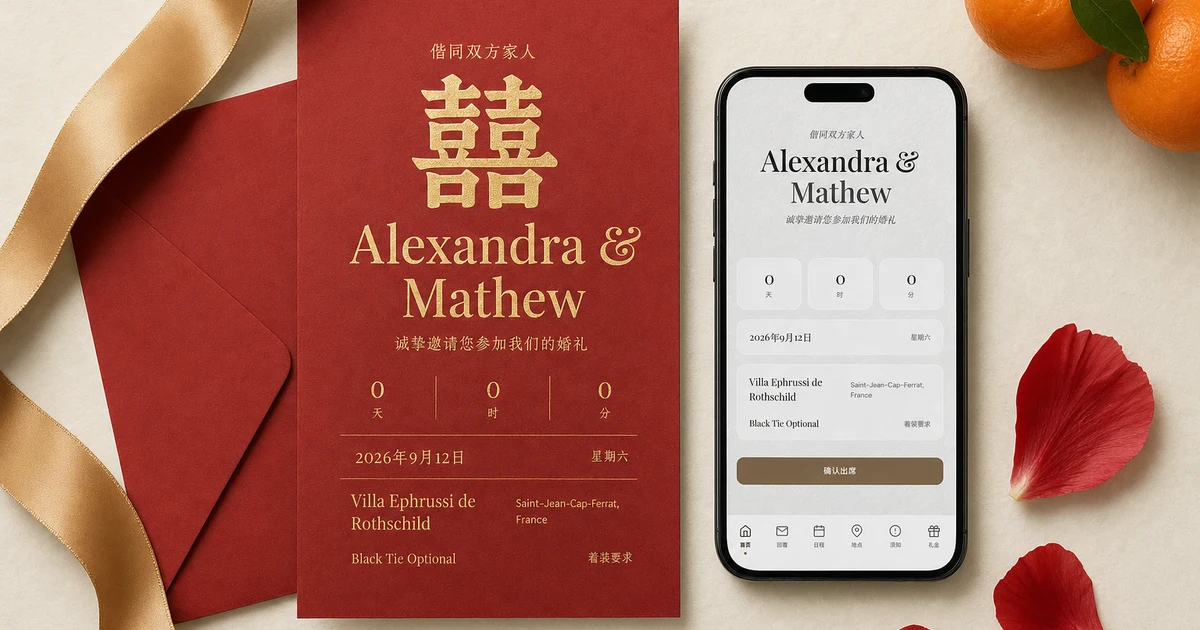
A bilingual English-Chinese wedding invitation in Singapore carries the same facts in both languages: the hosts' and the couple's names, the Gregorian date with the lunar date added for elders, the banquet venue with the reception and seating times (often written 七时恭候,八时入席), and a reply-by date, with formal Chinese phrases such as 谨定于 (respectfully scheduled on) and 恭请光临 (we request the honour of your presence). On The Private Wedding App you write the invitation in English and Chinese and each guest opens it in the language they read, with the buttons, RSVP form and date translated for them, as part of the full wedding planner at S$24.99/month or S$249 once, lifetime. 3-day free trial.
In many Singapore families the guest list reads in two languages. Your friends and colleagues read English, and your grandparents, your parents' friends and some uncles and aunts read Chinese first. A printed card usually solves this by squeezing both onto one side, English on the left and Chinese on the right, each at half size. A digital invitation can do better: each guest opens it in the language they read. This guide covers the wording in both languages, the lunar date, the names, and how to set the digital version up.
What both versions must say
The two versions are not translations of each other word for word. They carry the same facts in the register each language expects. English invitations are written in the third person and lead with the couple; traditional Chinese invitations are often issued by the parents and lead with the date. The facts are the same: who invites, who is marrying, the date, the venue, the times and how to reply.
The bilingual invitation gives every text field a Chinese twin, so each fact is written once per language and nothing is left untranslated.
Chinese wording you can adapt
A classic structure, with the parts in brackets to replace: 谨定于公历[年月日](星期[ ]),农历[月日],为[新郎]与[新娘]举行结婚典礼,敬备喜筵,恭请光临。席设[酒店][宴会厅],七时恭候,八时入席。
In plain English: "We respectfully announce that on [date] (lunar [date]) [groom] and [bride] will be married. A wedding banquet has been prepared, and we request the honour of your presence. The banquet is at [hotel, ballroom]; reception at seven, seated at eight." If the parents issue the invitation, their names go before 敬邀, the groom's parents usually first on the groom's family's cards and the bride's parents first on the bride's. Agree the order with both families before anything is printed or sent.
Ask a Chinese-reading relative to read the final text aloud. A wrong character in a grandparent's name or a formal phrase is the one error elders notice immediately.
The builder's one-click AI translation fills every empty Chinese field from your English text, and you then replace the formal lines with your family's exact wording.
The lunar date
SingaporeBrides invitation etiquette notes that invitations for elders often carry the lunar calendar date next to the Gregorian one. Many families choose the wedding date with the lunar calendar in mind, so for grandparents the lunar date is the real date. Check it against a Chinese almanac or with the family member who chose the date, and write it in Chinese numerals in the 农历 line.
On the digital invitation, the Gregorian date is shown automatically in each guest's language, so Chinese readers see 2026年9月12日 with the weekday. The app does not calculate the lunar date for you: you write it into the Chinese text, for example in the opening line, where only Chinese readers see it.
See how the digital invitation shows the date, the countdown and the venue on its cover.

Why one language per guest reads better than side by side
On paper, two languages share one card, so each gets half the space and smaller type, which is the opposite of what an elderly reader needs. On a phone the problem doubles: two languages on a small screen means a lot of scrolling past text the guest cannot read.
The Private Wedding App does it the other way. You set English as the main language and Chinese as the second, and when a guest opens the link they choose their language once. A grandparent who picks 中文 sees the cover, the schedule, the venue, the RSVP form, the buttons and the menu in Chinese, in full size; your colleagues who pick English never see the Chinese. The choice is remembered on their phone, and a link ending in ?lang=zh opens straight in Chinese, which is useful for the family WhatsApp group.
If you need a third language, add Malay or Tamil: guests then pick among three. The multilingual invitation page shows the language picker guests see.
Setting it up, and printing a few cards
Every printed Chinese invitation used to mean a second print run. With a digital invitation, the printed card becomes the doorway: a small card with a QR code that opens the invitation in Chinese. The builder's QR print card can be exported per language, so you print the Chinese version for grandparents and send the link to everyone else on WhatsApp.
Content that only one language needs, such as a note on the tea ceremony for relatives, can be set to show in Chinese only, on schedule items and info sections. Everything else falls back to the English text if a Chinese field is left empty, so nothing ever disappears.
The QR print card exports a printable card per language that opens the same invitation and RSVP.
- Main language English, second language Chinese, in the Languages tab
- Run the AI translation, then correct the formal lines and names
- Write the lunar date into the Chinese opening line
- Open the invitation with ?lang=zh and read it as a grandparent would
- Export a Chinese QR card for the elders who prefer paper
- Send the English link to friends and colleagues on WhatsApp
Your next step
Start the invitation on the free trial, add Chinese as the second language, run the translation and open both versions on your phone. When the RSVPs arrive, they land in one guest list, whatever language each guest answered in, with meals, plus-ones and a separate answer per event for the ROM, the tea ceremony and the banquet. Start the free trial, then S$24.99 a month or S$249 once for lifetime access.
Everything you need, in one place
Planning your own wedding without a planner is entirely achievable.
See it for yourself.
Explore the whole platform: cinematic invitation, RSVP with meals and allergies, guest list, seating chart, budget, vendors, checklist, moodboard, photo sharing and the AI planner. No account needed.
Try the full planner →How do we write a bilingual English-Chinese wedding invitation?
Write the same facts in both languages in the register each expects: English in the third person leading with the couple, Chinese often issued by the parents and leading with the date, with formal phrases such as 谨定于, 敬备喜筵 and 恭请光临, the Gregorian and lunar dates, the venue and the reception and seating times.
Do Chinese wedding invitations need the lunar date?
Not legally, but invitations for elders often carry it next to the Gregorian date, per SingaporeBrides etiquette, because many families choose the date by the lunar calendar. Check it against an almanac before printing or sending.
What does 七时恭候,八时入席 mean?
"We await you from seven o'clock; seated at eight." It gives guests the reception time and the time the banquet starts.
Whose names go on a Chinese wedding invitation?
Traditionally the parents issue the invitation, so their names appear with 敬邀, and each family's cards usually list their own parents first. Many modern couples issue it in their own names. Agree it with both families.
Can grandparents read the invitation in Chinese while friends read it in English?
Yes, on The Private Wedding App each guest picks English or Chinese when they open the link, and sees the whole invitation, RSVP form and buttons in that language. It is part of the full planner at S$24.99/month or S$249 once, lifetime. 3-day free trial.
Can a digital invitation show English and Chinese side by side?
The Private Wedding App does not put both languages side by side: each guest chooses one language and reads it in full size, which is easier on a phone and for elderly readers.
What colours are best for a Chinese wedding invitation?
Red and gold for luck and celebration are the classic choice. Many families avoid invitations that are mostly white or black.
Is it acceptable to send a Chinese wedding invitation on WhatsApp?
Increasingly, yes, especially when it opens in Chinese and is easy to read. For grandparents who prefer paper, print a QR card in Chinese that opens the same invitation.