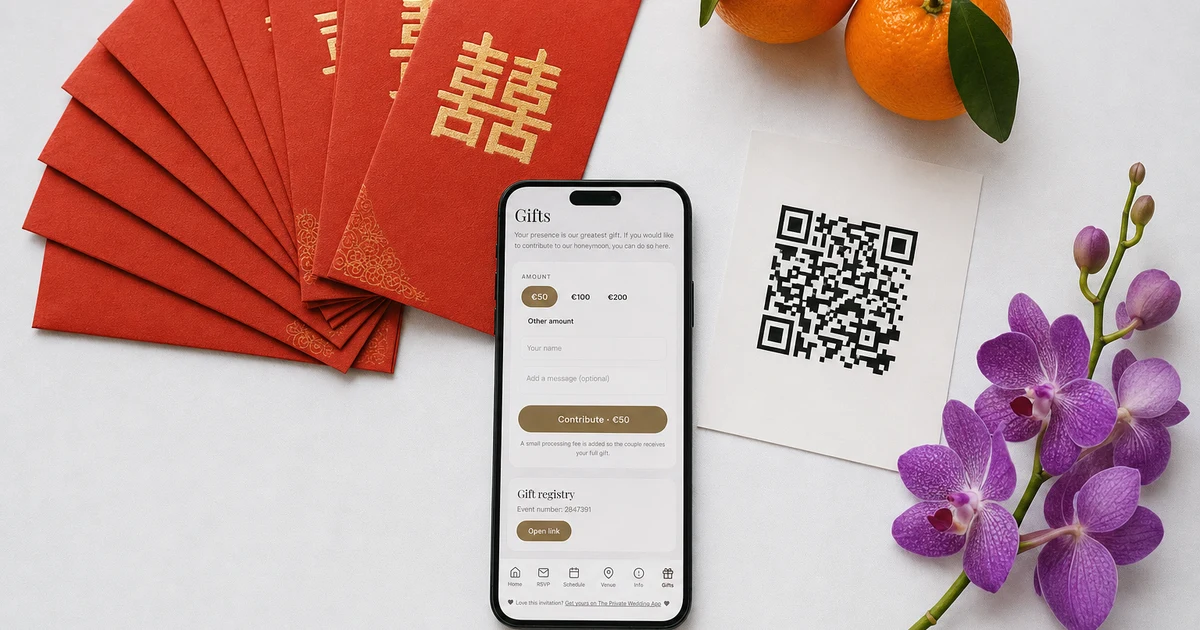
Wedding ang bao in Singapore follows one rule, cover your seat: the table price plus 10% service charge and 9% GST, divided by ten and rounded up to an auspicious number, which according to smartcalculator.sg and you.co/sg puts 2026 dinner rates at about S$258 to S$358 at premium hotels, S$388 to S$488 at luxury hotels and S$438 to S$588 at the very top, such as Capella, with lunch, restaurant and Malay weddings lower and church and Indian weddings following the venue of the meal. For couples, The Private Wedding App puts your own PayNow QR code on a gift card inside the invitation, so guests give straight from their banking app with no fee, as part of the full wedding planner at S$24.99/month or S$249 once, lifetime. 3-day free trial.
Every Singapore wedding season the same question lands in group chats: how much ang bao is enough? The answer has a logic to it, and once you know it you can work out the right amount for any venue in a minute. This guide gives the rule, the 2026 rates published by Singapore finance sites, the differences between a hotel dinner, a lunch banquet, a restaurant, a Malay, a church and an Indian wedding, and then the other side of the envelope: how couples can receive ang bao by PayNow without anyone paying a fee.
The rule: cover your seat
In Singapore a wedding ang bao is not a tip and not a price. It is a guest's way of making sure the couple is not out of pocket for their seat at the banquet. That is why the rate moves with the venue: the same friend gives more at a Saturday dinner in a luxury hotel than at a weekday lunch in a restaurant, and nobody finds that strange.
Hotels quote banquets per table of ten, with "++" after the price. The two plus signs are the 10% service charge and the 9% GST, and GST is charged on the service charge too. So the real cost of a seat is the table price multiplied by 1.1, then by 1.09, divided by ten. Then guests round up, usually to a number ending in 8, the auspicious digit, and avoid anything with a 4.
Couples use the same arithmetic: in the budget tracker you enter the nett price per head once and the catering line builds itself from the guests who confirmed.
2026 ang bao rates by venue
Finance and lifestyle sites in Singapore publish venue-by-venue tables each year. According to smartcalculator.sg and you.co/sg, the 2026 dinner rates sit at about S$258 to S$358 for premium hotels, S$388 to S$488 for luxury hotels and S$438 to S$588 for the very top, with Capella as the usual example. Their figures differ slightly from each other, so treat them as a range rather than an exact amount.
Lunch banquets are cheaper for the couple, and the ang bao follows. According to the 2026 price data compiled by divedeals.sg and themoneybees.co, a lunch banquet costs roughly 15 to 25% less than a Saturday dinner at the same hotel, so a guest who covers the seat gives less too. Restaurants are lower again: the same rule applies to the restaurant's per-table or per-head price.
For couples, these rates only become a real number once you know who is coming: the guest list counts attending, pending and declined guests as the RSVPs arrive.
Malay, church and Indian weddings
Malay weddings work differently. The walimah is often an open-house reception at a void deck, a community club or a hall, where guests come during a time window, eat from a buffet, greet the couple on the dais and leave. The gift is duit salam, passed in a sampul (envelope) when shaking hands, and the amounts run well below Chinese hotel ang bao, because there is no S$200 seat to cover. If the walimah is held in a hotel ballroom, guests usually give more than at a void deck.
Church weddings are judged by the meal that follows. A church ceremony on its own has no seat to cover; a church ceremony followed by a hotel lunch is a hotel lunch rate; a church ceremony followed by a dinner banquet is a dinner rate. Searches for "ang bao for church wedding" are really asking the hotel question.
Indian weddings in Singapore often run over several functions, from the mehndi and sangeet to the ceremony at a temple or gurdwara and a reception. Cash in an envelope is the norm, and many families add one dollar so the amount ends in 1. Base the amount on the reception if there is a seated dinner, and on closeness to the family for the other functions.
Weddings with several functions need a count per function: a separate RSVP per event asks each guest only about the events they are invited to, in English, Chinese, Malay or Tamil.
Who gives more, and when it is fine to give less
HardwareZone threads show strong opinions on a "minimum" ang bao. The calmer view is that the rule is a guide, not a bill. Couples who track exactly who gave what at a gift table usually do it for thank-you notes, not to keep score.
Card gifts made through the Gifts page appear in your dashboard with each guest's note, ready for your thank-you messages.
- Close family and best friends round up generously, often well above the seat
- Colleagues and acquaintances usually stay at the seat cost, rounded to an 8
- Couples attending together give one ang bao for both seats
- Guests who cannot attend can still give, often a smaller amount since no seat is used
- Students and young guests are generally excused from matching hotel rates
- Even numbers are preferred; amounts with a 4 are avoided
PayNow ang bao: is it acceptable, and how couples set it up
Red packets at the reception table are still the norm, but PayNow transfers are increasingly common, especially from guests who cannot attend, guests abroad and younger guests who no longer carry cash. The etiquette question is where the QR code goes. Printing a PayNow QR on the invitation card itself reads as asking for money. Putting it one tap away, on a separate gifts page of the invitation, reads as a convenience.
That is how the Gifts page of The Private Wedding App works. You switch the page on, add a gift card, and upload your own PayNow QR code to it, with your PayNow number or UEN and a short line in the card's note. Guests open the Gifts page from the invitation, scan the code or save it and open it in their banking app, and the money goes straight from their bank to yours. The app is not in the middle, so there is no fee on it.
If some guests prefer to pay by card, the same page can also take card gifts through Stripe, paid out to your own bank account. Card gifts are charged in one of ten currencies, and the Singapore dollar is not one of them today, so for local guests PayNow is the natural route. Card gifts carry a processing fee of 3.5% for couples outside the EU and UK, added on the guest's side by default.
See the Gifts page with a QR card, exactly as guests see it.
- Gifts page off by default, switched on only when you want it
- Your PayNow QR uploaded on a gift card, shown on white so it scans
- Your own message on top, for example "Your presence is the greatest gift"
- No fee on PayNow: guests pay you directly from their bank
- Optional card gifts through Stripe, paid out to your bank
- Message translated for guests who read the invitation in Chinese, Malay or Tamil
For couples: the seat cost is also your budget line
The ang bao rule works in both directions. If guests aim to cover their seat, then your banquet is roughly paid for by the people who actually come, and every guest who confirms and then does not show up is a seat you paid for twice: once to the hotel, once in the missing packet. That is why the RSVP matters more than the card design.
In The Private Wedding App, the RSVP feeds the guest list, the seating plan and the budget: set your currency to S$, enter the price per head including service and GST, and the catering line builds itself from the guests who confirmed. The full breakdown of what a Singapore wedding costs is in How Much Does a Wedding Cost in Singapore, and the table-by-table side in the banquet seating plan guide. Your next step: start the free trial, upload your PayNow QR on the Gifts page and open it as a guest would, then stay at S$24.99 a month or pay S$249 once for lifetime access.
Everything you need, in one place
Planning your own wedding without a planner is entirely achievable.
See it for yourself.
Explore the whole platform: cinematic invitation, RSVP with meals and allergies, guest list, seating chart, budget, vendors, checklist, moodboard, photo sharing and the AI planner. No account needed.
Try the full planner →How much ang bao should I give for a wedding in Singapore in 2026?
Cover your seat: the table price plus 10% service charge and 9% GST, divided by ten, rounded up to an auspicious number. According to smartcalculator.sg and you.co/sg, 2026 dinner rates are about S$258 to S$358 at premium hotels, S$388 to S$488 at luxury hotels and S$438 to S$588 at the very top, such as Capella.
How much ang bao for a wedding lunch versus dinner?
Less for lunch. A lunch banquet costs roughly 15 to 25% less than a Saturday dinner at the same hotel, according to the 2026 price data compiled by divedeals.sg and themoneybees.co, so the seat you cover is cheaper. Apply the same rule to the lunch table price.
How much ang bao for a restaurant wedding?
Below hotel rates. Take the restaurant's per-head price, add service charge and GST if they apply, and round up to a number ending in 8.
How much ang bao for a Malay wedding in Singapore?
Malay weddings are usually open-house receptions with a buffet, and the gift, duit salam in a sampul, runs well below Chinese hotel ang bao rates. Give more if the walimah is in a hotel ballroom and if you are close to the family.
How much ang bao for a church wedding?
Follow the meal. A church ceremony alone has no seat to cover; a church ceremony followed by a hotel lunch or dinner is the hotel lunch or dinner rate.
How much ang bao for an Indian wedding in Singapore?
Base it on the reception if there is a seated dinner, and on how close you are to the family. Many families prefer an amount ending in 1.
Can guests give ang bao by PayNow?
Yes, and it is increasingly common. The Private Wedding App lets couples upload their PayNow QR code on a gift card inside the invitation's Gifts page; guests pay from their banking app straight to the couple, with no fee. The planner costs S$24.99/month or S$249 once, lifetime.
Is it rude to put a PayNow QR code on a wedding invitation?
On the printed card itself, many guests find it too direct. On a separate gifts page one tap away from the invitation, with a warm line on top, it reads as a convenience for guests who cannot attend or do not carry cash.
Should a couple give one ang bao or two?
One envelope for both seats, with roughly double the single amount, rounded to an auspicious number.