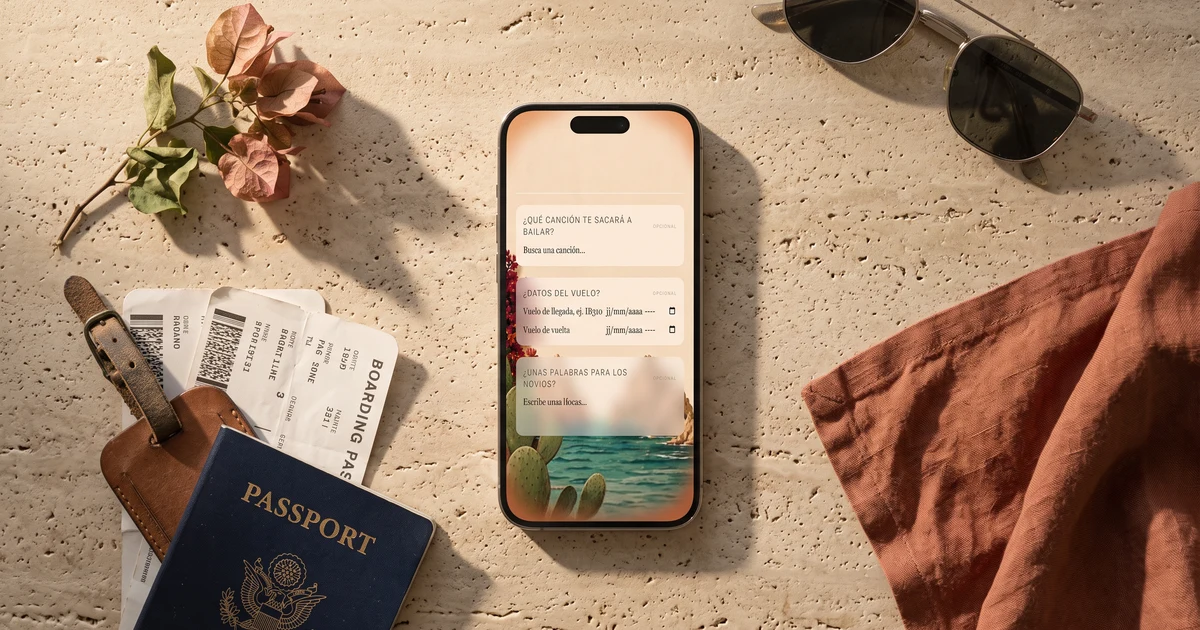
A destination wedding itinerary should cover the full arrival-to-departure window, not just the wedding day, and it should reach guests twice: a first version with the save the date, eight to twelve months out, so people can book flights around the right days, and a final version two to three weeks before, once arrivals are known. It needs the day-by-day schedule, the dress code for each event, how guests get between the airport, the hotel and each venue, who to contact on the ground, and anything they should book themselves. The piece that makes the rest work is arrival and departure flights, collected in the RSVP rather than chased in a group chat, because transfers, the welcome dinner headcount and the final catering numbers are all built from who is actually on the ground on which day.
A wedding at home is a day. A wedding abroad is three or four, and most of the stress comes from the parts that are not the ceremony. Someone lands at two in the morning and nobody knows. The welcome dinner is booked for forty and twenty-six are actually in the country. A cousin assumes there is a shuttle, and there is not. None of that is a catering problem or a venue problem, it is an information problem: the couple is holding arrival times in a group chat, flight screenshots in a camera roll and transfer notes in their head, and every one of those lists goes stale the moment somebody rebooks. This guide covers the itinerary that fixes it - what actually belongs in it, when to send it, and how to collect the one piece of information everything else depends on, which is when each guest lands.
The itinerary is the whole window, not the wedding day
The single most common mistake is writing a timeline that starts when the ceremony starts. For a wedding abroad, your guests have taken days off work and bought flights, and the questions they actually have are about the days either side: when should I arrive, is there something the night before, am I expected on the Sunday, do I need a car.
So the itinerary runs from the first arrival to the last departure, and every entry answers three things: what it is, where it is, and whether they are expected. That last one matters more than people think. A guest who does not know whether the Friday barbecue is for everyone or just the family will either turn up uninvited or stay away when they were wanted.
Mark optional events as optional in plain words. It reads as generous rather than vague, and it is the difference between a guest booking an extra night or not.
Send it twice, and know what each version is for
The first itinerary goes out with the save the date, eight to twelve months ahead, and its only job is to let people book the right flights. It does not need final times. It needs the dates, the rough shape of the days, and one sentence telling guests which days they should plan to be there. If you leave that out, people book a flight home on the Sunday morning and miss the brunch you paid for.
The final version goes out two to three weeks before, and it is the one with real times, addresses and transfer details. It goes out late on purpose: send it earlier and it will be wrong, because the schedule is still moving and arrivals are still being rebooked.
Between the two, resist the urge to send updates every time something changes. Guests stop reading. Keep one page that is always current and point everyone at the same link, so the latest version is wherever they already looked.
Arrival flights are the thing everything else is built on
Transfers, the welcome dinner headcount, who needs a late check-in, and the final catering numbers all come from one piece of information: when each guest lands. Collect it badly and every one of those decisions is guesswork.
Collected badly looks like this: a group chat where eleven people reply with screenshots, four reply with the wrong date, and three never reply. Then somebody transcribes it into a spreadsheet, somebody rebooks, and the spreadsheet is wrong by the time the transfer company asks.
The fix is to ask for it where the guest is already answering questions, which is the RSVP. In The Private Wedding App that is a block you switch on for a wedding abroad: each guest gives their arrival flight and time, and their return, right after confirming attendance. It is optional, so a guest who drives or has not booked yet just leaves it empty, and it is off by default so couples marrying down the road never see the question.
The arrivals then sort themselves by landing time in your guest list, which is exactly the order you need when you book transfers. If someone rebooks, they reopen their invitation and change it - their entry updates rather than creating a second one, which is what breaks spreadsheets.
- Arrival flight number and landing time, per guest
- Which airport, if the destination has more than one viable option
- Return flight, so departure transfers can be grouped
- Who is arriving the day before, for the welcome dinner count
- Who is staying on after, for the brunch or beach day

Transfers: what to arrange and what to leave to guests
You are not obliged to move everybody. What you are obliged to do is be clear about which it is, because the gap between what guests assume and what exists is where the bad moments happen.
The usual middle ground works well: arrange transport for the moments where everyone goes to the same place at the same time, which is the ceremony and the end of the night, and tell guests to sort their own airport transfers unless you say otherwise. If you do arrange airport pickups, group them - three cars at sensible hours rather than nine at random times - which is only possible if you have the arrival times in front of you.
Write the end of the night into the itinerary explicitly. A stated last shuttle at one in the morning is a kindness; an unstated one is forty people outside a venue in the dark looking for taxis that do not come.
The welcome dinner, sized from who is actually there
The welcome dinner is the event most often booked on a guess, and the guess is almost always the full guest list. In practice some guests arrive the morning of the wedding, some the night before, and some three days early, so the real number is usually well below what was reserved.
Size it from arrivals, not from invitations. If you know who lands before a certain hour on the day before, you know who can realistically be at a dinner that evening, and you can book for that number with a small margin rather than for everyone.
It is also the event where the dress code question actually matters, because guests pack for it. Say what it is, in plain words, in the itinerary they received months earlier.
What else belongs in the document, and what does not
The itinerary should carry the practical things a guest cannot look up: the exact addresses in the local language, who to contact on the ground and how, whether there is anything they need to book themselves, and the small local details that are obvious to you and invisible to them.
What does not belong is everything that belongs on the invitation instead. The itinerary is the logistics document; the invitation is where guests RSVP, choose a meal, flag an allergy and find the venue. Keeping them separate means the itinerary can be updated without resending the invitation, and the invitation stays the one place answers are collected.
- Exact addresses, written as a local taxi driver would need them
- A contact on the ground, with a phone number that works locally
- Dress code per event, including the welcome dinner
- What guests book themselves: hotel, airport transfer, car hire
- Local practicalities: currency, whether cards are taken, pharmacy, how long journeys really take
- Anything optional, labelled clearly as optional
Everything you need, in one place
Planning your own wedding without a planner is entirely achievable.
See it for yourself.
Explore the whole platform: cinematic invitation, RSVP with meals and allergies, guest list, seating chart, budget, vendors, checklist, moodboard, photo sharing and the AI planner. No account needed.
Try the full planner →What should a destination wedding itinerary include?
The full arrival-to-departure window rather than just the wedding day: a day-by-day schedule, the dress code for each event, how guests move between the airport, hotel and venues, exact addresses in the local language, a contact on the ground, what guests need to book themselves, and clear labelling of which events are optional. The practical local details matter more than people expect: currency, whether cards are accepted, and how long journeys actually take.
When should I send the destination wedding itinerary?
Twice. A first version with the save the date, eight to twelve months ahead, whose only job is letting guests book flights around the right days - it does not need final times, just the dates and which days they should plan to be there. Then a final version two to three weeks before with real times, addresses and transfers. The second one is late on purpose: sent earlier it would be wrong, because arrivals are still being rebooked.
How do I collect my guests' flight details?
Ask for them where guests are already answering questions, which is the RSVP, rather than in a group chat where answers arrive as screenshots and go stale. The Private Wedding App has a flight block you switch on for a wedding abroad: each guest gives their arrival flight and time and their return, right after confirming attendance, and the arrivals sort themselves by landing time in your guest list. It is optional for the guest and off by default, so couples marrying locally never see it.
Do I have to arrange transport for my guests?
No, but you do have to be clear about what exists. The usual middle ground is to arrange transport where everyone goes to the same place at the same time - the ceremony and the end of the night - and tell guests to handle their own airport transfers. Write the last shuttle time into the itinerary explicitly: an unstated one leaves forty people outside a venue looking for taxis.
How many guests should I book the welcome dinner for?
Size it from arrivals, not from your invitation list. Some guests arrive the morning of the wedding, some three days early, so the number who can realistically be at a dinner the night before is usually well below the full list. If you know who lands before a given hour the day before, you book for that number plus a small margin instead of for everyone.
What if a guest changes their flight after they have told me?
They should be able to change it themselves. In The Private Wedding App the guest reopens their invitation and updates it, and their existing entry changes rather than a second one being created. That is the specific failure that breaks spreadsheets and group chats: the rebooking arrives somewhere other than where the original answer was recorded.
Should the itinerary and the invitation be the same document?
No. The invitation is where guests RSVP, choose a meal, flag an allergy and find the venue. The itinerary is the logistics document. Keeping them separate means you can update the itinerary without resending the invitation, and the invitation stays the single place answers are collected.