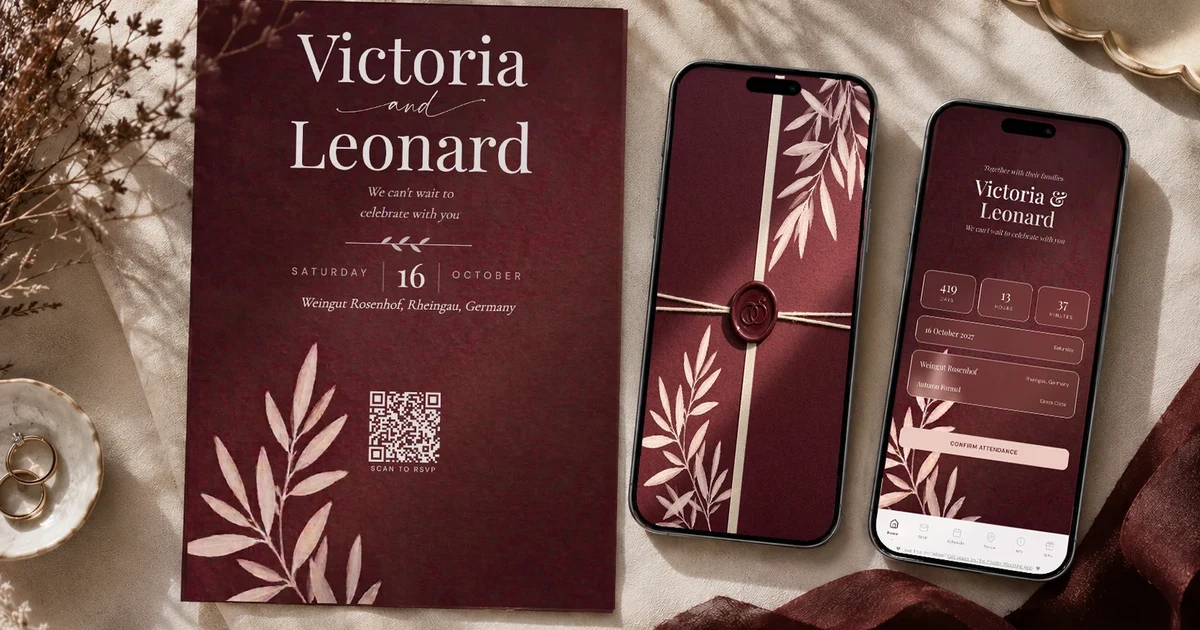
In 2026 a wedding website costs between $0 and about $20 per month. Free builders like Zola, Joy and The Knot include the website itself and the basics around it, and stop before the planning tools. Complete platforms charge either a subscription or a single payment: The Private Wedding App is $19.99 per month, or $189 once for lifetime access, and both versions include everything - the private digital invitation, RSVP with meal choices and allergies, guest list, seating chart, budget tracker, checklist, vendor comparison and guest photo sharing. The real cost difference between the models is not the website, it is whether the guest answers land in planning tools or in a spreadsheet you maintain by hand.
Every couple asks this question and almost every answer online dodges it, because the honest answer is a range: a wedding website costs anywhere from nothing to about twenty dollars a month, and the number itself matters less than what sits behind it. A free website that stops at the RSVP quietly sends you back to spreadsheets for the guest list, the seating and the budget. A paid one earns its price only if it replaces those tools. So instead of a single number, here is the full pricing map of 2026: the three ways wedding websites charge, what each model actually includes, where the paid unlocks hide inside the free tools, and the one question that decides whether monthly or pay-once is right for you.
The three ways wedding websites are priced
Every wedding website tool in 2026 charges one of three ways, and knowing which model you are looking at tells you most of what to expect from it.
Free builders make the website itself cost nothing and earn elsewhere. Subscription platforms charge monthly while your wedding is active. One-time platforms charge a single payment that covers the whole engagement. None of these models is a trick, but each one shapes what you actually receive.
What free actually includes, and where it stops
The free builders are genuinely free for what they cover, and what they cover is the website. Zola and The Knot give you a site, an RSVP form and a registry; Joy is a free invitation tool, and it stops at the RSVP.
The limits show up in the planning layer. The Knot's app lists a seating chart but does not state that it pulls in RSVP answers or meal choices. Zola's seating chart pulls in confirmed guests and is shown in its iOS app, with a $14.99 Seating Chart in-app purchase on its App Store listing. And Joy's guest answers land in a list you export, not in a seating chart, budget or checklist that uses them.
So the honest accounting for free is: $0 for the website, plus the spreadsheets, and the hours, for everything the website does not do. For couples who only want a page with a date and an RSVP form, that is a fine deal. For couples who want the wedding actually managed, it is where the real cost begins.
What a subscription buys
A subscription platform charges while your wedding is active, and in return the guest-facing side and the planning side are one system. On The Private Wedding App at $19.99 a month, the RSVP your guest submits updates the guest list, the meal and allergy report, the seating chart and the live headcount in your budget, automatically, in any language pair your families speak.
The strength of monthly pricing is that it matches short timelines. Engaged in March, married in September? You pay for the months you plan in, start the moment you sign up, and stop when the thank-you notes are sent. For engagements under about ten months, monthly is usually the cheaper of the two paid options.
Paying once: how lifetime pricing works
The one-time option is the model most couples do not know exists, because the big free builders do not offer it. On The Private Wedding App the lifetime plan is $189 paid once: the same complete platform as the monthly plan, with no renewals and no monthly anything after that single payment.
The arithmetic is simple. At $19.99 a month, ten months of planning costs more than $189 paid once. Long engagement, destination wedding with an 18-month runway, or simply a preference for one clean decision over a recurring charge: that is the lifetime buyer. Shorter runway, or a preference for spreading the cost: that is the monthly buyer. Same product either way, so the choice is purely about your timeline and temperament.
One honest note on 'lifetime' claims anywhere you see them: check what the word covers. On some products it covers one feature; on The Private Wedding App it covers the full platform, invitation, RSVP, guest list, seating, budget, checklist, vendors, moodboard and guest photos included.
The hidden-cost checklist, whatever you choose
Whichever model you pick, five questions surface the costs that do not appear on the pricing page. Ask them before you build, not after your guests have the link.
- Is there a guest cap, and what does lifting it cost?
- Which features on the tour are actually paid unlocks? (Seating tools are the classic one.)
- Do RSVP answers flow into planning tools, or into an export you manage by hand?
- Can the invitation run in the languages your families actually speak?
- If it is a subscription, what exactly happens to your site and data when you stop paying?
Everything you need, in one place
Planning your own wedding without a planner is entirely achievable.
See it for yourself.
Explore the whole platform: cinematic invitation, RSVP with meals and allergies, guest list, seating chart, budget, vendors, checklist, moodboard, photo sharing and the AI planner. No account needed.
Try the full planner →Can I pay once instead of a monthly subscription?
Yes. The Private Wedding App offers a lifetime plan at $189 paid once, alongside the $19.99 monthly plan. Both include the complete platform: private digital invitation, RSVP with meal choices and allergies, guest list, seating chart, budget tracker, checklist, vendor comparison, moodboard and guest photo sharing. Monthly fits shorter engagements; the one-time payment wins on runways longer than about ten months.
How much does a wedding website cost in 2026?
Between $0 and about $20 a month. Free builders like Zola, Joy and The Knot include the website and stop before the planning tools. Full platforms charge either a subscription (The Private Wedding App is $19.99/mo) or a one-time payment ($189 lifetime on the same platform). The price difference mostly buys the planning layer: whether RSVP answers land in a seating chart and budget, or in a spreadsheet you maintain yourself.
Are free wedding websites really free?
For the website itself, yes. The costs are in what they leave out: The Knot's app seating chart does not state that it uses RSVP answers or meal choices, Zola's App Store listing sells the Seating Chart as a $14.99 in-app purchase, and Joy's guest answers land in exportable lists rather than in planning tools. If you would have run your wedding on spreadsheets anyway, free is a fine choice. If you wanted the planning handled, count the hours before you count the dollars.
Is a lifetime wedding website plan worth it over monthly?
It is arithmetic plus temperament. At $19.99 a month, the $189 one-time payment breaks even just under ten months, so longer engagements and destination weddings favor lifetime, while short runways favor monthly. The product is identical on both plans of The Private Wedding App, so nothing else changes with the choice.
Is there a wedding website without a subscription?
Yes, two kinds. Free builders have no subscription and stop at the website basics. And The Private Wedding App's lifetime plan is the full planner platform with no subscription: $189 once, everything included, no renewals.
What does a wedding website cost for a bilingual or international wedding?
The same two prices on The Private Wedding App: $19.99/mo or $189 once. The invitation runs in any language, including bilingual and trilingual versions, each guest reading it in their own language, and right-to-left Arabic, at no extra cost - which matters because international weddings are exactly the ones with long planning runways where the one-time payment tends to win.